Aegirine: The Stone Shaped Like What It Does
Aegirine is a black pyroxene mineral that forms in long, blade-like striated crystals, and its protective function maps directly onto that shape: it severs cords and attachments already present in your energy field rather than building a barrier against new ones.
Shaped Like a Blade: Why Aegirine Belongs in Protection
Most dark protective stones work by creating or reinforcing a boundary. Black Tourmaline grounds first, then holds a perimeter. Black Kyanite grounds and shields, and has the unusual property of self-clearing — it doesn't accumulate what it deflects, and can clear other stones too. Shungite absorbs and neutralizes, a property backed by its documented use as a literal water purifier. Aegirine doesn't do any of those things. Its work is surgical, not architectural. It addresses what's already inside the perimeter, not what's pressing against the outside.
The reason this makes sense as a physical argument, not just a metaphysical one, is in how aegirine actually grows. It's a sodium iron silicate from the pyroxene group, forming in alkali-rich igneous rock, and it has a genuinely distinctive crystal habit for its family: long, striated blades with sharply tapering terminations, sometimes grouped into radial clusters, sometimes appearing as single needle-like points. When you look at a raw aegirine specimen, you're not looking at a chunky protective mass. You're looking at something that was built by geological pressure into a cutting shape. The correspondences follow that form: this is a stone governed by Saturn (discipline, structure, the enforcement of limits) with Pluto also appearing in some traditions, reflecting its capacity to surface and remove what's hidden. Its element is primarily Fire, though Earth is cited in some sources — the fire reading makes the most sense given its decisiveness and its capacity to burn through what's attached. It aligns with the root chakra, anchoring its work in the physical and energetic baseline of the body, and Scorpio governs it: the sign of excavation, severance, and transformation through honest encounter with what's been buried.
Practically, what this means is that aegirine is the right stone when you already know something has a hold on you. Not a vague ambient threat, but a specific connection: a relationship you left that still has hooks in you, a dynamic in which someone regularly drains your energy, a pattern of obligation or guilt that operates like a tether. Aegirine's work is to locate that attachment and cut it cleanly. The bladed crystal form is the tool made literal: this is a stone that came out of the earth already shaped for severance.
There's a meaningful secondary quality here, and it's worth naming directly. Alongside its protective function, aegirine is consistently cited for what might be called empowerment through integrity: the capacity to hold your own position without eroding under social pressure, to maintain your own energy signature even in environments designed to dilute it. This isn't a separate function from the cord-cutting — it's the same mechanism viewed from the other side. Once the attachments are gone, what remains is your own uncompromised field. That experience of returning to your own ground is what people describe as aegirine's empowerment quality, and it's honest to call it secondary: the confidence comes from the severance, not the other way around.
Aegirine or Acmite? Choosing and Handling This Stone
If you've searched for aegirine and encountered the name acmite alongside it, you're not looking at two different minerals. Acmite was the older of the two names, applied historically to a brownish, sharply pointed variety of the mineral that seemed distinct enough to merit its own label. In the twentieth century, mineralogists confirmed that acmite and aegirine are the same species, the variation in color and crystal habit falling within the normal range for a single mineral. The name aegirine won out as the accepted designation, but acmite still appears in older texts and occasionally in the vocabulary of mineral dealers. If a seller is offering you acmite, you're getting aegirine.
On the physical side, raw aegirine crystals are genuinely sharp. The bladed, needle-like terminations that make this stone visually striking are the same ones that will catch your skin if you're not paying attention. Raw specimens should be handled with the same care you'd give a small piece of broken glass: thoughtfully, and not dropped into a pocket without wrapping. For carrying or wearing, polished or tumbled aegirine is the more practical option — the energy of the stone doesn't depend on the points being exposed, and a tumbled piece in your palm or pocket will do the same work without requiring careful handling.
Aegirine is water-safe for brief rinsing; there are no toxicity concerns with normal handling. Major sources include Russia, Norway (where the mineral was first described), Canada, and South Africa, so it's not scarce, and well-sourced raw and polished specimens are available from reputable mineral and metaphysical dealers without much difficulty. Look for pieces with visible striations on the crystal faces — those lengthwise grooves running parallel to the blade's axis are characteristic of genuine aegirine and are part of what makes the stone identifiable even in its tumbled form, where some surface texture often survives the polishing process.
Three Practices for Cutting What Doesn't Serve You
The Cord Cut
Use this practice when a specific connection — a relationship, an obligation, a recurring dynamic — is actively draining your energy and you're ready to release your claim on it.
Hold the aegirine in your dominant hand, point or blade facing outward from your body. Spend a few minutes sitting quietly with the specific connection in mind — not ruminating, but naming it plainly to yourself, including what you've received from it and what it's cost you. When you feel that naming is complete, make a single slow sweeping motion with the stone from the top of your body downward, as though you're drawing a blade through a cord at your midline. You can do this over each major energy center in sequence if the attachment feels layered. Afterward, rinse the stone briefly under cool water. A black candle burning nearby reinforces the finality of the cut. If you want to work within a timed window, the Saturn hour on a Saturday is a natural fit for this kind of definitive, structural severance.
The Unmoved Ground
Use this when you're walking into a situation where someone will push you to compromise on something you've already decided — a negotiation, a confrontation, or any dynamic where your position is likely to be tested.
Before you leave the house, hold the aegirine between both palms for a moment. Don't ask it for anything. Just feel the weight and the cool hardness of it — this is a stone that doesn't bend, and you're borrowing that quality. Slip it into your left pocket, or hold it in your non-dominant hand if the situation permits. The stone isn't doing the work for you; it's a physical reminder that your position is already decided before you walk into the room. If you can, anoint it briefly with a drop of black pepper oil beforehand — its Mars sharpness pairs well with aegirine's Saturn discipline for situations involving direct opposition.
The Shoreline Ward
Use this practice to mark a personal boundary that's been permeable — not a wall, but a clear demarcation of where you end and someone else's claims begin, held as steadily as a coastline.
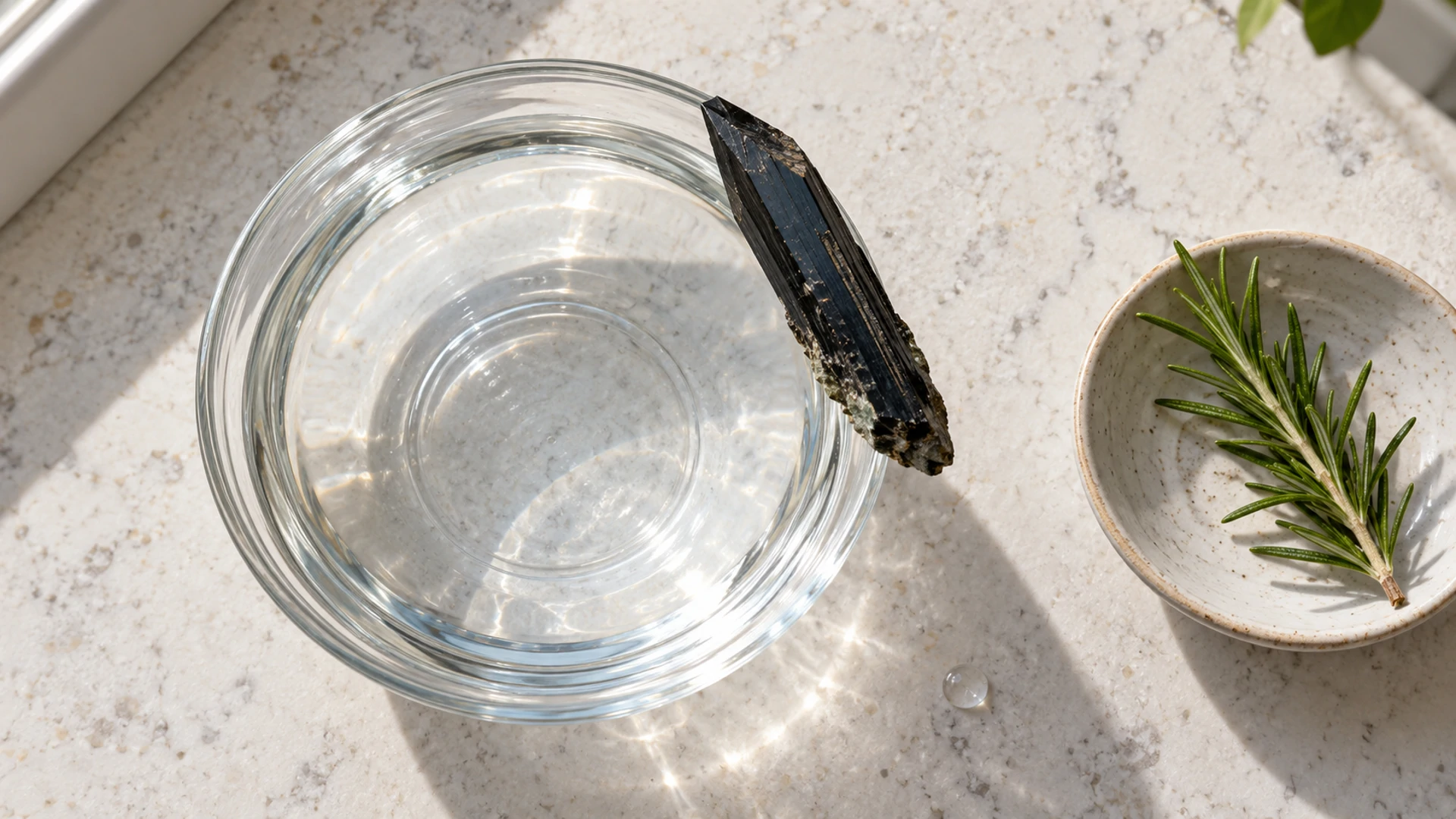
Aegirine was named for Ægir, the Norse god of the sea, and found at a coastal site — there's something useful in that origin when you're working with boundary-setting that isn't about aggression, but about the plain fact of where one thing stops and another begins. Sit with your aegirine and a bowl of water. Trace the stone slowly around the edge of the bowl, moving in a complete circle. As you do, name in your own words — silently or aloud — what belongs inside (your energy, your time, your choices) and what belongs outside (demands that aren't yours, obligations imposed without consent, the emotional weight of others that you've been carrying). When the circle is complete, set the stone at the edge of the bowl, not inside it. Leave it there for as long as feels right, then remove and dry it. The Moon hour works well here, particularly on a waning moon, when release is what you're working toward. You can add a sprig of rosemary to the water if you want the boundary to carry a protective quality alongside the demarcation.
Named for the Sea by a Priest, Confirmed by a Chemist
In 1834, a Norwegian priest and amateur mineralogist named Hans Morten Thrane Esmark was collecting specimens near the Langesundsfjord, a coastal fjord area of southern Norway, when he encountered the mineral at a seaside locality on Låven island. He proposed naming it after Ægir, the Norse god of the sea — a reference to where it was found rather than to any perceived quality of the stone. The following year, Jöns Jacob Berzelius, one of the founding figures of modern chemistry and a man responsible for establishing the system of chemical notation still used today, formally described and adopted the name. That pairing — an amateur clergyman's coastal discovery, confirmed a year later by one of the era's most significant working scientists — is the actual origin of the name most metaphysical sources treat as simply evocative.
What's worth noting for anyone working with this stone's mythology is that the Ægir connection is geographic, not symbolic in origin. Esmark wasn't claiming the stone carried the sea god's energy; he was naming a mineral after the feature nearest to where he found it, following a common nineteenth-century convention. The metaphysical resonance between a stone that cuts and a god associated with the power and indifference of the ocean is a later layer — a genuine one, but a later one. That doesn't diminish the connection; it just clarifies that it developed as practitioners worked with the stone rather than arriving pre-inscribed in the name.
The Stone That Cuts Clean
What distinguishes aegirine within the Protection category is that it doesn't ask you to hold a position or build a wall. It works on what's already there — the tethers, the hooks, the obligations that have taken hold without your full consent. That's a specific kind of protective work, and it's one that the other stones in the Protection cluster genuinely don't cover in the same way. Once that work is done, what remains is simply you: your own field, your own energy, intact.
If you want to see where aegirine fits alongside the rest of the Protection stones — and across the other six paths that stone magic covers — The Crystal Compendium: Seven Paths to Stone Magic is the place to start.