Sandalwood: The Stillness Inside the Smoke
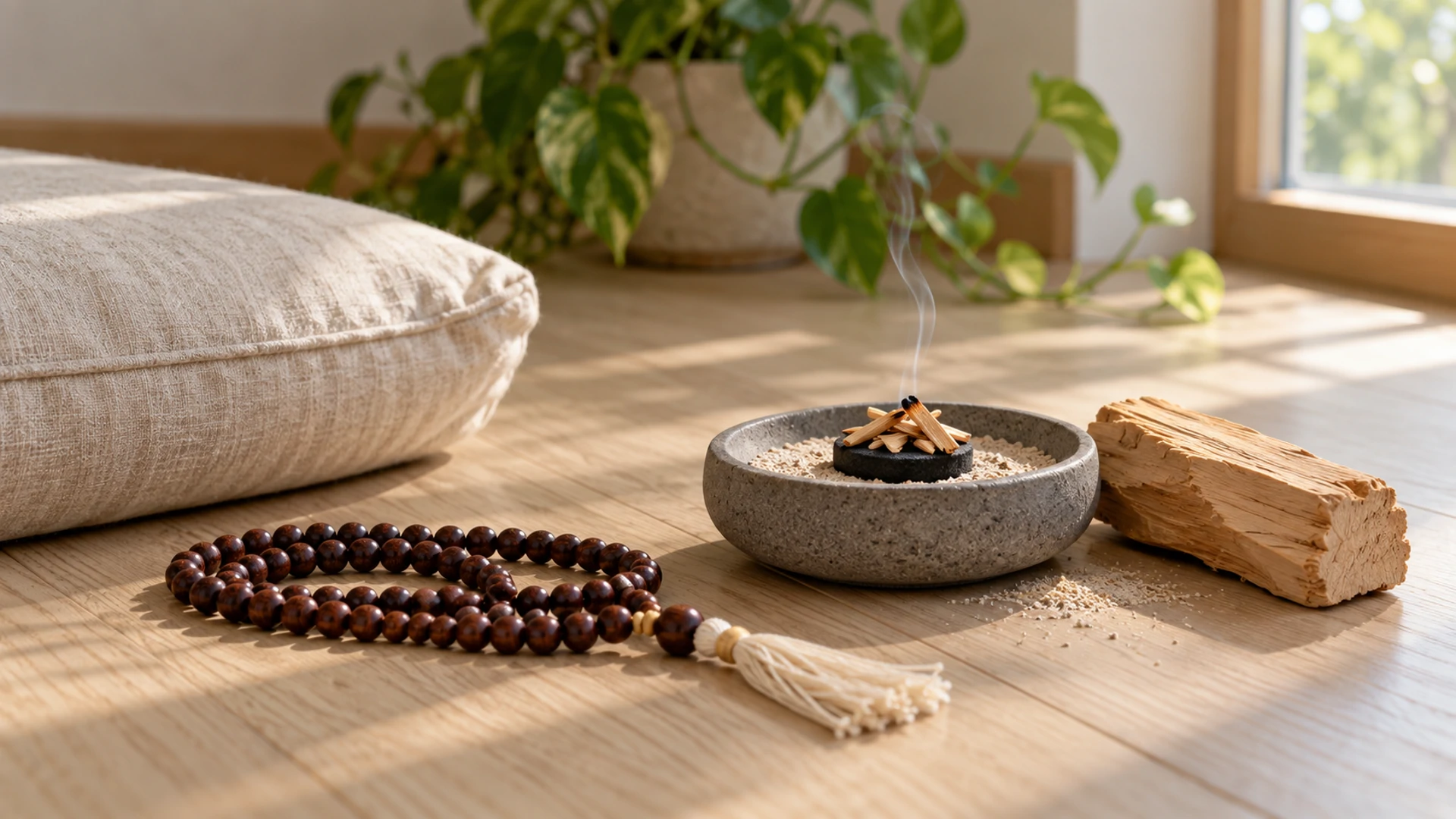
Sandalwood is a fragrant heartwood burned as incense or worked into paste to settle a space for meditation and to consecrate an altar — it does not forcefully clear so much as it quiets what is already there.
Consecration by Quieting: Sandalwood's Place in Cleansing
Sandalwood's cleansing angle is not heavy-duty clearing. It does not reset a space the way a powerful smoke does, and it does not drive anything out. What it does is settle. When sandalwood incense fills a room, the atmosphere doesn't change so much as it deepens — sound seems slightly farther away, the mind finds a resting point, and whatever was scattered or agitated before begins to still. That is what consecration by quieting means: it prepares a space not by elevating it toward something external, but by drawing it inward toward stillness.
Compare that to frankincense, which consecrates by lifting — it raises a space toward the sacred before ceremonial work, opening upward toward prayer, invocation, or ritual. These two are often named as a pair, and they work well together for exactly this reason: frankincense opens and elevates, sandalwood grounds and stills. Used alone, each does something distinct. Used together, one raises the ceiling while the other settles the floor. This pairing is not arbitrary — both consecrate, but they do it in opposite directions, and understanding that distinction makes the choice between them (or the combination of them) a deliberate choice.
For comparison, white sage is a forceful clearing — a strong, total reset of a space's atmosphere, not a gentle freshening and not a consecration. Sandalwood and white sage serve completely different purposes. If the room feels heavy with stagnant energy and you want it cleared to the walls, white sage is that tool. If the room is already reasonably calm and you want to deepen it, focus it, and make it ready for inner work, sandalwood is the right choice. They are not interchangeable, and using sandalwood hoping for the result that white sage produces will leave you disappointed. Its correspondences are the Moon, water (per Cunningham), and Monday. Its secondary work falls into Divination and Spirit Work, specifically meditation and devotion — both of which depend on the kind of interior quiet that sandalwood builds. Botanically, Santalum album is a semi-parasitic tree in the sandalwood family (Santalaceae), the same family as mistletoe, and the fragrant part is the heartwood, not the bark or the outer wood.
Chandan, Censer, and Carved Image
In Hindu puja, sandalwood paste — called chandan — is applied as a forehead mark and used to consecrate images and worshippers. The paste is made by grinding the wood on a wet stone until it becomes smooth and fragrant. It is a living practice, central to daily devotional life across much of South Asia, and its use in puja is not a technique to borrow but a context worth understanding if you want to grasp what sandalwood actually carries. The paste form and the tactile act of its application are inseparable from the ritual: it marks, it cools, it consecrates by direct contact with the sacred.
The wood itself has been burned in Buddhist and Chinese temple censers and carved into statues and ritual objects for centuries. The scent of sandalwood in a temple censer is not decorative — it signals the presence of sacred space, conditions the mind of the worshipper, and accompanies prayer and meditation in traditions where the boundary between the physical act of burning and the interior act of devotion is deliberately thin. These are not historical footnotes. They are the living contexts in which sandalwood's quieting quality was established and refined across generations. Knowing them helps you understand why the wood does what it does in practice, even outside those specific traditions.
Real Sandalwood Is Scarce, and Priced Like It
The most useful thing to know before buying is that the label should name the species and origin. Much of what is sold as sandalwood — in incense sticks, chips, powder, and oil — is Australian sandalwood (Santalum spicatum), another Santalum species, synthetic fragrance, or an unrelated wood entirely. All of these can smell similar, especially after fragrance enhancement, and most sellers do not volunteer this information. If the product lists Santalum album and specifies India or Mysore as the origin, that is the species this page is about. If it does not name the species, treat it as a substitute until you can confirm otherwise. Red sandalwood — Pterocarpus santalinus — is a completely unrelated plant that belongs to the legume family; it shares a common name and nothing else, so the two should never be confused.
Santalum album has been listed as IUCN Vulnerable since 1998. The causes are over-harvest, illegal trade, and spike disease — a phytoplasma disease that kills infected trees. Wild Indian sandalwood populations have been under serious pressure for decades, and the heartwood that makes the tree valuable takes years to develop, which makes recovery slow. Plantation-grown Indian sandalwood — including operations in northern Western Australia — and certified sources reduce pressure on wild trees, and both are worth seeking out. This is not a lecture; it is a buying guide. Knowing that the tree is Vulnerable tells you why the price of genuine Santalum album is high, and why anything priced like a common commodity probably is not what the label claims.
Safety risk with sandalwood is low. The oil can occasionally sensitize skin in some people, so it is worth patch testing before applying it to the body, and the standard care around any incense smoke applies — ventilate the space, avoid prolonged exposure in a sealed room, and use a reasonable amount rather than an excessive one. None of this should be a deterrent, just a habit.
Three Quiet Workings With Sandalwood
Settling the Room Before Meditation
Use this before any sitting practice where you need the mind to stop moving before it can go anywhere useful.
Light a sandalwood incense stick or place a few wood chips on a lit charcoal disc, ideally on a Monday or during a Moon hour, so the timing supports the quieting rather than working against it. Do this five to ten minutes before you sit — not as the first thing you do when you enter the room, but a few minutes earlier, so the smoke has time to settle into the space rather than still being active while you are. Sit at the edge of the room briefly and let the scent reach you. You are not doing anything yet. You are letting the room do its work on you. When the atmosphere feels different — denser, quieter, slightly less occupied by the noise of the day — that is when you begin. The scent of sandalwood functions here as a threshold, one the mind learns to recognize over time as the signal that interior work is starting.
A Mark of Paste on the Altar
Use this when you are dedicating a new altar object, establishing a working altar, or refreshing an existing one after a long absence from practice.
Mix a small amount of sandalwood powder with just enough water to produce a paste — thick enough to hold shape, not so wet that it spreads. Drawing from the same logic as the chandan practice in Hindu puja (without imitating puja itself), apply a small amount to the base of a candle holder, the edge of an altar cloth, or a corner of the altar surface. You are not trying to mark everything; you are placing a point of stillness. Let it dry in place. The act is deliberate and slow. Work the paste with one finger and apply it with intention rather than efficiency. This is the kind of consecration that happens through contact rather than through smoke or word — the material settles into the surface, and the surface carries that quality forward into every working that happens on or around it.
Blessing Prayer Beads in Its Smoke
Use this before the first time you work with a new set of prayer beads, mala, or meditation beads of any kind.
Hold the strand over sandalwood smoke — incense stick or chips on charcoal — and pass it through slowly, bead by bead if you have time, or as a full strand if you prefer a single continuous pass. The goal is for the smoke to reach each bead rather than only the exterior of the strand. State clearly, in your own words, what you intend the beads for: focus, counting, devotion, meditation. Let the smoke carry the intention into the object. This is a short working — it should not take more than a few minutes — and its brevity is appropriate. You are not charging the beads with an elaborate will so much as you are giving them a beginning, a first context, before they accumulate the weight of use.
Where the Cleansing Goes Quiet
Sandalwood sits within the Cleansing and Purification category as the herb that ends in stillness. Most cleansing work is about removal or transformation — clearing what was, making space for what comes next. Sandalwood does something slightly different: it arrives after the clearing and settles what remains. It is not the start of the work so much as the final condition you are aiming for. If you understand that distinction, you understand when to reach for it and when to reach for something else.
To see sandalwood in relationship with the other eleven cleansing herbs and the six other magical categories, the Witch's Herbarium guide is the place to go. It gives the full map.