Pine: Evergreen Renewal for a Stale House
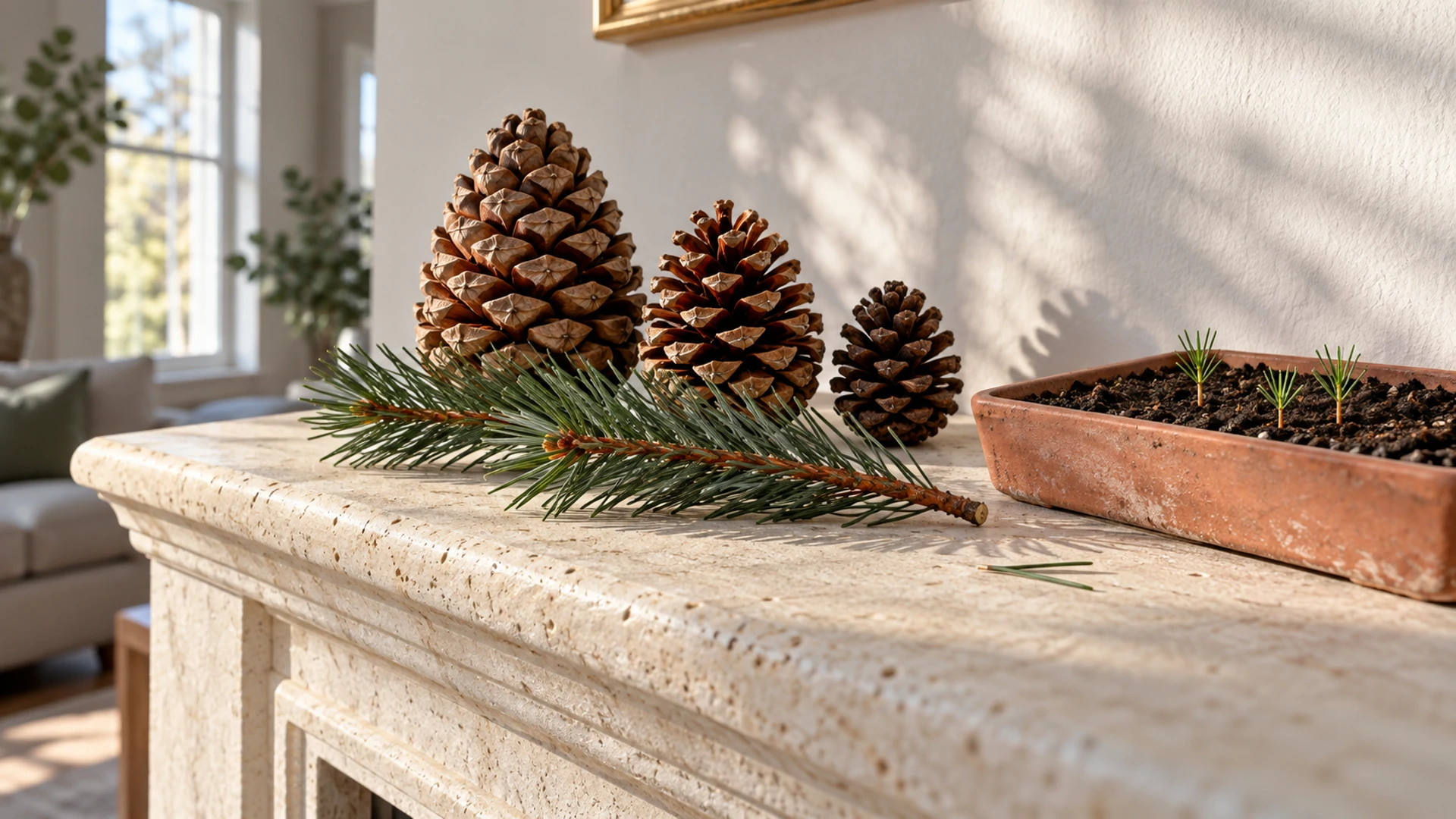
Pine is the evergreen cleansing herb of renewal — a cold, fresh clearing that cuts through staleness and carries the midwinter promise of life continuing through dark. Its secondary sits in Prosperity & Success, grounded not in invented money lore but in the cone itself: the tree's seed-holder, built to survive fire and cold and open when conditions finally turn.
Renewal in the Cold Months: Pine's Place in Cleansing
Among the herbs of Cleansing & Purification, each one carries a different angle. Pine's is renewal. Not the deep atmospheric reset of white sage's forceful clearing, not the consecration by lifting that frankincense performs before ceremony, not the sharp cut of lemon after an argument. Pine clears in the way that cold outdoor air clears a room that has been shut up too long — it freshens, restores, and carries something that feels like a beginning. That's the quality to work with: not purging, but reviving.
The evergreens each hold a distinct office in magical practice. True cedar preserves and protects — the Old World sacred timber of Solomon's temple, whose rot-resistance gave it a practical root in keeping what it holds safe. Thuja is the North American purifying cedar, carrying the lighter, resinous smoke of Anishinaabe sacred-medicine tradition. Juniper is the fierce warding smoke, burned in Scottish saining rites to drive harm from house and byre at the new year. Cypress mourns and consoles, lining the churchyards of the Mediterranean. Yew, the most ancient and toxic of conifers, belongs to death, rebirth, and ancestor work. Pine renews and freshens. It is the one you reach for when something needs to start again.
Pine's correspondences are Mars and air (Cunningham gives air as the element), with Tuesday as the aligned day. Mars might seem like an odd fit for a freshening cleanse, but it makes sense once you feel the sharpness of pine resin in cold air — there's nothing soft or passive about it. It clears because it refuses to be stale.. The species most commonly worked with are Scots pine (Pinus sylvestris) in Europe and eastern white pine (Pinus strobus) in North America. The parts used are the needles, the hardened resin (pitch), and the cones. All three have distinct characters in practice, and all three are freely available from a living tree without harming it.
Thyrsus, Tree of Peace, and the Midwinter Bough
A pine cone topped the thyrsus, the fennel staff carried by Dionysus and his followers in Greek religious procession. In myth, Attis — the consort of Cybele — was transformed into a pine tree, and his cult involved rituals of mourning and renewal that centered on the pine as a symbol of a life that does not simply end. These associations are not accidental. The pine tree is evergreen; it does not shed and go bare in winter the way deciduous trees do. It stays. That visible persistence made it a natural focal point for rites about continuation, and a natural vehicle for the idea that what looks like death is not the end.
Across northern Europe, the custom of bringing evergreen boughs indoors at midwinter — the darkest point of the year — carried exactly that message into the house. Pine, along with holly, ivy, and fir, promised that green and growing things would return. The bough over the door or across the mantelpiece was not primarily decorative; it was a statement of faith in the returning light, made with the most persistent living material available. This is the root of what pine means in a cleansing context. It does not just clear — it clears and makes a claim about what comes next.
The eastern white pine holds a different and wholly separate significance in the tradition of the Haudenosaunee Confederacy, where it is known as the Tree of Peace. In Haudenosaunee tradition, the weapons of warring nations were buried beneath its roots when the Great Law of Peace was established, and the tree's four white roots were said to reach out to the four directions, inviting all peoples who sought peace to follow them to its shade. This is Haudenosaunee tradition, not a technique to borrow, and it is named here because any practitioner working with eastern white pine in North America should understand the full weight of what they are touching.
Gathering Needles and Resin Without Mistakes
Before you gather anything from a pine tree, make sure the tree you are standing under is actually a pine. Two identification errors matter enough to mention explicitly. Norfolk Island pine, which is widely sold as an indoor plant and often called a pine, is not a pine at all — it belongs to a completely different family and has no history in herbal practice. More urgently, yew, another conifer, can be mistaken for pine by someone gathering needles. Yew is among the most toxic plants in the European flora, capable of killing an adult through heart failure from a small quantity of needles, and it looks like it could be a conifer to someone who is not paying close attention. The rule is simple: if you are not certain of the tree, do not gather from it. The visual differences — yew's flat, dark needles with lighter undersides arranged in two neat rows along a twig, versus pine's needles in bundles of two to five depending on species — are learnable, and worth learning before you ever carry needles home.
Once you have identified your tree, gathering is straightforward. Needles can be collected from the ground or snipped from a branch without damaging the tree. Resin is best gathered from what has already hardened on the bark — the amber-colored pitch that seeps out after a wound or naturally from the tree's surface — rather than cutting into healthy bark to collect it fresh. Fresh resin is extremely sticky and can be difficult to work with; hardened pitch is far more manageable on charcoal. When burning pine resin indoors, use a small amount on a charcoal disc in a well-ventilated space, as with any resin incense. On safety: pine-needle tea is a traditional preparation with a long history in North America, but it should be avoided during pregnancy. Needles of some pine species, notably ponderosa pine, have been documented to cause miscarriage in cattle, and the caution extends to pregnant people as a precaution. Oxidized pine oil can also sensitize skin, so older or improperly stored oil should not be used in a skin preparation.
Three Evergreen Workings
The Midwinter Bough
This practice belongs to the darkest stretch of winter, when the light is at its lowest and the house needs a reminder that the season turns.
Cut or gather a full branch of pine — the longer the better, something that takes up real space over a doorway or across a mantelpiece. Hang it where it will be seen and passed beneath. You are not decorating; you are making a declaration. Hold your intention clearly as you put it up: this house is still alive, and the light is coming back. Leave the bough in place through the darkest weeks of winter. When the days have visibly lengthened and you feel the turn has genuinely arrived — not when the calendar says so, but when you feel it — take the bough down. Burn it outside if you can, or compost it. The practice closes as intentionally as it opened.
A Needle Wash for the End of Winter
This is the practice that carries pine's renewal angle most directly — not a smoke, not a charm, but water moved through the house on the first mild day after a long closed winter.
Bring a large handful of fresh or recently dried pine needles to a boil in a pot of water, then lower the heat and steep for twenty minutes. Strain out the needles and let the water cool to room temperature. Open every window in the house. Start at the back and work toward the front door — the direction matters, you are moving stale energy out. Use the pine water to mop or wipe floors, moving from room to room. As you work, keep your attention on what you are clearing: the closed-in quality of winter, the staleness that accumulates when a house has been sealed against the cold. When you reach the front door, mop the threshold and then step outside. Let the fresh air finish what the water started. You can pour any remaining wash at the base of the tree it came from, or at the foot of a living plant.
Cones on the Altar for a Growing Season
Use this at the beginning of a new project, venture, or growing season — any moment when you are planting something that will take time to bear fruit.
Collect two or three pine cones, preferably ones that are still closed or only partially open. Clean them by leaving them in the sun for a day or brushing off any debris. Place them on your altar at the start of whatever you are beginning. The cone is the tree's seed-holder: it carries the next generation, protected inside scales that can survive fire and years of cold before finally opening. That's the quality you are working with — not quick abundance, but patient, persistent growth that survives hostile conditions. Leave the cones on the altar for the duration of the project. If a cone opens during that time, take it as a sign that conditions are becoming favorable. When the project concludes, return the cones to the earth.
Green Through the Dark
What makes pine distinct within Cleansing & Purification is that it does both things at once: it clears and it refreshes. Most cleansing herbs are weighted toward one pole or the other — they remove something, or they consecrate something. It moves stale air out and brings cold, living air in, and those are the same action. The staleness leaves because something living takes its place. That is the renewal angle, and it is what you are working with every time you bring pine into a practice.
If you want to see how pine sits among the other cleansing herbs — and among the six other categories of plant magic — the place to look is the Witch's Herbarium guide. It covers all eleven other herbs in the Cleansing & Purification category alongside the full range of intentions, from protection and banishing to love, prosperity, and spirit work.