Tealight Candle Magic: A Fresh Flame for Daily Practice
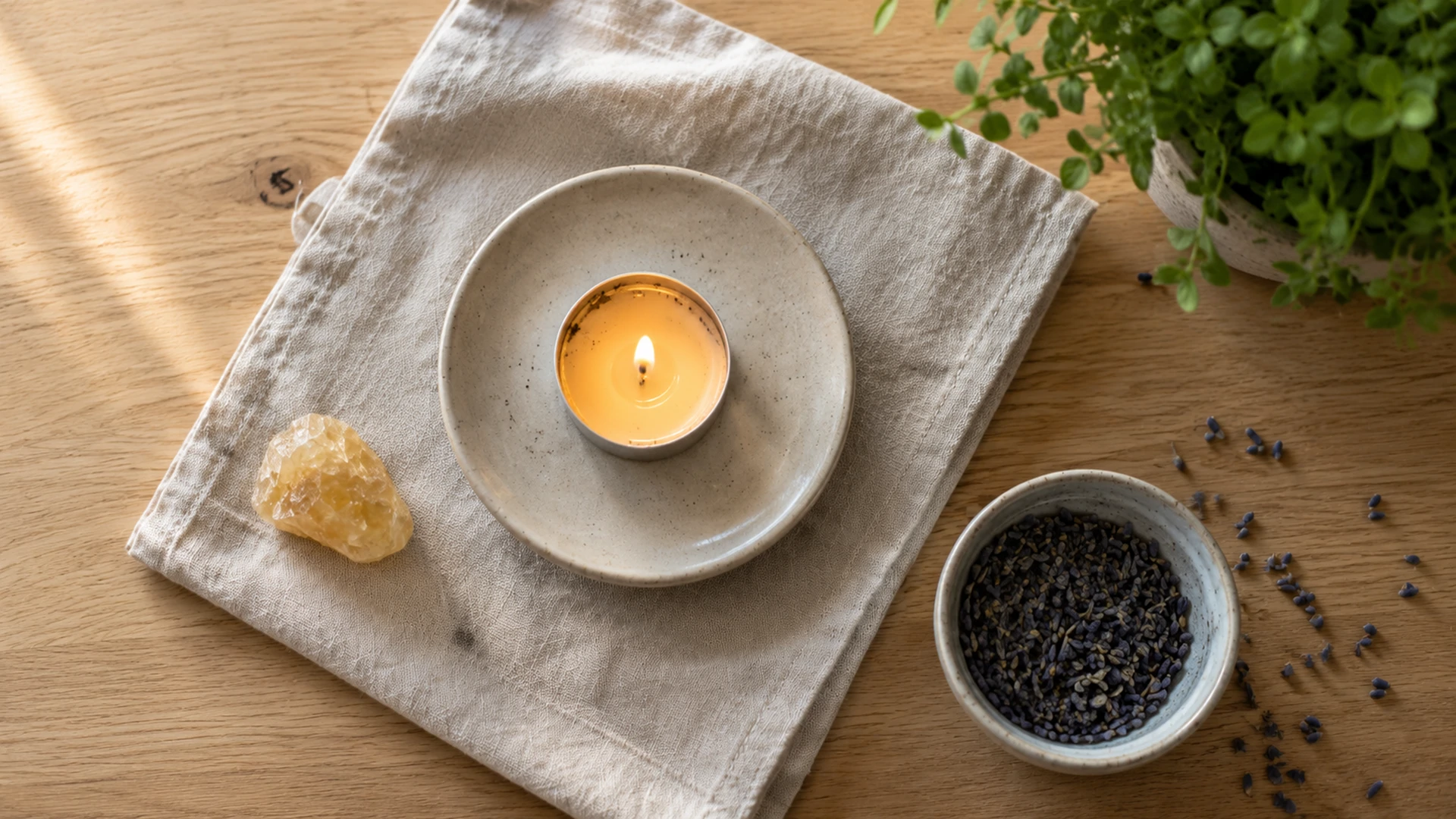
If you want a candle format that genuinely fits daily magical practice, the tealight is one of the most practical tools you can reach for. Tealight candle magic suits daily workings in a specific, structural way: these candles burn completely in one sitting, they cost almost nothing, and they ask very little of your setup. That combination makes them uniquely well-suited to the kind of consistent, low-friction ritual practice that actually produces results over time. This guide walks you through everything — why tealights work for daily spellwork, how to prepare and dress them, how to run the ritual itself, and how to read what the burn tells you when it's done.
Why Tealight Candles Suit Daily Workings
The tealight candle spell has a built-in advantage most people overlook: the burn time. A standard tealight runs for three to five hours, which means you light it, hold your intention through the working, and it extinguishes itself — all within a single session. You don't need to relight it the next day, track where you left off, or manage a candle that's been sitting on your altar for a week. Each daily working is complete and self-contained. That completeness matters magically because it trains your mind to treat each session as a finished act of will, not an ongoing hope.
The physical format supports this too. Tealights come pre-poured in a thin metal or plastic cup, which holds the wax as it melts. That means any oil or herb you apply stays contained rather than running across your altar surface. The cup also makes the candle stable enough to burn safely on a small dish, a folded paper, or even a ceramic tile without needing a dedicated holder. For daily practice — meaning you're doing this most days, not occasionally — that portability and low setup overhead is genuinely useful.
The surface area on a tealight is smaller than a chime candle or a pillar, which does limit how much you can inscribe. But for daily workings, you often don't need elaborate inscription. A single symbol, a word, or a brief sigil pressed into the wax is enough. The constraint actually encourages precision — you're forced to distill your intent down to its clearest form, which is good magical discipline.
The tealight is built for repetition. Its real strength is what happens when you use one every day: each candle is a fresh start, a clean surface, a new act of will. You're not pouring more intention into a container that's already been burning for three days. You're beginning again, deliberately, with the same target. That daily reset is what turns a single working into an accumulating current — intention that grows stronger precisely because you keep choosing it. For daily practice, that rhythm is the whole point. If you want to see how tealights fit alongside other candle formats, the Candle Types for Magic: Complete Guide covers the full picture.
Preparing Your Tealight Candle
Color is your first decision. For daily workings, the right color depends on what you're reinforcing each day. White is the reliable all-purpose choice — it carries amplification and clarity, and it works when your daily intent shifts slightly from one session to the next. If your daily practice has a specific focus, match the color to that. Yellow for mental clarity and communication. Green for steady abundance and growth. Blue for calm focus and wisdom. Purple for spiritual development and intuition. The full color system is worth knowing well — the complete candle color guide covers every option in depth.
Dressing a tealight requires a light touch. Because the wax sits in a shallow cup, you have two options: work directly on the exposed wax surface, or dress the candle before it's lit by applying a small amount of oil to the top of the wax only. Use a toothpick or a pin to apply a drop of oil and spread it thinly — you do not want pooled oil near the wick, because that creates a fire hazard and a sooty burn. A single drop is genuinely enough. For herbs, press a tiny pinch into the wax surface away from the wick. Dried herbs near an open flame can catch, so keep them at the edges. The full technique for dressing a candle with oils and herbs applies here, but scale everything down for the tealight's smaller surface.
If you want to inscribe a tealight, use a toothpick, a pin, or the tip of a small athame. The wax surface is soft, so inscription is actually easier here than on a taper or pillar. Press lightly — you only need to score the surface, not carve through to the cup. A single symbol, a planetary glyph, your initial, or a one-word intention works well. For more on the technique and symbolism of candle inscription, the complete inscribing guide gives you everything you need. The full preparation process — dressing, inscribing, and charging together — is covered in the preparing candles for magic guide.
Timing your daily working adds another layer of intentional alignment. Morning is the natural window for workings focused on momentum, clarity, and building — you're setting the tone for the day ahead. Evening works well for reflection, gratitude, releasing what didn't serve you, and drawing in what you want to call forward. If you're working with planetary days, match the day to your intent: Monday for intuition and emotional work, Wednesday for communication and mental sharpness, Sunday for success and vitality. Moon phase matters less for a true daily practice than consistency does, but if you're beginning a new cycle of workings, starting at the new moon gives you a clean energetic opening.
One practical safety note specific to tealights: the metal cup gets hot. Don't pick it up while it's burning or immediately after it's gone out. Set it on a ceramic dish, a small stone tile, or a dedicated heat-safe surface — not directly on wood, fabric, or a plastic altar cloth. Tealights are designed for unattended burning in most domestic settings, but that assumes a stable, fireproof surface and no flammable materials nearby. Because you're using them as active ritual tools rather than ambient lighting, you'll typically be present for the burn anyway. That presence is part of the practice.
Lighting and Working with Your Tealight Candle
Before you strike the match, take a moment to settle. Set the candle in front of you on your working surface and hold your hands around it — not touching the cup, just close. Breathe and let the intention you've encoded into the candle's color, oil, and inscription become clear in your mind. Not as a wish, but as a statement. This is not the moment to ask for something. It's the moment to know something. Daily workings build power through repetition, and each time you light this candle you are reinforcing a specific current of will. The more clearly you can hold that current before the flame even starts, the stronger the working becomes.
Light the candle with intention. As the flame catches, speak your intention aloud or in your mind — one clear sentence is better than a paragraph. Something direct and present-tense: "Clarity fills my mind and sharpens my focus today," or "Abundance flows into my life consistently and in growing measure." The exact phrasing matters less than the certainty behind it. You are not pleading. You are stating what is already in motion.
Once the candle is burning, you have options. Because a tealight burns for three to five hours, you don't need to sit with it for the entire duration. Many practitioners light the candle at the start of their morning routine — during coffee, journaling, or a few minutes of quiet — hold the intention clearly for five to ten minutes, and then allow the candle to continue burning while they go about their day. The flame acts as a sustained transmitter while it burns. Others prefer to sit with the candle for its full duration during meditation or ritual reading. Both approaches work. What matters is that the opening focus is real and deliberate, not distracted.
If you're working with visualization, picture your intention as already complete while the flame burns. For abundance work, see yourself moving through a day where resources flow easily. For clarity, feel the sensation of a sharp, uncluttered mind. For spiritual development, let your awareness soften and expand. You don't need to sustain this visualization for hours — a few solid minutes of genuine feeling is more effective than extended half-hearted imagining. The candle holds the space. Your job is to seed it clearly at the start.
If you need to leave the candle burning unattended, make sure there's nothing flammable within at least six inches of it, the surface is genuinely heat-safe, and there's no draft that could push the flame sideways. Tealights sit low to the surface in their cups, which makes them more stable than tapers, but common sense still applies. Return to it before it goes out if you can — the act of coming back to the candle, checking in on your intention, and watching the last of the wax melt is a meaningful closing gesture that grounds the working.
Reading the Burn and Closing the Working
Tealights give you clear, readable burn data once they go out. Start with the wax pool. A tealight that burns completely to a clean, clear pool with no residue is a strong sign — your intention met no significant resistance and the working ran cleanly. If there's leftover wax around the edges or a partial pool that didn't fully melt, that can indicate the working needs reinforcement. Repeat it the next day with fresh focus and a new candle.
Flame behavior during the burn is worth watching when you're present. A tall, steady flame indicates strong energy and forward movement — the working is running well. A low, struggling flame suggests resistance, distraction, or an intention that needs sharpening. Flickering without a visible draft often signals active energetic movement around the working. A flame that splits into two can indicate a conflict or duality in the intention — worth examining whether your stated desire and your deeper expectation actually align. If the flame goes out before the wax is fully consumed, relight it once with renewed focus. If it goes out a second time, close the working and return to it the following day. Forcing a working that keeps extinguishing rarely produces results.
Soot on the inside of the metal cup is readable too. A clean cup with minimal blackening suggests a smooth, unobstructed burn. Heavy black soot, especially if the cup is darkened all the way around, can indicate obstacles in the path of the intent. It's not a sign to panic — it's information. Consider whether there's external interference with what you're working toward, or whether your own ambivalence about the outcome is creating friction.
To close the working, let the candle finish burning out on its own rather than snuffing it. Blowing out a candle is thought in many traditions to scatter the accumulated intention — letting it burn to completion seals the working. Once the wax has solidified and the cup is cool, you have two main disposal options. For daily workings you're repeating on an ongoing basis, you can bury the spent cup in the earth (remove the metal if you're burying in a natural space) to ground and release the energy into the earth. Alternatively, simply dispose of it in a bin outside your home — releasing it from your space entirely. Do not keep spent tealights from ongoing workings on your altar indefinitely, as accumulated spent wax can muddy the energetic clarity of your space.
After the candle is out and disposed of, close the working with a grounding gesture. This can be as simple as pressing both palms flat to the table or floor for a moment, taking three slow breaths, and speaking a closing statement aloud: "It is done, it is real, it is mine." Or write one sentence in a magical journal noting the date, the intention, the candle color, and any notable burn behavior. That record becomes your data over time. Patterns emerge — you'll start to notice which workings burn clean, which need repeating, and what conditions in your life correspond to particular burn behaviors. That observational practice is what separates someone who does magic occasionally from someone who actually gets good at it.
A Fresh Candle Every Day, A Sharper Will Over Time
The tealight does something specific to your practice that no other format quite replicates: it resets completely every single day. You don't carry a half-spent candle forward. You don't inherit yesterday's energy or yesterday's distraction. Each session opens on a clean surface, fresh wax, and an unlit wick — which means your intention has to be freshly articulated every time. That daily act of re-stating what you're working toward, with no residual charge to lean on, is what builds real precision in how you hold and direct will.
The cost matters here too, in a practical way. At a few cents per candle, you can run a daily working for a full lunar cycle — 29 days straight — for less than the price of a coffee. That low cost removes the psychological weight of "wasting" a candle on a day when your focus isn't perfect. You show up anyway. You light it anyway. And that willingness to practice imperfectly, consistently, is exactly how the skill deepens.
Use the preparation steps in this guide as your template, but adapt them to what your daily practice actually needs. If you're working on abundance, reach for green candles with a drop of patchouli or cinnamon oil. If you're reinforcing mental clarity and focus, a yellow tealight with a scored mercury glyph is clean and direct. If spiritual growth is your current thread, purple or white with a drop of frankincense oil is a solid daily anchor. The format is consistent; the content shifts with where you are and what you're building toward.
This is a practice you can return to indefinitely. Every time you begin a new cycle of daily workings — a new moon, a new month, a new intention — you have the same reliable format waiting for you. Light a candle, hold the intention, let it burn. The simplicity is the point. If you want to go deeper into which candle format fits which kind of working, the Candle Types for Magic: Complete Guide gives you the full picture.