Pillar Candle Magic: Built to Burn Across Days, Not Hours
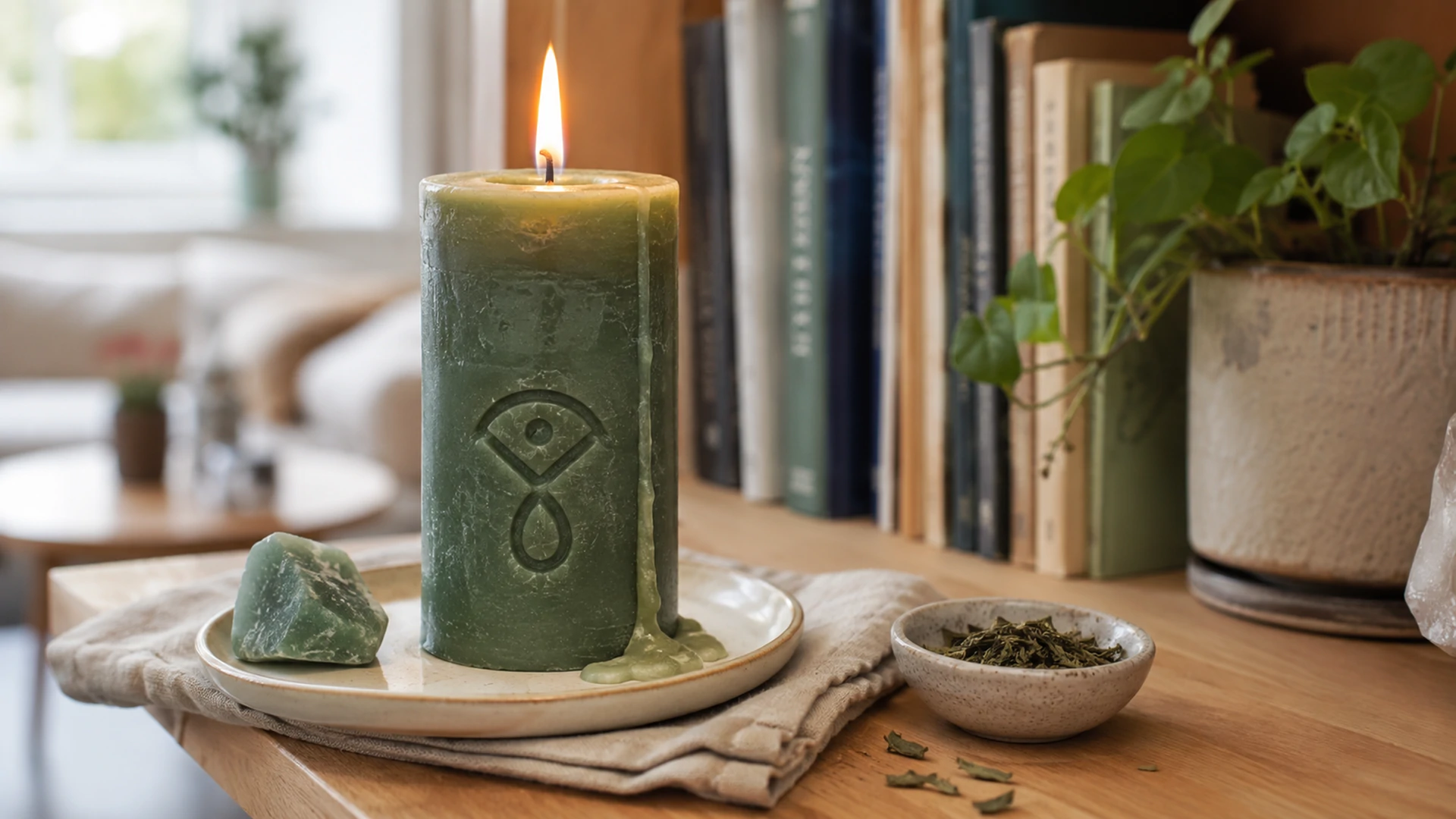
If you've ever tried to hold a spell's momentum across three days, a week, or a full lunar cycle, you already know that not every candle format can carry that weight. A taper burns down in an hour or two. A tealight lasts even less. Pillar candle magic solves this differently: a standard pillar burns anywhere from 40 to 100-plus hours depending on its diameter and height, making it one of the few formats genuinely suited to the kind of slow, sustained magical work that builds real force over time. This guide walks you through every stage of working with a pillar candle for multi-day rituals — from choosing the right candle to reading what the wax tells you when it's done.
Why Pillar Candles Suit Sustained, Multi-Day Ritual Work
A pillar candle is a freestanding wax column, typically 3 to 9 inches tall and 2 to 4 inches in diameter, designed to burn on a plate or heat-safe surface without a container. What makes it genuinely useful for ritual work comes down to two things: burn time and surface area. A 3x6 inch pillar burns for roughly 45 to 60 hours. A 3x9 inch pillar can exceed 90 hours. That's enough to sustain a working across a full week of daily sessions without replacing the candle — which matters more than it might seem, because continuity of the same physical object carries continuity of intention.
The surface area is the other major advantage. Unlike a taper, which gives you a narrow column with minimal carving depth, a pillar's wide body gives you real estate. You can inscribe a full name, a date, a sigil, a planetary symbol, and a petition word on the same candle without running out of space. You can layer oils and herbs from base to crown in distinct bands corresponding to different phases of your working. If you're doing a seven-day spell — one session per day — you can carve markers into the wax at measured intervals and track the candle's progress visually. Having those notches to return to gives you something concrete to orient around at each check-in, a physical record of how far the working has come.
Traditionally, pillar candles have been central to Hoodoo and folk magic specifically because of this stamina. Seven-day candles — tall, glass-encased pillars that burn continuously — are one of the most recognized formats in American folk magic, used for fixed workings that need to run without interruption. Freestanding pillars serve the same principle: a single vessel of intention that holds your working across time. In Wiccan and Neopagan practice, pillar candles frequently anchor altar setups for moon-phase workings, where a candle lit at the new moon is meant to burn in stages through the full. The format fits the working because the working demands duration.
The pillar's power is in continuity. For an extended intention — a money-drawing spell you tend over two weeks, a protection working you renew nightly, a manifestation ritual aligned to a full lunar cycle — the pillar holds the energetic thread intact from one session to the next. You return to the same candle, the same carved name, the same dressed surface. Each time you relight it, you're adding to something already in motion. That's a fundamentally different kind of working than anything you'd run in a single sitting, and that accumulation is what gives it force. You can explore how pillar candles compare to the full range of candle formats in the Candle Types for Magic: Complete Guide.
Preparing Your Pillar Candle
Color is your first decision. For multi-day workings, color choice operates differently than in a single-session spell — you're going to be looking at, tending, and returning to this candle for days, so pick something that genuinely resonates with the intent rather than the nearest approximate. A full breakdown of what each color carries is in the complete candle color guide, but as a quick orientation for common sustained workings: white anchors purification, clarity, and spiritual protection across extended periods; green feeds money, growth, and abundance over time; red sustains passion, strength, and vitality; black holds banishing and protective barriers across a working's full duration; purple supports spiritual development, psychic work, and long-form vision.
Once you have your candle, inscribing it is where the real preparation happens — and the pillar's size makes this more forgiving than most formats. A sharp nail, a burin, a toothpick, or a dedicated inscribing tool all work. Carve toward yourself to draw things in, or away from yourself to push things out or banish. For a multi-day working, consider inscribing not just your core intent but also a timeline marker: a simple notch or symbol at the one-third and two-thirds points of the candle's height gives you a visual cue each time you return to it. Full technique guidance lives in the candle inscription guide.
Dressing the candle — applying oil and, optionally, herbs or powders to the surface — is equally well-suited to the pillar format. Because the body is wide, you can dress it in sections or layers: anointing the crown for drawing power downward, the center for the core intent, and the base for grounding and stability. Use a few drops of an oil matched to your purpose and work it into the wax with your fingertips. Herbs can be lightly pressed into the surface after oiling. For guidance on choosing oils and herbs for dressing, the complete candle dressing guide covers this in full. One practical note specific to pillars: avoid packing herbs densely against the wick or near the top of the candle, since as the wax pool forms, loose material can catch and cause uneven burning or small flares — a light press into the outer surface is enough.
Timing matters more for sustained workings than for one-off sessions, because you're setting up a working that will run across multiple days or even moon phases. For most drawing or growth workings — money, love, success, healing — begin on the new moon and plan for the candle to burn through to the full, aligning the working's peak with the moon's maximum pull. Waning moon energy suits banishing, releasing, and binding work. If you're working with planetary days, match your start day to your intent: Sunday for vitality and success, Monday for emotional and psychic work, Thursday for abundance and expansion, Saturday for binding and banishing. Starting on the aligned day isn't mandatory, but it adds coherence — your working begins already moving in the same current as the larger forces you're calling on.
One genuine safety note specific to this format: pillars are not container candles. They burn openly, and as the wax pool deepens, the sides can develop thin spots or small cracks that let liquid wax escape. Always burn your pillar on a wide, heat-safe plate or in a shallow bowl rather than a flat surface. If you're burning it in sessions rather than continuously, snuff it rather than blow it out — this keeps the wax pool intact and the wick centered. Between sessions, trim the wick to about a quarter inch to prevent mushrooming and uneven burns. You do not need to babysit every minute of a pillar burn, but checking it every couple of hours is reasonable, especially in the first few sessions while you learn how your specific candle behaves.
Lighting and Working with Your Pillar Candle
Before you strike the match, take a moment to get clear. Not elaborate — just present. A pillar working is a practice of accumulated intention, and the quality of each lighting feeds the whole. Hold the candle briefly, or simply rest your hands on your working surface and call your intent to mind as a single, complete thought. Not a long recitation, just a clear picture of what this working is for. Then light it.
The first session is the most ceremonially significant. This is when you're setting the working in motion and establishing the energetic current it will run on. Spend at least a few minutes with the candle after lighting it — watching the flame settle, stating your intention aloud or in your mind, and committing to the full duration of the working. Some practitioners write their petition on paper and place it under the candle's plate, folded toward themselves for drawing or away for banishing. Others hold their hands near the flame without touching it and visualize the intent moving from their will into the working through the heat and light. Both are valid. What matters is that the first lighting feels intentional, not mechanical.
For the subsequent sessions — each time you return to the candle over the following days — the lighting ritual can be briefer, but it should still be deliberate. Relight the candle with the same focused thought you used the first time. Even thirty seconds of clear intention before walking away is enough to recharge the working. You're not starting over; you're adding momentum to something already in motion. Think of each relighting as a renewal of your commitment to the outcome you've named.
Where you place the candle matters practically and symbolically. For drawing work, many practitioners keep the candle on their main altar or on a surface they pass regularly — proximity keeps the working present in your awareness, which reinforces your will toward the outcome. For banishing or binding work, some prefer a more isolated placement: a shelf away from living spaces, or a corner that faces the direction you're pushing the energy toward. For healing work, placing the candle near a photograph, an object belonging to the person being worked on, or a written name is traditional in both Hoodoo and folk magical practice.
One of the real advantages of a multi-day pillar working is the relationship you develop with the candle over time. Check in with it daily — not obsessively, but with awareness. Notice whether the flame burns bright and upright, whether the wax pool is forming evenly, whether the scent or color of the smoke changes. These observations aren't just interpretive; they keep your attention on the working and your will actively engaged with it. A spell you forget about after lighting it doesn't carry the same charge as one you tend with genuine focus. The pillar's long burn gives you repeated opportunities to pour intention into the working. Use them.
Reading the Burn and Closing the Working
What the candle does as it burns tells you something about how the working is moving. A steady, upright flame that holds without guttering or going out is the most positive sign — it reads as clear passage, your intention meeting little resistance. A tall, active flame that flickers and reaches suggests strong energy moving, sometimes urgency, sometimes that the working is drawing in force quickly. A low, struggling flame, especially in the early sessions, can indicate obstacles, doubt, or a need to reinforce your preparation — consider redressing the candle lightly or revisiting the clarity of your stated intent.
For multi-day pillar workings specifically, two burn patterns carry particular traditional significance. If the candle burns out before you expected it to — well ahead of its projected burn time — folk magical tradition reads this as the working having completed quickly, or alternatively as the working meeting a strong counter-force and consuming itself. Neither is automatically negative. If it went fast and clean, with no soot and a full wax pool, the first reading is likely. If it burned irregularly and left heavy soot, the second is worth considering. If you need to relight a candle that has gone out on its own (not snuffed), traditional Hoodoo practice treats this as a signal to reinforce your working — restate your petition clearly, re-anoint the wick with a small amount of oil, and relight with fresh intention rather than just touching a match to it reflexively.
Soot and wax pooling are your two most readable physical signs. Black soot on the inside of a glass candle or collecting heavily on the sides of a freestanding pillar, especially early in the burn, suggests the working is clearing through interference — negative energy, resistance, or crossed conditions. A fully clean burn with clear white soot or no soot at all suggests unobstructed movement. Wax that drips dramatically to one side carries directional meaning in many traditions: dripping toward you for drawing workings is a favorable sign; dripping away during a banishing working is equally positive. Wax that pools without dripping and resolidifies cleanly suggests the energy is being contained and built, which suits workings focused on accumulation over time.
When the working is complete — whether the candle burns all the way down or you've reached the planned end of your working's duration — close it deliberately. Don't just walk away. Thank whatever forces, spirits, or aspects of your own will you invoked. State the working as done, not ongoing: speak aloud or in your mind that the intention has been released and the working is closed. This matters practically because it signals your own subconscious that the active phase is over and you can stop directing energy toward it. Anxiety-fueled re-casting is one of the most common ways people undermine their own workings.
For wax remains, disposal should match the working's intent. For drawing work — love, money, healing, protection drawn toward you — keeping a small piece of the cooled wax in a charm bag, wrapping it with herbs and carrying it, or burying it on your property are all traditional methods of holding the working's energy close. For banishing or binding, the opposite: take the remains away from your home and dispose of them at a crossroads, in a body of moving water, or in a trash receptacle far from where you live. If you bury remains from a drawing working, bury them near your front door or in the eastern corner of your property where the sun rises — an old directional correspondence for new beginnings and incoming energy.
The Candle That Keeps Burning: Returning to Pillar Work
A single candle that holds your carved name, your chosen oil, your stated petition, and your accumulated attention across multiple days becomes a physical anchor for your will. Every time you return to it, you're not starting a new working. You're deepening the same one. The pillar's burn time makes that continuity possible in a way no other common candle format sustains — and that sustained charge is what gives this format its real potency.
This is also a format you can return to repeatedly for similar workings. Once you've run a seven-day money-drawing working with a green pillar and know how to read its burn, you have a template. The next time you need sustained abundance work, you reach for the same format with the same structure and deepen your skill with it rather than starting from scratch. That's how magical practice actually builds — not by doing something once and hoping, but by working the same methods with increasing precision and awareness over time.
The practices in this guide — color selection, inscription, dressing, timed relighting, burn reading, and intentional closure — apply to any sustained pillar working you run, regardless of intent. Swap the color, the oil, the carved words, and the petition, and the approach holds. If you want to build out your broader candle magic toolkit alongside pillar work, the Candle Types for Magic: Complete Guide maps the full range of formats and where each one genuinely earns its place.