Shungite: The Protection Stone That Purifies Water
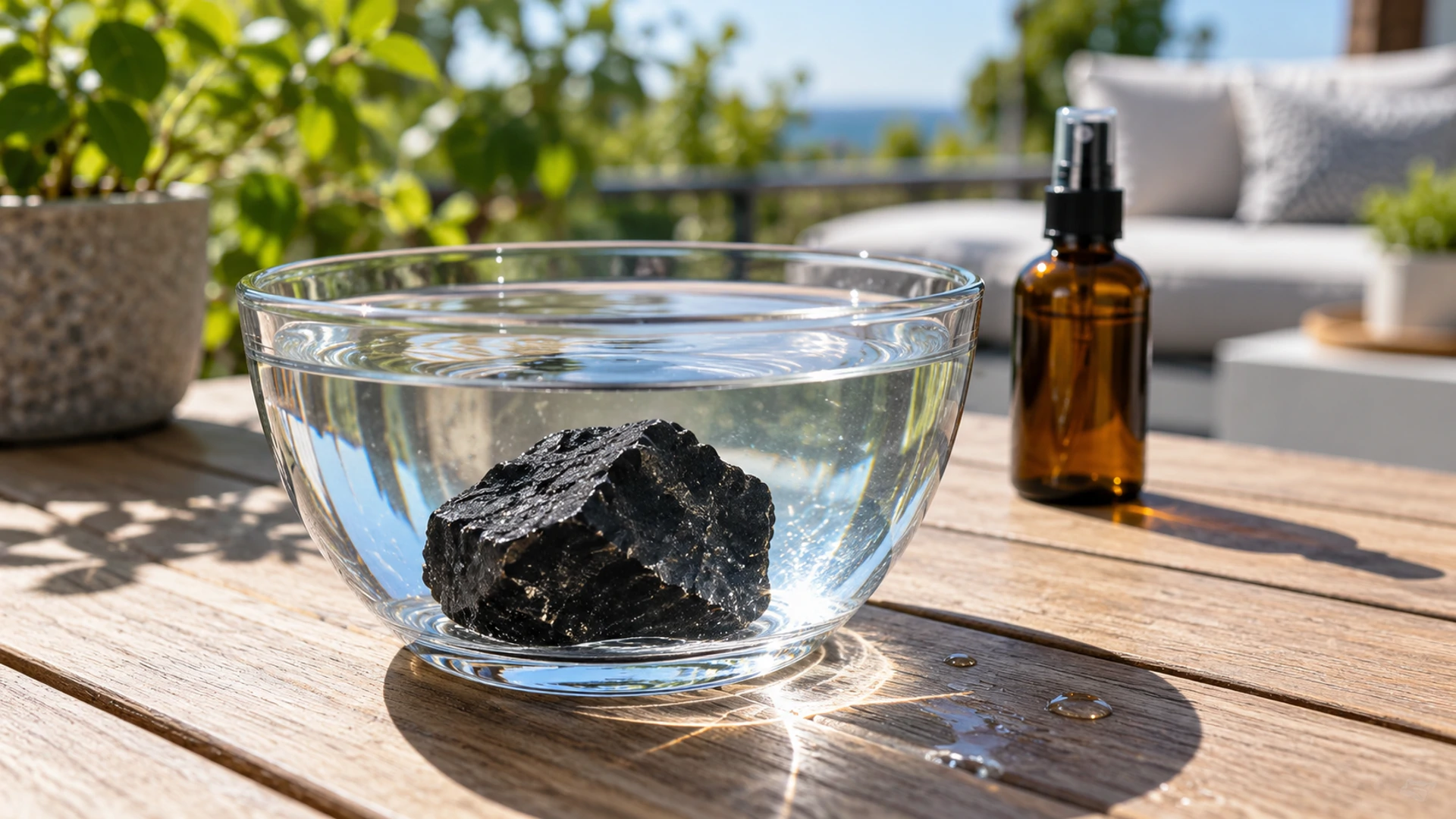
Shungite sits in the Protection category because it absorbs and neutralizes — and unlike most stones that carry that reputation on tradition alone, this one has a documented, non-metaphysical physical credential behind it: it has been used to purify water for centuries.
A Physical Credential: Why Shungite Belongs in Protection
Most protection stones earn their category through accumulated tradition. Black tourmaline grounds first, then holds a boundary — a Saturn mechanism built through centuries of use as a talisman against curses and psychic attack. Black obsidian functions as a mirror, reflecting and revealing rather than absorbing. Shungite does something different, and it's worth being precise about what that is before getting into the metaphysical layer.
Shungite is almost entirely carbon — a black mineraloid, not a true crystalline mineral, found almost exclusively near Lake Onega in Karelia, Russia. Its high carbon content includes fullerene molecules, the same molecular structures that earned a Nobel Prize in chemistry in 1996. This is not a mystical claim. It is basic material science. And it's what makes shungite genuinely unusual as a purifying agent: carbon filtration is a real, established method for removing organic compounds and other contaminants from water, and shungite's fullerene content has been studied in that context at a laboratory level. The stone has been used in Russian water-treatment and spa traditions for well over three hundred years. That's the physical credential, and it's real.
Where the credential stops is equally worth naming plainly. The popular claim that shungite blocks electromagnetic frequencies from phones, wifi routers, and other electronics is widely repeated in crystal-healing spaces, but it is not scientifically established. Carbon does not function as an EMF shield in the way the marketing suggests, and no peer-reviewed study has confirmed that placing shungite near a device meaningfully reduces your exposure to its emissions. This doesn't mean the practice is worthless — the grounding, anchoring quality of a stone placed intentionally in your space carries its own value in terms of how you relate to your environment. But the EMF-shielding claim specifically should be held as unverified, not settled fact.
The metaphysical mechanism, then, is this: shungite absorbs and neutralizes. In the language of the Protection category, it works by taking in what enters its field and transforming rather than deflecting it — a different posture than the reflective mirror of obsidian or the active boundary of tourmaline. This makes it a natural fit for the root chakra, where the work is about filtering what comes in at the most fundamental level. Its element is Earth, reinforcing that slow, dense, matter-of-fact quality — this is not a stone with a dramatic or flashy energy. Its planetary correspondence is Saturn, the planet of boundaries, structure, and long-term endurance. All of that lines up with a stone that sits near still water and does its quiet, documented work.
Elite or Regular? Choosing Genuine Shungite
Shungite is graded by carbon content, and this distinction matters more than most buyers realize. The version usually called "elite" or "noble" shungite runs up to roughly 94 percent carbon. It looks visibly different from regular material — it has a brighter, almost silvery metallic luster and tends to be more fragile, since the high carbon content means it lacks the other mineral stabilizers that give denser rock its durability. Elite shungite is rarer, more expensive, and more often used for water infusion or altar work where its visual quality and concentrated carbon structure are relevant.
Regular black shungite — the far more common type — runs closer to 64 percent carbon. It looks matte and stone-like, feels heavier and more stable in the hand, and is what you'll find in most palm stones, tumbles, and shaped pieces for everyday protection and grounding work. Neither grade is inherently superior for the purpose; they're suited to different applications. If you're placing a piece at a corner of your workspace or carrying one in a pocket, regular shungite is what you want. If you're working with it in water-based ritual practice, elite material is the more intentional choice.
The authenticity concern worth knowing about is less about identifying fakes through a checklist and more about sourcing honestly. Because shungite comes almost entirely from one region in Russia, material labeled as shungite from unspecified origins should prompt a question. Cheap jewelry sold online sometimes substitutes plain black stone or dyed glass for the genuine article. A seller who can name the grade and the origin — Karelia, Russia — is giving you something worth trusting. One practical note: genuine shungite is conductive, because of its carbon content. Touching both terminals of a battery tester to a real piece will produce a readable electrical response. Inert black glass will not.
On care: shungite is water-safe, and unusually so for this category. Most protection stones benefit from being kept dry, but shungite's entire documented credential is built on its contact with water. Brief rinsing is not only fine but appropriate for pieces used in absorption work, since rinsing physically clears surface residue that accumulates during use. There are no toxicity concerns with normal handling. Store it away from other stones if you're treating it as an absorbing piece — the same logic that applies to any stone doing active protective work applies here — but it requires no extraordinary maintenance.
Three Practices for Grounded, Documented Protection
The Marcial Waters Practice
Use this when a space needs clearing at the energetic level — after conflict, after illness, after a period of stagnation that's left the air feeling flat.
Place a piece of elite or regular shungite in a glass bowl of clean water and let it sit for several hours or overnight. Decant the water into a spray bottle, adding a few drops of frankincense or rosemary essential oil if you work with botanical correspondences. Move through each room of your space, misting doorframes, corners, and windowsills while holding a clear intention for what you're releasing. This practice draws its logic directly from shungite's documented history as a water purifier — the stone's presence in the water is the point, not incidental. The spray isn't a health tonic or a wellness drink; it's a ritual instrument, and the framing stays there. Work during a Saturn hour if you want to lean into the planetary correspondence, or on a Saturday for the same reason.
The EMF Corner
Use this as a deliberate, intentional placement practice for spaces where you spend significant time near electronics — a desk, a router, a bedside table — offered honestly as a ritual of conscious relationship with your environment rather than as a verified physical shield.
Place a shungite piece — a sphere, a pyramid, or a palm stone work well — on or near the surface where your electronics live. Before placing it, hold it briefly in your hands and state your intention clearly: you are placing this stone as a marker of a boundary you've chosen, not because you've verified what it does physically, but because the act of placing it shifts how you inhabit that space. That shift is real. Anchor the placement with a black candle burned nearby while you settle into the setup, and return your attention to the stone at the start of each work session as a grounding reset. The stone's EMF-shielding reputation is not settled science; what is settled is that intentional placement of a boundary marker changes how you relate to what's inside it.
The Grounding Anchor
Use this on days when you feel scattered, unmoored, or too far in your head — when you need to come back down into your body and the present moment before anything else can work.
Hold a piece of shungite in your non-dominant hand and sit or stand with both feet flat on the floor. Feel the weight of the stone specifically — shungite has a distinctive density to it for its size, and that physical quality is doing something for you before any layer of intent is added. Breathe down into the root chakra, at the base of the spine, and let each exhale be a release into the ground rather than a letting-go into space. Shungite's Earth element grounding is not dramatic; it's more like something becoming heavier and more settled in place. Hold for as long as the breath wants to move that way, then set the stone down deliberately rather than just putting it aside. If you find you need something to help carry you through the rest of the day, black kyanite can be a companion stone here — it grounds and shields while being self-clearing, which makes it a low-maintenance pairing for active protection work.
Peter the Great's Spa: Shungite's Documented History
Most protection stones carry histories that are richly layered but difficult to pin to a single verifiable event. Shungite is one of the rare exceptions. In 1719, Tsar Peter the Great established Russia's first official spa — known as Marcial Waters — in Karelia, the same region where shungite is found. He founded it specifically for the waters filtered through shungite deposits, which he credited with significant restorative properties. This was not a metaphysical attribution — it was a practical royal decree backed by observable results from water that had been in contact with the stone. The name Marcial, invoking Mars, reflected the iron content of the water as much as any martial symbolism, though the planetary correspondence adds an interesting dimension if you work within that framework.
Peter the Great is also widely credited — in Russian tradition — with having his soldiers carry pieces of shungite to purify their drinking water on military campaigns. Whether this was a formal military directive or a regional practice that accrued to his name over time is difficult to verify with the specificity a historian would require. What is verifiable is that shungite-filtered water has been in documented practical use in the Karelian region for centuries, that the tsar's spa established it at an institutional level, and that its use as a purifying material predates any of its modern crystal-healing marketing by a significant margin. That matters. It means the stone's reputation for neutralizing what passes through it is rooted in something you can check, not just in accumulated tradition.
The scientific study of shungite's fullerene content is comparatively recent, picking up significantly after the 1996 Nobel Prize in chemistry brought fullerene molecules into wider scientific awareness. Research into its properties as a material continues, particularly in materials science and water treatment. The metaphysical community's interest in shungite grew alongside that broader attention, which is why its marketing sometimes conflates the verified (water purification) with the speculative (EMF shielding). Knowing where that line sits makes you a more grounded practitioner, not a more skeptical one.
Protection You Can Verify
What shungite offers that few stones in the Protection category can match is a mechanism you can point to outside the tradition itself. The absorption and neutralization it performs in water is not a metaphor — it's a documented physical process, and that credential extends naturally into the ritual logic of using this stone as a field-clearing, boundary-setting tool in your practice. You don't have to choose between the historical fact and the magical use. They reinforce each other.
If you want to see how shungite sits alongside the other sixteen Protection stones, and how the Protection category itself relates to the six other paths — Cleansing, Healing, Empowerment, Abundance, Love, and Intuition — the full context is in The Crystal Compendium: Seven Paths to Stone Magic.