Pyrite: Wealth Earned, Not Wished For
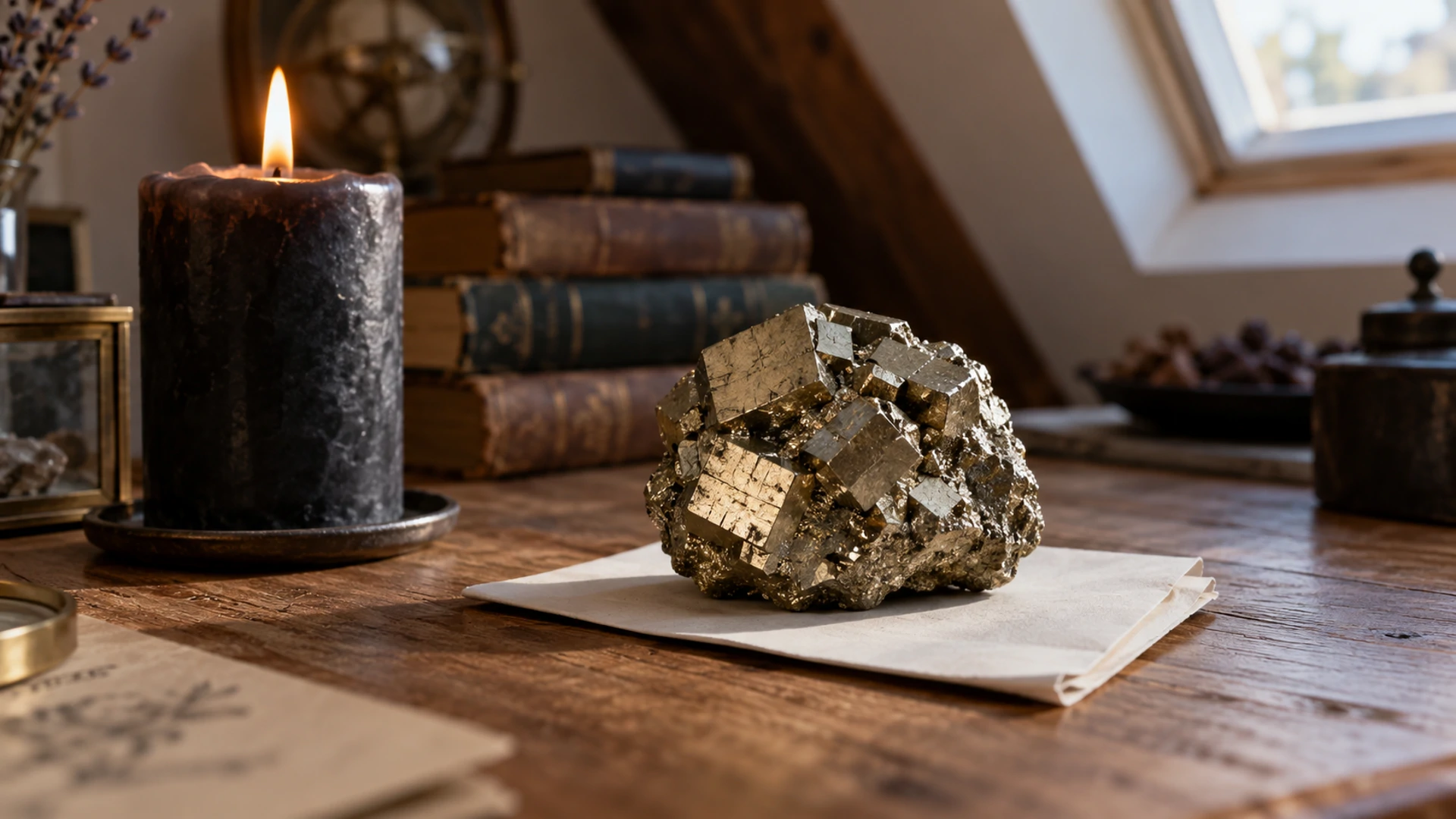
Pyrite doesn't bring you wealth. It builds the conditions in which you can earn and hold it — through focus, resolve, and a refusal to let what you've worked for slip away. It's the abundance stone for people who understand that discipline is a practice, not a personality trait.
Wealth Earned, Not Wished For: Why Pyrite Belongs in Abundance
The first thing to understand about pyrite in magical practice is what kind of abundance work it actually does. Pyrite's mechanism is protective, disciplined wealth-building — abundance through willpower, resolve, and safeguarding what's already been built, not spontaneous luck or a sudden arrival of opportunity. This puts it in a very specific lane, and knowing that lane makes the difference between a working that lands and one that just sits there looking shiny on your altar.
Compare it to citrine's spontaneous manifestation — active, radiant generation of new wealth and opportunity through confidence and joy — and the distinction becomes clear immediately. Citrine radiates outward, drawing abundance in through an almost solar magnetism. Pyrite holds the line. It fortifies. Where green aventurine offers luck and chance-based opportunity — positioning you to catch a lucky break rather than generating or accumulating wealth through effort — pyrite demands that you show up and do the work, then ensures the work is protected. These are three genuinely different mechanisms, and conflating them produces muddled results.
Pyrite's primary chakra correspondence is the solar plexus — the seat of personal will, self-discipline, and the kind of confidence that comes from follow-through rather than optimism. This is the chakra that governs your capacity to act on decisions rather than just make them, which maps precisely onto what pyrite actually does. The solar plexus also governs financial discernment: the ability to see where money is leaking, where it's being protected wisely, and where it should be deployed.
Elementally, pyrite sits at an unusual intersection. Its iron-sulfide composition and brassy, sparking nature give it a genuine Fire quality — strike it against flint and it literally throws sparks, which is part of its documented practical history. But its dense, heavy, cubic crystal structure and its formation deep within the earth give it an equally real Earth quality. That dual Fire-Earth nature is part of what makes it so effective for sustained abundance work: Fire provides the ignition and drive, Earth provides the staying power and groundedness that keeps a financial intention from burning bright and then gutting itself. Its zodiac association is Leo, a fire sign ruled by the Sun — reinforcing that solar plexus energy and the connection between personal will and visible, earned success. Its Solar and Martian correspondences also appear in the broader tradition, both fitting for a stone whose energy is more about forging than receiving.
Gold That Isn't: Choosing and Caring for Pyrite
Before anything else: pyrite requires specific care, and this isn't a precaution you can skip. Pyrite is iron sulfide, and when it's exposed to moisture or humid conditions over time, it oxidizes. That oxidation process produces sulfuric acid and iron oxide — the same chemistry behind acid mine drainage in industrial contexts. For your practice, this means two things directly. Never use pyrite to make a gem elixir or infused water. This is a genuine material safety issue, not an abundance-of-caution disclaimer. And avoid storing pyrite anywhere damp — a bathroom altar, a humid basement, a windowsill that gets condensation. Keep it dry.
Cleansing should always use dry methods. Sound works well — a singing bowl or tuning fork directed at the stone is effective and risk-free. Smoke is another solid option, as is brief contact with soil (place it in a dry pot of earth overnight, then brush it clean). Avoid salt baths, water rinses, and anything that introduces moisture.
On choosing a specimen: genuine pyrite is not subtle. It has a brassy, metallic luster that catches light with a warmth just slightly cooler than actual gold, and it forms in highly distinctive geometric shapes — cubic crystals with flat, striated faces are the most recognizable, though pyritohedral forms (twelve-faced, like a soccer ball's geometry pushed into a pentagon pattern) are also common. If the piece you're looking at is perfectly smooth, uniformly dull, or lacks any visible crystal faces or structure, be skeptical.
The classic field test for distinguishing pyrite from gold is the streak test: drag the mineral across a piece of unglazed porcelain (the back of a ceramic tile works fine) and check the color of the streak it leaves. Pyrite leaves a greenish-black streak. Gold leaves a gold-colored streak. That single test resolves most confusion. The other key difference is that pyrite is brittle — it will fracture or crumble if struck — while gold is soft and malleable enough to bend without cracking. Pyrite's hardness sits at Mohs 6 to 6.5, which means it can scratch glass but will itself be scratched by a steel file. For magical use, raw or minimally polished specimens are ideal. The natural cubic form carries more presence than a tumbled stone that's lost its geometry, and part of working with pyrite intentionally is acknowledging what it actually is, not smoothing it into something generic.
Three Practices for Building on Resolve
The Steady Resolve
Use this practice when you have a specific financial goal already defined and you need to stay disciplined toward it over weeks or months, rather than letting focus drift.
Write your goal in concrete terms on a small piece of paper — not "I want more money" but the actual figure, the actual deadline, the actual purpose. Fold the paper once and place your pyrite specimen directly on top of it. Light a gold candle beside the stone. Hold the stone briefly in your dominant hand before setting it back down, and state your goal aloud in one sentence — present tense, specific, direct. Leave the arrangement in place and return to it weekly. Each time you return, hold the stone, state the goal again, and do one small concrete action toward it before or immediately after the working. The stone anchors the intention; the action keeps the circuit live.
The Locked Vault
Use this practice for protecting savings or resources you've already built, when the threat is dissipation, impulsive spending, or outside pressure on your financial stability.
Place your pyrite on your altar or workspace beside a black candle — the color of firm boundaries and what doesn't get through. Write a single word on a slip of paper that represents what you're protecting: a specific account, a fund, a resource you've worked hard to build. Tuck the paper beneath the stone. During a Saturn hour, light the candle and spend a few minutes holding the stone with both hands, visualizing your resource held firmly in place — not growing in this moment, simply immovable. When the session is over, snuff the candle. Keep the stone and paper in place for as long as the protective period needs to hold.
The Spark Struck
Use this practice when you've already made a financial decision intellectually — a budget cut, an investment, a conversation you've been avoiding — but haven't been able to actually act on it.
This practice draws directly on pyrite's documented history as a fire-starting material: struck against flint, it produces sparks. The metaphysical use mirrors the physical one. Hold your pyrite in one hand. In the other hand, hold a small piece of raw flint or any rough stone. Strike them together once — not violently, just firmly enough to feel the contact. That percussive act is the ignition. Immediately after, without pause, pick up your phone or your pen and take the first, smallest, non-reversible step toward the stalled decision: send the message, move the transfer, schedule the call. The pyrite provides the spark; you provide the motion. A Mars hour is the ideal timing for this working, since Mars governs decisive action under resistance. Basil burned or kept nearby reinforces that Mars-driven momentum.
The Stone That Sparked Fires
Before pyrite ever appeared in a wallet or on an altar, it had a job that was far more immediate: starting fires. Struck against flint or steel, iron sulfide throws sparks reliably enough that it served as an early ignition source across many cultures and time periods. This predates and runs parallel to its ornamental and metaphysical use, and it continued into early firearm technology — wheellock mechanisms used the same spark-producing percussion principle, sometimes substituting pyrite as the striking material.
That origin matters more than it might seem. A stone that literally creates fire when struck is not a passive talisman. It responds to contact and force. The energy it carries in magical practice isn't gentle or receptive — it's kinetic. It rewards the practitioner who applies pressure and shows up with intention, not the one who sets it on a shelf and waits. The nickname "fool's gold" obscures this. Yes, pyrite has been mistaken for gold throughout mining history, and yes, that's embarrassing for the miners who made the error. But calling it a fool's stone misses the real point: what it actually does — both literally and magically — is produce the spark that starts the fire. The only fool here is the one who dismisses it.
Abundance That Holds Its Ground
Most abundance magic focuses on drawing things in. Pyrite covers something just as important and considerably less glamorous: making sure what you've built doesn't dissolve under pressure, distraction, or a lack of sustained will. That's its mechanism — protective, disciplined wealth-building — and it's what makes it irreplaceable in a serious abundance practice rather than just an aesthetic choice.
If you're curious how pyrite fits alongside the other stones working in the Abundance category, or how the Abundance category itself sits among six others — Protection, Cleansing, Healing, Empowerment, Love and Relationships, and Intuition — the full breakdown is in The Crystal Compendium: Seven Paths to Stone Magic. Each stone is placed where it is for a reason, and seeing them together shows you the full range of what's available.