Blue Lace Agate: Named During the Space Race
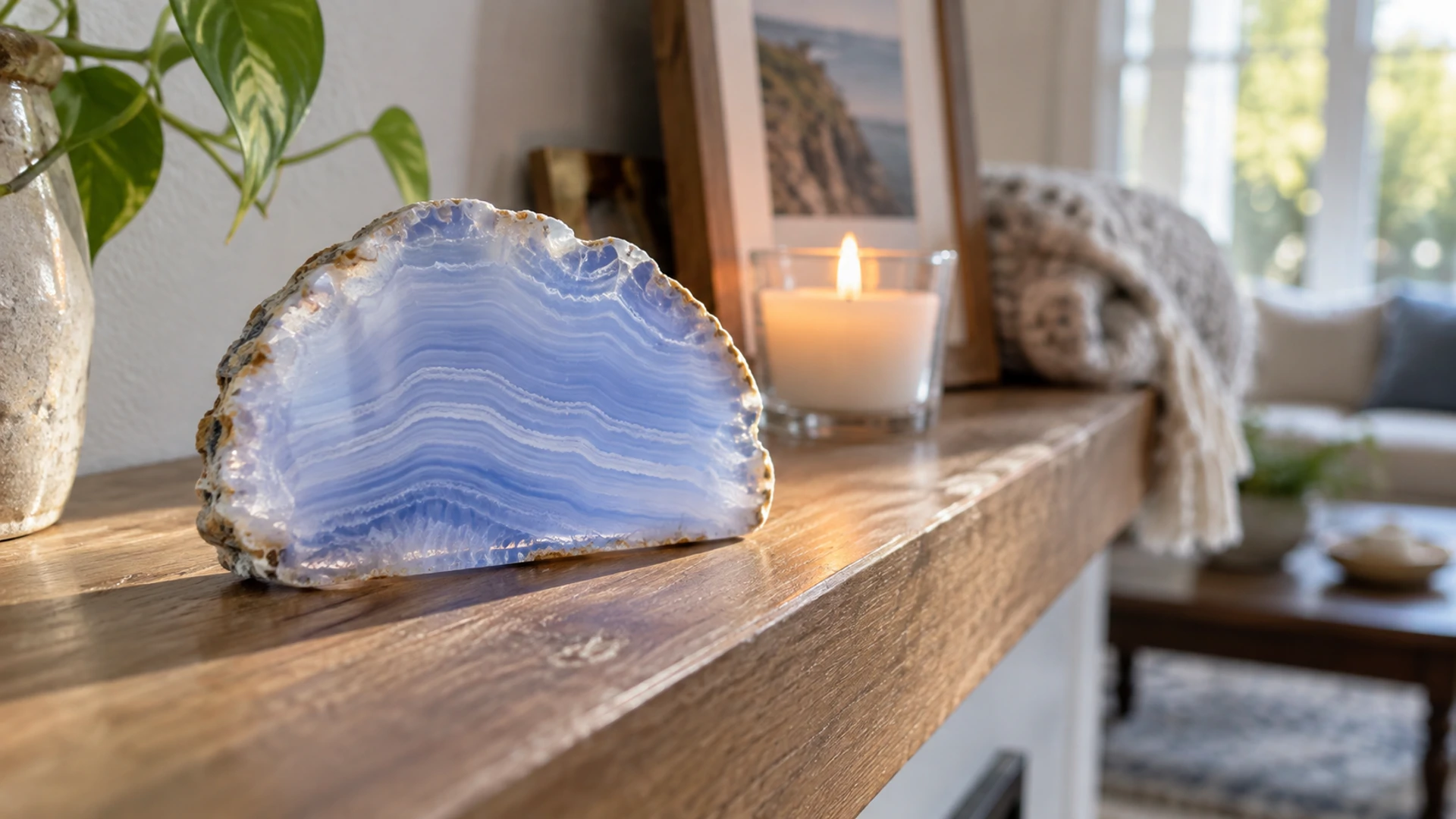
Blue lace agate is a pale blue, white-banded chalcedony with a single well-documented origin in Namibia and a correspondingly narrow magical identity: it soothes anxiety around self-expression, making it the most gentle entry point into throat-chakra healing work available.
Named During the Space Race: Why Blue Lace Agate Belongs in Healing
The name "Gem of Ecology" was coined in a specific cultural moment — the early Space Race era — when the sight of Earth from above had just become real to ordinary people for the first time. The swirling pale blue and white bands of this stone genuinely do look like cloud formations photographed from orbit. That visual resonance between sky, atmosphere, and the stone's coloring isn't incidental to why blue lace agate ended up in the healing tradition. It shaped the early language around it from the start.
Within the Healing category, blue lace agate occupies a very specific position. It is not a stone that surfaces buried trauma the way malachite does, nor does it stabilize the nervous system through its mineral composition the way lepidolite does with its lithium-bearing structure. Blue lace agate's mechanism is narrower and gentler than either of those: it eases the specific anxiety that forms around speaking, being heard, and expressing yourself when past experience has taught you that doing so is unsafe or unwelcome.
That distinction matters if you're choosing between healing stones intentionally. Someone working through relationship patterns — codependency, caretaking burnout, how they've allowed themselves to be treated — is probably better served by chrysocolla, which heals within those patterns specifically. Someone who needs a slow, layered return to an old wound at progressively deeper levels will find unakite more suited to that work. Blue lace agate is for the person who has something to say and can't get it out — or who has learned, over time, not to try.
Its correspondences all point the same direction. Blue lace agate works with the throat chakra, the energetic center most associated with communication, honest speech, and being heard. Its element is air — movement, breath, the medium through which sound travels. Its planetary ruler is Mercury, which governs language, thought, and the transmission of ideas. Its zodiac associations are Gemini and Pisces: Gemini for its love of words and ideas, Pisces for the sensitivity that makes self-expression feel so high-stakes. Every one of these correspondences points back to the same core function. This is a stone that exists almost entirely in the register of voice.
Genuine Namibian Blue, or Dyed? Choosing Blue Lace Agate
Here's something worth knowing before you buy: a bold, vivid, saturated blue in any agate should make you pause. Natural blue lace agate is pale. The blue is soft, almost watery, and the white lacing runs through it in fine, layered bands. That delicate appearance is not a sign of lower quality — it is, counterintuitively, the more trustworthy sign of authentic material. The deeper and more uniformly blue a piece looks, the more likely it has been dyed.
Blue lace agate comes almost entirely from a single historic source area in Namibia. As that original find has become increasingly scarce over the decades, the market has responded with dyed substitutes — often dyed white or grey chalcedony, which is far more abundant and much cheaper to source. The treatment produces a visually striking stone that photographs well and sells easily, but it's not the same material. If you want the real thing, look for the pale, soft tones and visible natural banding. A price that seems too low for a named Namibian stone is another signal worth paying attention to.
One practical test: if a seller can tell you exactly where a piece was sourced and the lacing appears in naturally variable bands rather than uniformly saturated color, that's a reasonable indicator of genuine material. Reputable crystal dealers who specialize in quality over volume will typically source blue lace agate from verified suppliers and disclose origin. Big-box import lots are where dyed material is most commonly found, though not exclusively.
On care, blue lace agate is straightforward. As a member of the chalcedony family, it sits at Mohs 6.5 to 7 — durable enough for regular handling and wearing without special precautions. Brief water contact is fine; there are no toxicity concerns. It doesn't need any special storage conditions beyond the basics you'd apply to any stone: avoid prolonged direct sunlight if you want the color to stay stable, and keep it away from harder materials that could scratch it. This is not a high-maintenance stone in any sense.
Three Practices for Relearning to Speak
The Held Tongue
This practice is for anyone who has been silenced, dismissed, or talked over — not just once, but enough times that the habit of staying quiet has become automatic.
Hold a piece of blue lace agate at the base of your throat. You don't need to say anything significant. Start with something small: read a sentence aloud from a book, describe what you see out the window, name three things you are thinking right now. The content is almost irrelevant — the practice is about letting your voice exist in the room without bracing for a reaction. Work in a Mercury hour if you want to layer in the planetary current, or simply use it when the space is quiet and entirely yours. Do this for as many days as it takes to notice that the bracing has softened.
The Listening Parent
This practice is for a parent, caregiver, or anyone responsible for truly hearing another person who may not have the words — or the trust — to speak clearly yet.
Before the conversation or the daily care routine begins, hold blue lace agate in your non-dominant hand for a few quiet minutes. The intention is not to prepare what you're going to say, but to loosen your grip on it — to arrive with more capacity to receive than to direct. Blue candle work alongside this practice is optional but useful: a tealight burned briefly before the interaction begins can function as a small anchor — a signal to your own nervous system that this moment calls for listening, not managing. Keep the stone nearby during the conversation itself, not hidden away.
The Public Word
This practice is for the specific anxiety that arrives just before a difficult conversation, a presentation, or any moment where your voice matters and the stakes feel high.
Carry blue lace agate into the moment itself rather than using it only in advance. Tuck it into a pocket you can reach, hold it briefly before you begin, or keep it in your hand until you need both hands free. The stone's role here is to give the anxiety somewhere to land that isn't your body — a physical point of focus that interrupts the loop of anticipatory fear. If you want to support this with a broader working, blue lotus and chamomile both complement the stone's calming quality. But the core of this practice is presence: show up with the stone, breathe, and speak.
Willy Preiss, George Swanson, and the Gem of Ecology
Agate as a mineral family has a documented history going back thousands of years. It was named by the ancient Greeks for the Achates River in Sicily, was used across the ancient Mediterranean world for carved intaglios and protective amulets, and appears in archaeological records from Egypt to Mesopotamia. But that lineage belongs to agate broadly — and blue lace agate specifically does not share it. It would be inaccurate to extend that ancient history to this particular variety. Blue lace agate is a recently discovered stone with a short, specific history of its own.
The story begins with a Namibian prospector named Willy Preiss, who found a narrow seam of pale blue and white banded agate near Windhoek. The deposit was far enough from his workshop that he couldn't develop it alone, so he eventually struck a deal with a man named George Swanson, who had the resources to work the site. Swanson coined the name "Gem of Ecology" for the material, a name that now reads as distinctly of its era. The Space Race had made satellite imagery of Earth newly present in popular consciousness, and the stone's swirling blue-white banding genuinely does resemble cloud systems photographed from altitude. It was a name shaped by the visual vocabulary of the 1960s.
What makes this origin story worth telling isn't just its novelty — it's what it clarifies about the stone's identity. Blue lace agate has no medieval European association, no Egyptian tomb history, no role in an ancient protective tradition. Its entire metaphysical reputation has been built in the modern era, in relatively short order, based on its color, its texture, and the direct quality of the experience people report when working with it. In some ways that makes it a cleaner case study than stones with centuries of layered symbolism: the correspondence between its pale blue coloring, its air and Mercury associations, and its consistent use for throat-chakra and communication work hasn't had centuries to drift or accumulate folklore. It arrived specific and has stayed specific.
Healing That Starts With Your Own Voice
What sets blue lace agate apart within the Healing category isn't potency — it's precision. A lot of healing work eventually requires you to name something: to your therapist, your partner, yourself. Blue lace agate addresses the moment before that naming, when the words are there but the nerve to speak them isn't. It's not a substitute for the other Healing stones and what they do, but it is often where the work needs to begin.
If you want to see how blue lace agate fits alongside the other stones in the Healing category — and how that category sits within the six others — The Crystal Compendium: Seven Paths to Stone Magic is the place to start.