Garnet, the January Birthstone: The Fire That Burns Low and Holds
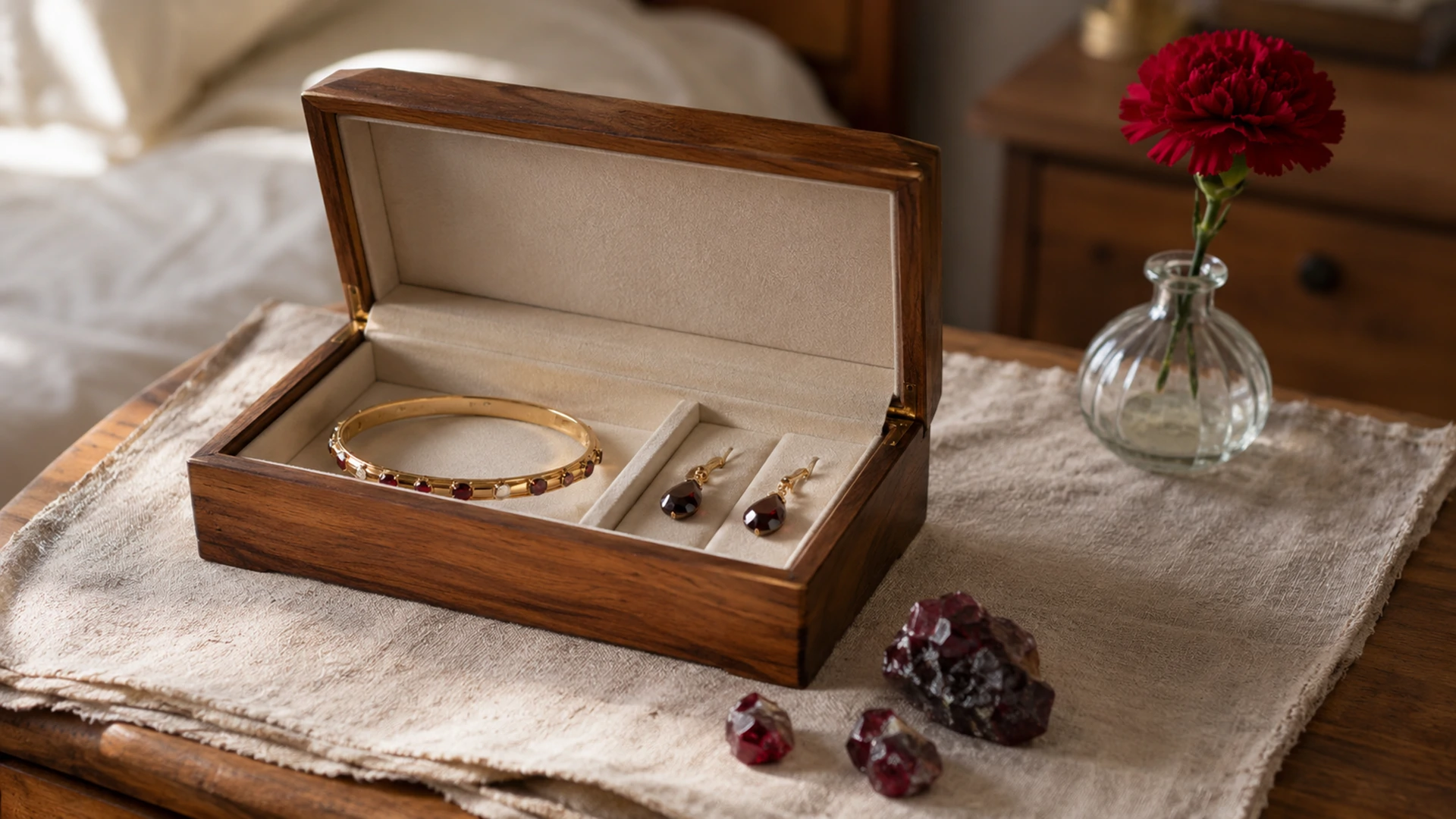
Garnet is one of the oldest and most enduring birthstones in recorded history, and it carries a particular kind of power for those born in January. This isn't just a pretty red gem assigned to a cold month by accident. The connection between Garnet and January runs through ancient lapidary traditions, astrological correspondence, and the energetic reality of what it means to begin a new year in the dead of winter. If Garnet is your traditional January birthstone, you have a stone that was essentially built for the tension you live in: the pressure to ignite, to move, to begin, when everything around you is still and frozen.
This article goes deep on what Garnet means specifically as a January birthstone, how to use it in ritual and daily life, and which stones pair best with it. Whether you're just starting to work with your birthstone or you've carried Garnet for years, there's something here to sharpen your practice.
What Garnet Means as the January Birthstone
January sits at the hinge of the year. It's a month of endings folding into beginnings, of resolution and inertia existing at the same time. In the Northern Hemisphere it's the coldest, darkest stretch of winter — and yet January carries this enormous cultural and psychological weight of new starts. That tension is real. And Garnet is the stone that speaks directly to it.
The assignment of Garnet to January is traditionally traced back to the Breastplate of Aaron described in the Book of Exodus, which listed twelve gemstones corresponding to the twelve tribes of Israel. Early biblical scholars and later medieval gem theorists built on this foundation, and by the time formal birthstone lists were being standardized — a development often credited to 18th-century Poland, where gem traders are said to have popularized the month-by-stone tradition — Garnet was firmly established as January's stone. The association was codified in the modern era by the National Association of Jewelers, which met in Kansas City and formally adopted the modern list in 1912. That organization is known today as Jewelers of America. The list is relatively recent, but Garnet's claim on January runs considerably deeper. January also has a modern alternative birthstone in Ruby — a stone with its own distinct magical character and a solar energy that contrasts sharply with Garnet's Mars-ruled fire.
January is governed by two zodiac signs: Capricorn (December 22 through January 19) and Aquarius (January 20 through February 18). Capricorn is an earth sign ruled by Saturn — disciplined, ambitious, sometimes cold in its relentless drive toward achievement. Aquarius is an air sign ruled by Uranus and Saturn — visionary, innovative, and occasionally detached from the emotional and physical body. Both signs share a particular challenge: they can get so locked into their mental frameworks — Capricorn's structure, Aquarius's idealism — that they lose touch with the raw life-force energy that actually drives things forward. Garnet addresses exactly that. Its fire-and-earth nature supplies the visceral fuel these signs need to move their plans from idea into embodied reality.
For a broader look at the magical and spiritual properties Garnet carries across all practices, the full guide to Garnet's correspondences, uses, and care covers everything from planetary alignment to cleansing methods. But birthstone work operates differently from general crystal work, and the distinction matters.
Working with Garnet as your birthstone isn't the same as picking it up for a single working. Garnet's Mars rulership and fire-and-earth nature aren't qualities you're borrowing — they map directly onto the energetic signature of the month you were born into. January is a Mars-flavored moment in the year: the pressure to act, to push forward, to survive the cold and build something despite it. Your root chakra is the seat of that survival drive, that instinct to plant yourself and endure. Garnet doesn't import those qualities from outside you. It finds them already operating in you and gives them somewhere to anchor. That's what makes birthstone practice different from using any red stone for courage: the correspondence runs inward, not just outward.
Garnet's Hardness, Care & Origins
Garnet isn't a single stone — it's a mineral family, and the varieties differ meaningfully in hardness, color, and origin. On the Mohs scale, most garnets land between 6.5 and 7.5. Almandine, pyrope, spessartine, and tsavorite sit at the harder end of that range. Demantoid, the vivid green variety prized in Victorian jewelry, runs softer. That range matters if you're choosing a stone for daily wear — harder varieties hold up better in rings and bracelets that take regular impact.
For cleaning, warm soapy water is always safe across all garnet varieties. Ultrasonic cleaning is generally fine for stones that are eye-clean and unfractured, but skip it for any piece with visible cracks or inclusions. Steam cleaning isn't recommended — the combination of heat and moisture can stress natural inclusions and weaken fracture-filled stones. If your garnet has been fracture-filled (a treatment used to improve clarity in lower-grade material), warm soapy water only, every time.
Major garnet deposits are found across Tanzania, Sri Lanka, Madagascar, Brazil, Russia, Canada, and the United States. Two varieties carry names that tell you exactly where they came from: tsavorite, the vivid green grossular garnet, takes its name from its discovery site near Tsavo National Park in Kenya. Spessartine, the orange-to-red variety, is named for the Spessart region of Germany, where it was first described. Both are now sourced globally, but those place-names stuck.
Ruby: January's Modern Alternative Birthstone
Garnet is January's traditional birthstone — the one with the deeper historical claim, the older documented use, and the lower price point that made it accessible to common people long before formal lists existed. Ruby is its modern counterpart, added as an alternative for those born in January who resonate with its distinct energy and are willing to invest in a considerably rarer stone.
The practical differences are real and worth knowing before you choose. Ruby sits at 9 on the Mohs scale, making it one of the hardest gemstones available — significantly more resistant to scratching than Garnet's 6.5–7.5, which is worth considering for a ring or bracelet you intend to wear daily. Ruby is also substantially rarer and more expensive than most garnet varieties, especially in quality sizes. A fine red garnet and a fine ruby may look similar in photographs, but they're not the same stone at any level — mineral, energetic, or practical.
Energetically, the two stones pull in different directions. Garnet is Mars-ruled, fire-and-earth in nature, and rooted in survival instinct, physical endurance, and the kind of courage that digs in and holds. Ruby is a Sun-ruled stone, all heat and radiance, associated with sovereignty, vitality, and the expansive confidence of someone who takes up space without apology. Both are red. Both carry fire. But Garnet's fire burns low and sustained, like coals that hold heat through the night — Ruby's blazes upward and outward.
For January-born practitioners, the choice often comes down to which energy you actually need. If you're Capricorn-dominant and your challenge is maintaining stamina and groundedness through long, difficult climbs, Garnet is your stone. If you're working on expansion, visibility, and the solar confidence to lead rather than endure, Ruby speaks to that more directly. You can also work with both — they're not in conflict. The full case for Ruby as a January stone, including its Capricorn astrological justification and ritual applications, is covered in the dedicated article on Ruby as a January birthstone.
How to Use Garnet as Your Birthstone in Magic Rituals
The rituals below are written specifically for birthstone practice. They lean into Garnet's core correspondences — fire energy, Mars rulership, root chakra activation, survival instinct, courage, passionate will, and regeneration — as expressions of your own inner force. These are not passive rituals. Garnet work asks you to show up with commitment.
Charging and Carrying Your Birthstone
The most foundational birthstone practice is also the most powerful one: charging your Garnet and keeping it on your body. Start by cleansing the stone — place it under running cold water for a minute, or leave it on a piece of Selenite overnight. Then, on a Tuesday (Mars's day) or on any day during the first week of January, hold the Garnet in your dominant hand. Sit somewhere quiet, close your eyes, and breathe slowly until you feel settled. Bring to mind the single most important thing you want to build or claim in the year ahead — not a list, one thing. Feel the drive behind it. Feel the hunger for it. As that feeling peaks, press the stone firmly into your palm and state aloud: "This is mine to build. I carry the fire." Hold that feeling in the stone for at least two minutes.
Carry the charged Garnet in a pocket against your body, in a bra, in a pouch worn around your neck, or in any piece of jewelry that touches skin. Recharge it at each new moon or whenever you feel your momentum flagging. The stone is a physical anchor for the intention you've loaded into it — every time you touch it, you're re-activating that charge.
Red Candle Ritual for Igniting New-Year Will
Garnet pairs most naturally with red candle magic — both carry Mars energy, fire element, and a direct correspondence to willpower, courage, and life-force activation. For this ritual, choose a red pillar or taper candle and dress it with a warming oil such as cinnamon or dragon's blood. If you work with inscriptions, carve a single word — your core intention for the year — into the wax before dressing it.
Set the candle on your altar or a fireproof surface. Place your Garnet at the base of the candle, touching it. Light the candle and sit with it for a minimum of fifteen minutes. Don't multitask — watch the flame. Let the warmth of the fire and the presence of the stone do what they're built to do: stir something alive in you. Speak your intention aloud three times, once at the lighting, once midway through your sit, and once before you close. Let the candle burn down fully if it's small, or snuff it and relight it across multiple sessions if it's a pillar. The Garnet stays at the candle's base for the entire working.
New Year Threshold Ritual
January is a threshold — a liminal crossing point — and Garnet is historically a stone of safe passage and protection during transitions. This ritual is timed to the first week of January, ideally the first or second day. Hold your Garnet in both hands and stand at the front door of your home — the literal threshold between your private world and the outside one. Face the door. Take a few slow breaths and let yourself feel the weight of the year that just ended. Acknowledge it briefly: what it took from you, what it gave you, what you're ready to leave behind.
Then turn and face into the room — into your home, your interior life, the year ahead. With the Garnet still in your hands, speak aloud what you are choosing to carry forward and what you are actively choosing to leave at the threshold. You are not asking for permission. You are declaring a crossing. When you're done, place the Garnet just inside the door — on a shelf, in a dish, or on the floor beside it — to mark the threshold as protected and intentional. You can move it after a week, but let it sit there as a guardian for the first days of the year.
Root Chakra Activation Practice
Garnet's primary chakra correspondence is the root chakra — the energy center located at the base of the spine that governs physical safety, survival instinct, groundedness, and the sense of having a right to exist and take up space. January-born practitioners, especially Capricorns who over-identify with achievement and Aquarians who live in abstraction, often run energetically top-heavy. This practice pulls the energy back into the body's foundation, where Mars-ruled drive can actually move something.
Lie flat on a mat or firm surface. Place your charged Garnet at the base of your spine if lying on your stomach is comfortable, or just below your navel if you're on your back. Set a timer for ten to fifteen minutes. Breathe into the lower belly, long and slow. With each inhale, feel the stone's weight pressing down into you — not warmth radiating inward, but pressure, the physical reality of something solid meeting the earth beneath you. With each exhale, extend roots: not as a soft visualization but as an act of will, a deliberate claim on the ground. You belong here. You are built to endure. Garnet's Mars-and-earth combination isn't about comfort — it's about stamina, the biological certainty that your body knows how to survive and push through. When the timer ends, sit up slowly. Notice the difference in how your legs feel, how your lower back settles. Do this practice any time you feel scattered, anxious, or unmoored from your sense of purpose — not to relax, but to re-anchor.
Shadow-Work Dream Practice
Garnet has a long traditional association with prophetic dreaming and with illuminating what is hidden — including the parts of yourself you'd rather not examine directly. This is supported both by its historical use as a traveler's protective stone (it was believed to light the way in darkness) and by its Mars correspondence, which in shadow work addresses suppressed anger, desire, and drive.
Before sleep, cleanse your Garnet and hold it briefly while naming aloud one thing you've been avoiding looking at honestly — a fear, a resentment, a desire you've dismissed, an aspect of your own behavior you haven't wanted to examine. You don't need to solve it. Just name it. Then place the Garnet under your pillow or on your nightstand within arm's reach. Keep a journal beside the bed. In the morning, write immediately upon waking — whatever you remember from your dreams, even fragments, even feelings with no images attached. Do this for seven consecutive nights. The Garnet isn't generating the dreams — it's holding the intention you've set to look honestly at yourself, and that intention shapes what your dreaming mind brings forward.
Protection Altar Placement
Garnet's protective function is one of its oldest documented roles. Historically worn by soldiers, travelers, and royalty as a ward against harm, it carries a specific kind of protective energy — not the boundary-setting, deflecting protection of Black Tourmaline, but an active, Mars-ruled protection that projects strength outward. On your altar or sacred workspace, place your Garnet in the south position — the directional quarter associated with fire, will, and active force. Surround it with symbols or items that represent what you are protecting: your health, your relationships, your creative work, your sense of self. You can dress the altar stone with a tiny drop of frankincense oil, which shares Garnet's protective and purifying function. Revisit this altar placement at each new moon to restate what you are actively choosing to protect and why.
Wearing & Carrying Garnet for Daily Protection
Garnet doesn't need a ritual to do its work in your daily life. Its root-chakra grounding and Mars-ruled fire translate directly into everyday energetic support — you just need to keep it close.
Jewelry
Wearing Garnet as jewelry is the most direct delivery method for its energy, because skin contact allows sustained resonance throughout the day. A Garnet ring on the right hand activates its outward, projective force — good for days when you need to push forward, assert yourself, or maintain courage in difficult interactions. A Garnet pendant worn at the chest brings its energy closer to the heart center, which can soften its intensity slightly and make it useful on days when you need sustained warmth and resilience rather than sharp drive. A Garnet bracelet or bangle on the wrist keeps it in your peripheral awareness without demanding as much of your attention. If you're choosing a variety for daily-wear jewelry, lean toward almandine or pyrope — the harder end of Garnet's range — for better durability in pieces that take regular impact.
In the Home
Place Garnet near the front entrance to maintain the protective threshold energy Garnet has carried historically as a guardian stone. The south-facing wall of any room is also a strong placement, given Garnet's fire correspondence.
In the Workspace
Keep a piece on your desk. Garnet's Mars energy supports sustained effort, decisive thinking, and resistance to the kind of fatigue that makes you procrastinate or abandon projects midway through. This is a stone built for long hauls, not quick wins — which makes it particularly useful during January's push to actually begin what you resolved to do.
As a Keepsake or Gift
Garnet has a specific historical role as a parting talisman — given by loved ones to travelers as a token and pledge of safe return, not simply a generic protective charm. If someone you love is leaving for an extended trip, a new city, or a difficult deployment, a piece of Garnet exchanged between you carries that tradition forward. The stone was understood to hold the bond across distance.
Its warrior associations also make it a meaningful carry for anyone walking into ongoing high-stakes situations — not just physical danger, but the sustained courage required in difficult workplaces, caregiving roles, or any environment that demands you show up and hold your ground day after day.
Garnet is also the traditional gemstone for second wedding anniversaries, a correspondence that reflects its character well. It's not about new love or courtship — it's about commitment that has been tested and held. If you're working magic around loyalty, long-term partnership, or the kind of love that digs in rather than burns bright and fades, Garnet is the stone for that working. No other January stone carries this particular resonance.
Garnet Crystal Combinations: What Pairs Well
Garnet and Carnelian: Both are fire-element stones with sacral and root chakra correspondences. Carnelian supplies creative drive and emotional momentum; Garnet supplies the grounded commitment that keeps that momentum from burning out. Together they cover the full arc of initiation — the spark and the sustained flame. This pairing is ideal for starting new creative or professional projects in January when you need both inspiration and staying power.
Garnet and Black Tourmaline: Both stones are strongly protective, but they operate differently. Black Tourmaline creates a deflective boundary that repels unwanted energy. Garnet projects outward strength that actively dissuades threat. Combined, they provide layered protection — boundary-setting and force projection — which is particularly useful for empaths or anyone who finds themselves energetically drained in crowds or high-stress environments.
Garnet and Hematite: Hematite is deeply grounding and earth-element, with a strong correspondence to physical stamina and mental focus. Garnet brings the fire and drive; Hematite ensures that energy stays earthed and doesn't burn chaotically. For January-born practitioners who tend toward Capricorn's relentless ambition or Aquarius's scattered mental energy, this pairing creates the combination of fire and iron — heat that holds its shape.
Garnet and Rose Quartz: This is a pairing of productive contrast. Garnet rules passionate, Mars-driven love — the kind that is fierce, embodied, and willing to fight for what it wants. Rose Quartz rules Venus-ruled, receptive, gentle love. Together they balance the full spectrum of heart energy: the courage to pursue and the softness to receive. This combination works especially well in love magic or self-love practices where you need both the will to open up and the tenderness to stay open.
Garnet and Clear Quartz: Clear Quartz is a universal amplifier — it doesn't add its own energetic agenda, it magnifies what's already there. Pairing it with Garnet amplifies Garnet's fire, courage, and protective force without changing the nature of the working. This is the pairing to reach for when you need Garnet's energy turned up — in high-stakes situations, during intensive ritual work, or when you feel like your birthstone connection needs a significant boost.
Your Birthstone Is a Relationship, Not Just a Tool
Garnet has been the January traditional birthstone for centuries because it matches what January actually asks of you. The coldest month of the year, the one with the most cultural pressure to begin, is governed by signs that can think their way into paralysis and plan their way past action. Garnet's Mars-ruled fire goes underneath all of that. It speaks to the root — the physical body, the survival instinct, the part of you that knows how to keep going even when conditions are against it. That's not a coincidence. That's the stone doing exactly what stones in this tradition are supposed to do.
What sets Garnet apart from any other red stone you might reach for is endurance. Not the flash of ignition, but the sustained burn. The rituals in this article, the daily carries, the pairings — all of them build on that quality. You're not using Garnet to manufacture drive you don't have. You're working with a stone whose Mars-and-earth nature reflects the specific will that January puts in you, and strengthening it through consistent practice.
Start with the charging practice. Get the stone in your hand, feel its weight, load it with one real intention, and carry it. Garnet rewards exactly what it's built to cultivate: showing up, holding your ground, and building something that lasts. The more you bring to the practice, the more it gives back.
If you want to see how Garnet fits alongside the other eleven months in the birthstone tradition — and why the month-to-stone correspondence holds up as a magical framework — the full breakdown is in the complete guide to every month's birthstone.