Moonstone: Intuition on a Cycle
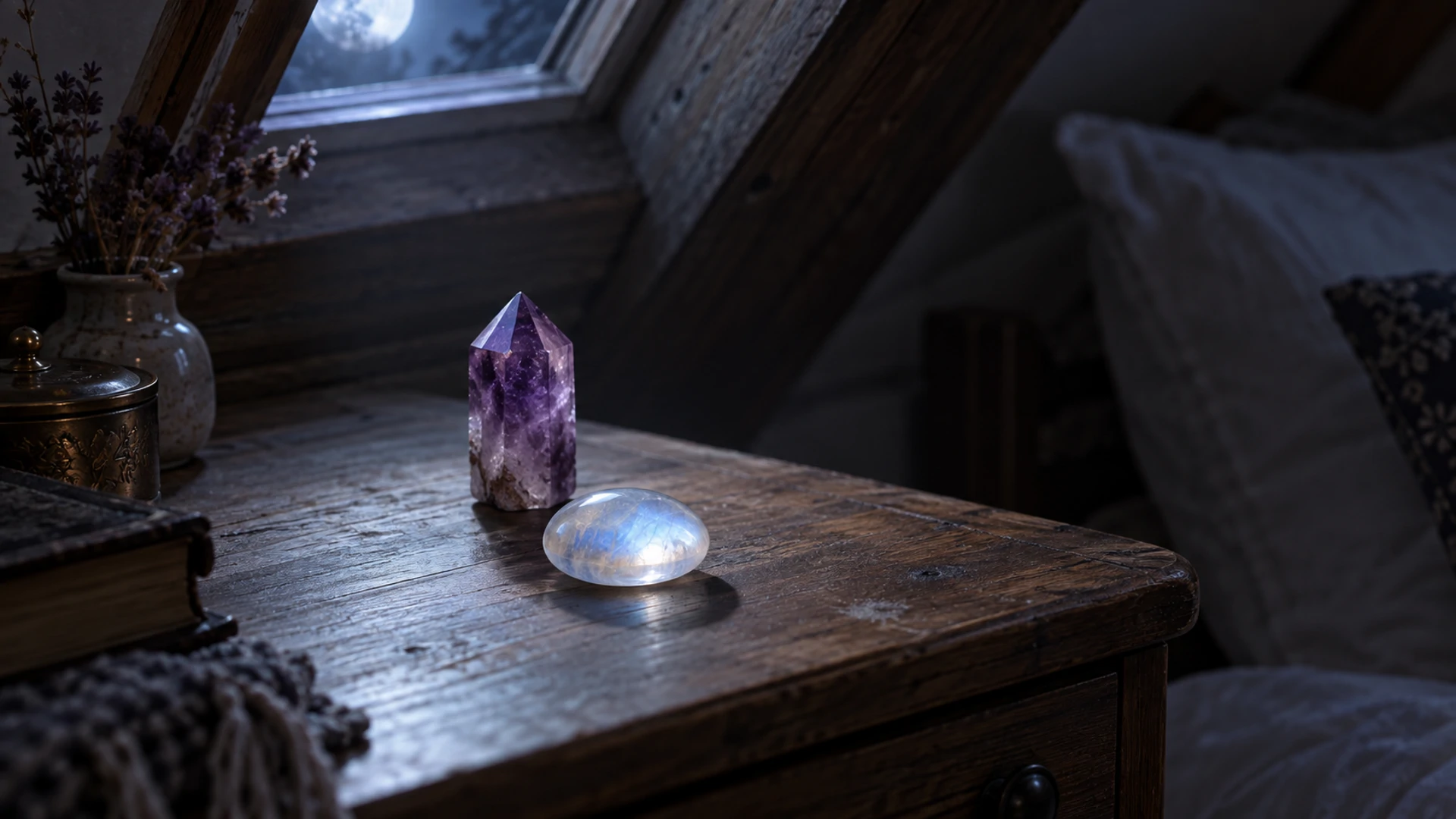
Moonstone's defining quality is that it works with your intuition the way the moon works with the tides: rhythmically, cyclically, in response to something larger than the individual moment. This is not a stone you charge once and carry as a constant steady broadcast. It's a stone you work with over time, across the full arc of a lunar cycle.
Intuition on a Cycle: Why Moonstone Belongs in Intuition & Psychic Development
Moonstone is a variety of feldspar, specifically an orthoclase feldspar that forms with thin intergrown layers of a second feldspar mineral, albite. Light entering the stone scatters between those alternating layers, producing the soft, billowing glow the gem world calls adularescence. It's not a surface flash. It's a light that seems to float just beneath the stone's skin, moving as you tilt it. That internal quality is worth understanding before you choose a specimen, because not everything sold as moonstone actually shows it.
Its governing body is the Moon, which makes its category placement straightforward. The mechanism that distinguishes Moonstone within the Intuition & Psychic Development category is cyclical, lunar-tied intuition: dream work and divination that ebbs and flows with lunar phases rather than staying at a fixed level. This is meaningfully different from what the other stones in this category do. Labradorite works by awakening dormant psychic ability while shielding the aura during that opening, a protector-and-awakener stone that holds its function regardless of the calendar. Celestite provides gentle, receptive contact with angelic and higher realms, the softest and most passive stone in this category, reaching up rather than reaching out. Moonstone does neither of those things. It doesn't awaken and shield simultaneously, and it isn't about reaching toward something above. It opens a channel inward, and that channel is widest at the full moon and narrowest at the new moon, with real gradations at every point between.
The primary chakras are the third eye and the crown. Some traditions also associate it with the sacral chakra, particularly for work around emotional cycles, creative fertility, and the body's own rhythms. Water is its element, which makes sense given the moon's relationship to tides and the flowing, impressionable quality of Moonstone's energy. None of these correspondences are incidental. They describe a stone that works at the level of perception, feeling, and cycle rather than at the level of intellect or force. If you're drawn to Moonstone because you want stronger, sharper insight on demand, it's worth pausing on that. This stone teaches a different relationship with knowing: one that involves waiting, noticing, and returning to questions across time rather than extracting answers in a single session.
Moonstone has a documented secondary correspondence with healing, specifically the kind of healing that supports emotional balance and works with the body's own rhythms, cyclical or hormonal. That secondary use is real and worth knowing. But the primary application, and the one most consistently cited across sources, is intuitive and psychic development. It belongs here not because it's calming (though it is) but because its core function is opening perception to impressions that arrive slowly, in layers, the way a dream gives itself up in pieces across a morning rather than all at once.
Adularescence, Not Labradorescence: Choosing Moonstone
The confusion between moonstone and rainbow moonstone is widespread enough that it's worth addressing directly. Rainbow moonstone is technically a variety of labradorite, not true moonstone. What it shows is labradorescence: a vivid, prismatic multicolor flash that plays across the surface of the stone in sharp, dramatic bands of blue, violet, green, or gold. It's striking, and it's a legitimate stone with its own properties. But it is not the same optical phenomenon as moonstone's adularescence, and the distinction matters when choosing a stone for lunar-cycle practice.
True moonstone, the orthoclase feldspar variety, shows adularescence: a soft, contained, billowing inner light that seems to float beneath the surface rather than flash across it. In good specimens it appears almost three-dimensional, like there's a pale light source suspended inside the stone. In classic white or gray moonstone the background is translucent to semi-transparent, and the glow is usually blue to white. In peach or golden moonstone the background warms and the adularescence is softer, sometimes barely there in lower-quality pieces. When you're shopping, tilt the stone under a single light source and watch how the glow moves. If it shifts with a broad, rolling quality, you have adularescence. If it flashes hard in specific bands of vivid color, you're likely looking at rainbow moonstone, which is labradorite.
Quality varies considerably. The finest moonstone, called "blue moonstone" or "cat's eye moonstone" in the trade, comes from Sri Lanka and shows a vivid blue adularescent glow against a colorless to near-colorless body. This material has become rarer and more expensive as deposits thin out. Indian moonstone is the most common on the market, often a peach or pale body color with a white to mild blue glow. Madagascar material tends toward the translucent gray end. All of these are genuine moonstone. Opacity is not a defect, but a more translucent stone will typically show cleaner adularescence.
On care: Moonstone sits at Mohs 6 to 6.5, which makes it moderately soft for a stone this commonly worn as jewelry. That rating means quartz, amethyst, citrine, and most other popular stones can scratch it on contact, so storing moonstone with your broader collection without separation is a real risk. Keep it in its own pouch or compartment. Avoid ultrasonic cleaners entirely, since the vibration can exploit existing fractures within the stone. A brief rinse under cool water is generally fine, but avoid soaking, harsh chemicals, and abrupt temperature changes, since the stone's internal layering can be stressed by sudden heat or cold. Wipe it with a soft cloth after handling and keep it out of situations where it's going to knock against harder materials.
Three Practices Timed to the Moon
The New Moon Question
This practice is for opening an intuitive inquiry at the new moon and following it through the cycle, rather than seeking an answer in a single sitting.
On the night of the new moon, sit in a quiet space with your moonstone in your non-dominant hand. The room can be dim or dark; you don't need candlelight for this, though a silver candle is a natural fit if you want one. Hold a single question in your mind, something you genuinely don't know the answer to, and state it aloud once. Then close your hand around the stone and sit with it for five to ten minutes without trying to receive anything. The new moon is not a time for reception; it's a time for seeding. Write the question down exactly as you spoke it, and set the stone on top of the paper where you'll see it daily. Over the following two weeks, before the full moon, note any impressions, dreams, or unexpected clarity that surfaces around that question, without forcing interpretation. The answers, when they arrive, tend to arrive sideways.
The Full Moon Dream
This is a bedside practice for deepening dream recall at the full moon, when Moonstone's cyclical strength is at its peak and the stone is most receptive to working with the subconscious.
Place your moonstone on your nightstand or just beneath your pillow on the night of the full moon. Before sleep, hold it briefly and recall the question or intention you set at the new moon if you're continuing that thread, or simply state that you are open to receiving whatever needs to come through. Keep a notebook and pen within reach. When you wake in the morning, do not reach for your phone or speak before writing. Even partial impressions, colors, emotional tones, or single images are worth recording. Moonstone works at the level of feeling and impression rather than literal narrative, so don't discount fragments. If you combine this with amethyst, which quiets mental noise into clear, sober perception and supports dream recall through calm rather than active awakening, place the amethyst at the crown end of your pillow and the moonstone at your side. The two stones work in complementary registers here without competing.
The Waning Release
This practice is for consciously releasing an intuitive impression or pattern that has run its course, timed to the waning moon when the energy naturally supports letting go.
Sometime between the full moon and the new moon, identify something intuitive you've been carrying that no longer needs your attention: a concern you've been circling, an impression that resolved, a hunch that played out or that you're ready to stop feeding. Hold your moonstone in both hands and name the thing aloud, specifically and plainly. Then set the stone down, leave it alone overnight, and in the morning rinse it briefly under cool running water, which both cleanses it and marks the release physically. This timing matters. Running this practice at the waxing moon works against its intent. The waning phase isn't a time of diminishment; it's a time of completion. Using Moonstone here is appropriate precisely because the stone understands that intuition isn't a ratchet that only accumulates, it contracts as much as it expands. You can pair this working with mugwort, burned as incense or kept nearby, since mugwort's long-standing association with lunar energy and psychic opening makes it a fitting companion for any moonstone work, and its bitter quality suits the releasing register of this particular practice.
Solidified Moonlight
Ancient Roman tradition held that moonstone was literally solidified moonlight. Not a metaphor, not a poetic parallel: the stone was understood to have formed directly from lunar light condensed into physical matter. This belief is documented as sincere tradition in Roman natural history writing, and it's worth presenting as exactly that, a tradition, rather than retrofitting modern mineralogical understanding onto it or dismissing it as superstition. The Romans were working with observable evidence. The stone had a soft, shifting inner glow that moved the way moonlight on water moves. It appeared and was named at a time when the moon's connection to tides, cycles, and the body's own rhythms was considered established knowledge rather than folklore. Calling it solidified moonlight was, in context, a reasonable interpretation of what was visibly there.
That origin story matters for understanding why Moonstone carries the specific correspondences it does rather than generic intuition associations. The Roman identification didn't travel forward as a vague "moon energy" label; it embedded itself into a specific set of uses: divination tied to lunar timing, dream-work that follows the lunar calendar, and an understanding that the stone's effectiveness isn't constant but cyclical. The solidified moonlight idea is also why Moonstone became known across multiple traditions as a Traveler's Stone, particularly for those journeying at night or on water, since traveling under the moon carried its own risks and the stone that embodied lunar light offered a kind of sympathetic protection. That protective travel association is the other face of this stone's history, distinct from but tied to its primary intuitive one.
Intuition That Moves With the Moon
Moonstone's cyclical mechanism is the thing that makes it genuinely interesting within the Intuition & Psychic Development category. It doesn't promise a permanent level of access to intuitive information. It offers a relationship with perception that changes shape across the month, which is a more honest model of how intuition actually works for most people. The practices here are timed to specific lunar phases for a reason: new moon for seeding, full moon for reception, waning moon for release. Working with that rhythm over several lunar cycles changes how you relate to your own knowing.
If you want to see how Moonstone sits alongside the other stones in this category, and alongside the six other categories of stone magic, the full Crystal Compendium: Seven Paths to Stone Magic is the place to go. Each category has its own logic, and seeing the whole map makes the individual stones' distinctions sharper.