Tanzanite: The Newest Awakening
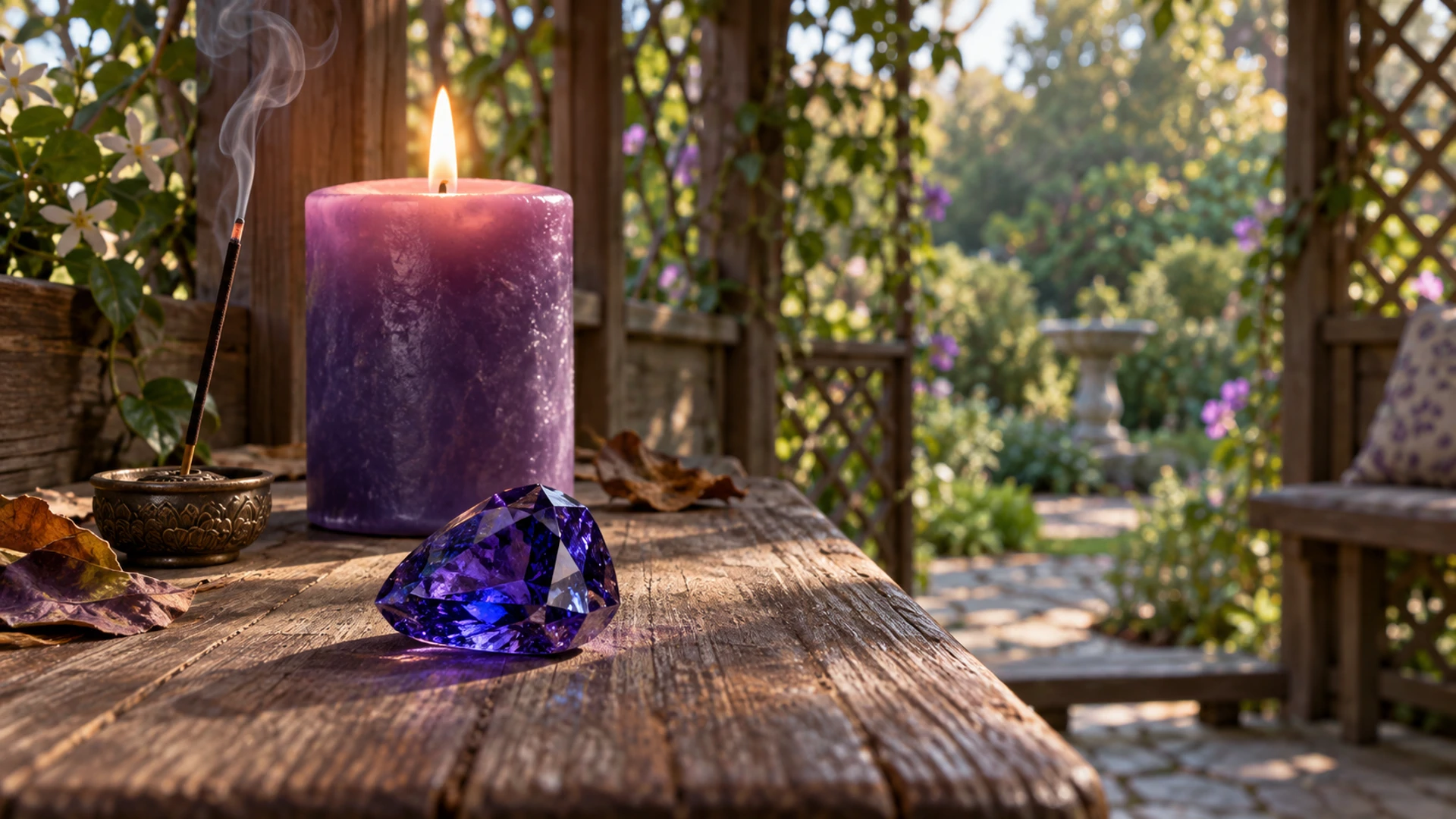
Tanzanite is a blue-violet variety of the mineral zoisite, found in exactly one place on Earth, and it works fast. Where most stones in the intuition and psychic development category open a single channel gradually, tanzanite moves across three at once — throat, third eye, and crown — in an accelerated shift that leaves you somewhere different than where you started.
The Newest Awakening: Why Tanzanite Belongs in Intuition & Psychic Development
There are stones that gently clear the way, and then there's tanzanite. Its mechanism in the intuition and psychic development category is rapid spiritual transmutation — the highest-intensity stone in this group, and the most recently formed as a metaphysical tradition. It bridges the throat, third eye, and crown chakras together in a single working rather than opening them one at a time, which makes it categorically different from stones that operate on one center or move in the background without demanding your attention.
To understand what makes tanzanite distinct, it helps to see what it isn't. Blue Kyanite operates through instant, self-maintaining chakra alignment — it never needs cleansing, and cuts through confusion via its blade-like structure to open honest communication. That's a passive, structural process. It works whether or not you're actively engaged with it. Amethyst works by quieting mental noise into clear, sober perception — psychic reception through calm rather than active awakening. Neither of those describes tanzanite. Tanzanite asks you to show up for the shift. It's not a background current. It's a threshold.
The three-chakra span is the core of what this stone does. At the throat, it opens honest expression — the ability to say what you're perceiving rather than holding it inside. At the third eye, it sharpens vision and accelerates the reception of insight. At the crown, it connects the individual mind to something larger. When all three are working simultaneously, you get a stone that doesn't just open you — it asks you to receive, understand, and articulate in one continuous motion. That's unusual. Most intuition work is sequential. Tanzanite compresses it.
Mineralogically, tanzanite is a blue-violet variety of zoisite, colored by vanadium, with a Mohs hardness of 6 to 7. It forms in a narrow metamorphic belt in the Merelani Hills near Mount Kilimanjaro in Tanzania — nowhere else on Earth. The deposit is geologically singular. No equivalent formation exists on any other continent. That scarcity isn't a marketing claim; it's a fact of the planet's mineralogy. Every piece of genuine tanzanite, regardless of quality or price point, comes from the same few miles of Tanzanian earth.
Correspondences: throat, third eye, and crown chakras as a linked triad. Water element. Neptune, which governs dissolution of ego boundaries and contact with the transpersonal. The stone is a modern birthstone for December, alongside turquoise and zircon. Its planetary and elemental correspondences put it firmly in the receptive, dissolving register of intuition work — but unlike softer Neptune-aligned stones, tanzanite doesn't let the process unfold on its own timeline. The intensity is its defining character.
Always Treated, Never Duplicated Elsewhere: Choosing Tanzanite
Before anything else about quality: virtually all commercial tanzanite has been heat-treated. The mineral comes out of the ground in a dull brown to burgundy, and gentle heating — typically to around 600 degrees Celsius — converts it permanently to the blue-violet color the market knows. This isn't an exception or a disclosure flag in the way fracture-filling is for emeralds. It's universal, standard, and stable. The color produced by heat treatment doesn't revert. When you're buying tanzanite, you're buying heat-treated tanzanite. That's the stone.
What to look for beyond that: the color range runs from a pale violet-blue to a deep, saturated blue with violet undertones. The deeper and more evenly saturated pieces are rarer and more expensive. Tanzanite is also pleochroic — meaning it shows different colors depending on the angle you hold it, shifting between blue, violet, and a reddish burgundy. That optical quality isn't a defect. In practice, it's part of what makes the stone work well for the kind of multi-angle perception it's associated with in ritual use.
Because the deposit is singular and finite, geological rarity is built into every piece regardless of grade. A small, pale, commercial-grade tanzanite tumble and a museum-quality faceted gem come from the same strip of earth. That doesn't mean price doesn't reflect quality — it does — but it means the scarcity argument applies across the board. The Merelani Hills are not an inexhaustible source. Estimates have put the remaining supply at somewhere between a few decades to a generation. Whether or not that timeline is exact, tanzanite is not a stone whose supply is expected to grow.
On care: tanzanite is genuinely fragile for a prized gemstone. At Mohs 6 to 7, it sits in a similar vulnerability range to opal and pearl — stones that most people intuitively treat carefully. Avoid ultrasonic cleaners, which can fracture it internally. Avoid sudden temperature changes, which stress the crystal structure. Store it separately from harder stones, particularly anything Mohs 8 and above, which will scratch it. Brief water contact is fine, but keep it away from prolonged soaking, harsh chemicals, and anything that generates heat suddenly. If you're setting tanzanite in jewelry for regular wear, a protective bezel setting is worth considering over prongs that leave more of the stone exposed to impact.
Three Practices for a Fast-Moving Shift
The Rapid Opening
Use this practice when a spiritual awakening or period of intense insight is already underway and you need a structured channel for it rather than an attempt to slow it down.
Sit quietly with the tanzanite held at the center of your chest. Spend the first few minutes simply breathing and letting the stone warm in your hand. When you feel settled — not calm necessarily, but present — move it to your forehead and hold it there for five to ten minutes. You're not directing anything. You're giving the shift somewhere specific to move through rather than letting it diffuse. Close by returning the stone to your chest and speaking one sentence aloud about what you're experiencing, even if it's incomplete. The act of forming language around a fast-moving intuitive experience is what grounds it. You can work this during a Moon hour if you want to layer lunar receptivity into the practice, or during a Saturn hour if you want the structure to feel more binding and contained.
The Three-Point Bridge
Use this practice when you've received an insight — in a dream, during meditation, or in a moment of clarity — that you understand but haven't yet been able to articulate.
Set a purple candle in front of you and hold the tanzanite loosely in both hands. Begin at the crown: place the stone on the top of your head for two or three minutes with eyes closed, receiving. Move it to your forehead for the same duration, this time asking internally: what does this mean? Finally, bring it to your throat and hold it there while you speak aloud — in full sentences, to no one in particular — what the insight is and what it asks of you. The sequence doesn't need to produce something polished. The point is to complete the circuit from reception to comprehension to speech in a single sitting, using the stone's three-chakra correspondence as the map. Burning a small amount of frankincense before you begin clears the space and marks the working as intentional.
The Grounded Intensity
Use this practice during periods of unusually high spiritual activity — when you're receiving more than you can easily integrate and need to stay functional rather than flooded.
Hold the tanzanite in your non-dominant hand and a grounding stone in your dominant hand — black tourmaline or smoky quartz both work well. The pairing is intentional: tanzanite keeps the upper channels open and active, while the grounding stone keeps the root engaged so you don't lose your footing in the physical. Sit for ten to fifteen minutes and breathe slowly, resisting the urge to analyze or chase any particular thought or image. At the end, put both stones down, eat something small, and do something ordinary for a few minutes before returning to your day. This practice works especially well in the days following a strong ritual, a significant dreamwork session, or any period of sustained energetic exposure. The goal isn't to reduce the intensity — it's to stay present with it rather than being swept past your capacity to absorb it.
Found in 1967, Named a Year Later
Tanzanite was discovered in 1967 in the Merelani Hills near Mount Kilimanjaro, in what was then newly independent Tanzania. Tiffany & Co. acquired the rights to introduce it to the American market and named it tanzanite the following year — after the country, a choice that was as much marketing as geography, but one that stuck permanently. Before the Tiffany name, it had been catalogued under the less memorable designation "blue zoisite."
The popular story of the discovery involves Masai herders who reportedly came across blue crystals after a lightning-sparked grass fire swept through the hills and transformed the dull brown stones in the earth. It's a compelling story, and it circulates widely. It should be understood as popular legend rather than settled history. Accounts of the discovery differ meaningfully — some eyewitness versions don't mention fire at all — and gemologists have raised questions about whether a grass fire could reach the sustained temperature needed to produce the color change that heat treatment achieves in a controlled setting. What is officially documented is that the Tanzanian government, in 1984, credited a local miner named Ndugu Jumanne Ngoma as the discoverer. The fire story may have elements of truth, or it may be the kind of origin myth that attaches to remarkable stones. What's certain is that the actual discovery remains contested enough that no single version should be presented as confirmed fact.
Tanzanite's rapid rise from obscurity to one of the most recognized gemstones of the twentieth century happened almost entirely through Tiffany's promotional campaign. It was the company's first major gemstone promotion since it championed tanzanite's launch — a deliberate effort to establish a new stone in an industry built on ancient names. That history is worth knowing because it shapes how the stone's metaphysical tradition developed: tanzanite entered the crystal-healing world while it was simultaneously being established as a luxury gem. Its associations with spiritual transmutation, high-frequency energy, and accelerated awakening all developed in the late twentieth century, a tradition measured in decades rather than millennia. That's not a disqualification. It's just an honest account of the stone's timeline.
Awakening Without the Wait
What tanzanite offers is specific: a fast, high-intensity bridge across three chakra centers, for practitioners who are ready to move through spiritual opening rather than approach it slowly. It's not a stone for hesitant first steps. It's the stone you reach for when something is already opening and you want to meet it directly rather than manage it from a distance.
If you want to see how tanzanite fits alongside every other stone in this category — and how the intuition and psychic development path sits among the six other paths in crystal magic — The Crystal Compendium: Seven Paths to Stone Magic is the place to go. Every cluster, every mechanism, every category — all mapped in one place.