Alexandrite: Two Truths at Once
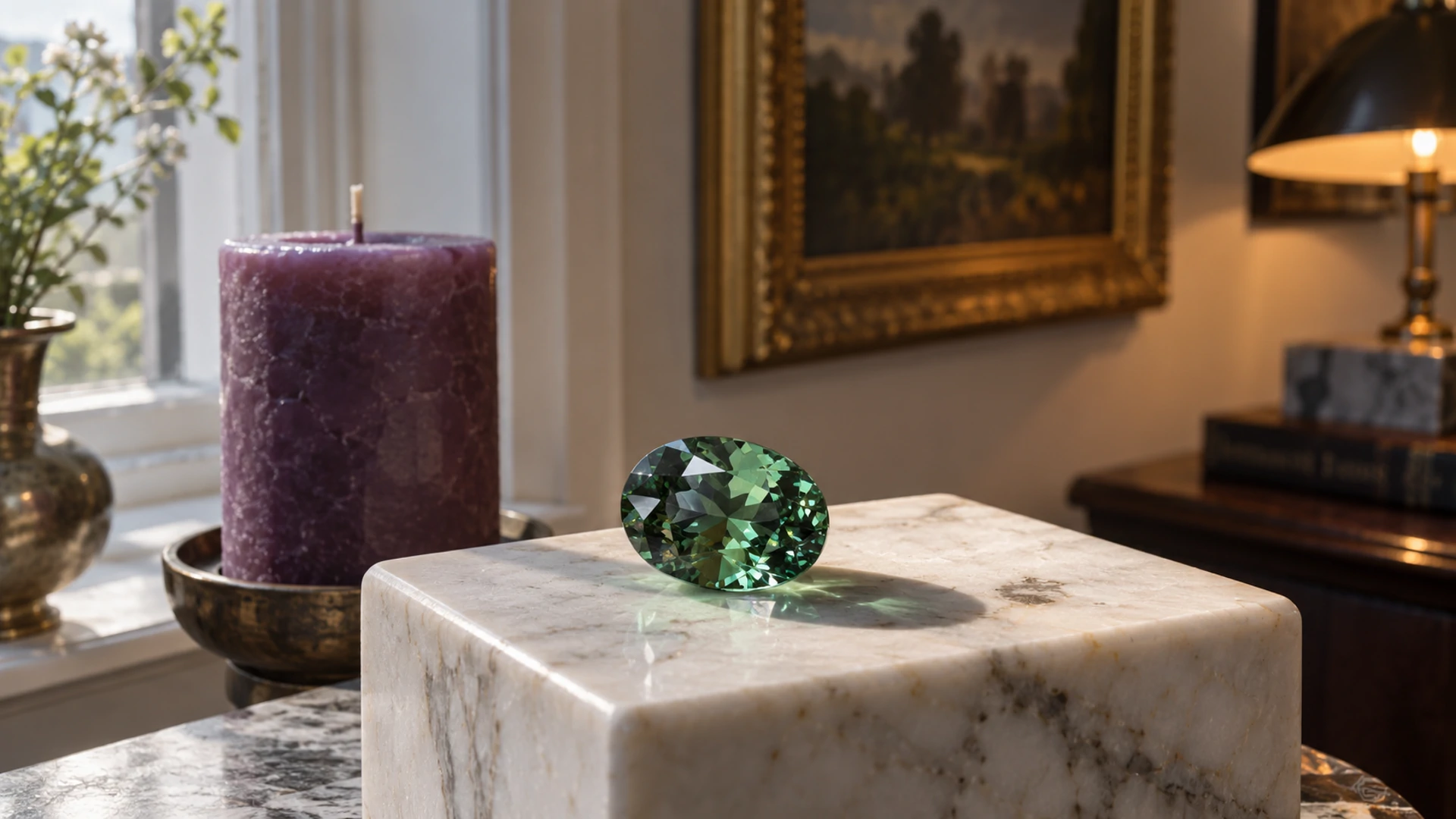
Alexandrite holds two genuinely different realities at the same time — green in daylight, red by incandescent light — and its value in intuition work comes directly from that. It is a stone for discernment when both readings of a situation are true.
Two Truths at Once: Why Alexandrite Belongs in Intuition & Psychic Development
Alexandrite is a chromium-bearing variety of chrysoberyl. Its signature "alexandrite effect" — the dramatic color change from green in daylight to red under candlelight or incandescent light — isn't a surface coating or optical illusion. It comes from chromium's unusual relationship with light. Chromium atoms absorb light strongly in two bands of the visible spectrum, and the precise balance of what gets through depends entirely on the light source hitting the stone. Daylight is rich in short-wavelength green light, which passes. Incandescent light is weighted toward longer red wavelengths, which also pass. The stone doesn't change — the light does, and chromium is sensitive enough to register both readings faithfully. That's the physical mechanism. In magical practice, that mechanism becomes the stone's defining virtue: not picking one truth and discarding the other, but holding both with equal clarity.
This puts alexandrite in a specific position within the Intuition & Psychic Development category, distinct from every stone around it. Labradorite works by awakening dormant psychic ability while shielding the aura during that opening — its mechanism is the protector-and-awakener, for those beginning to access what was always there. Moonstone moves through cyclical, lunar-tied intuition — dream work and divination that ebbs and flows with lunar phases rather than staying constant. Alexandrite does neither. It doesn't unlock something new or ride a rhythm. It holds two already-existing, simultaneous readings of a single situation without collapsing them into one verdict. This is the stone for when you are not confused — when you can genuinely see two valid angles and the question is how to act with both in view, not how to choose which to suppress.
The correspondences across sources reflect that complexity. Both the heart chakra and the crown chakra are consistently named for alexandrite, and some traditions place the third eye alongside or instead of the crown. This isn't an unresolved error — it reflects the stone's actual scope. The heart chakra connection speaks to its role in navigating transformation with emotional honesty, the recognition that two feelings can both be real at once. The crown connection speaks to the higher perspective required to hold both without collapse. The third-eye reading overlaps with that: active perception of what is rather than what you'd prefer to see. There is no single settled pairing across traditions, and the variation itself is worth knowing — the stone resists being reduced to one function, which is consistent with everything else about it.
In terms of elemental and planetary associations, water and fire are both cited, again reflecting the stone's dual nature. The water current carries emotional depth and adaptability; fire carries will and transformation. No single planetary ruler dominates the literature for alexandrite, but its role in self-discipline and navigating major personal change places it in the general orbit of transformative practice. What is consistent is that this stone is suited for periods of real upheaval — moments when you are genuinely mid-transition and need to see where you came from and where you're going at the same time, without letting either view cancel the other.
Rare Enough to Fake: Choosing Alexandrite
The first thing to understand about alexandrite on the market is that natural, gem-quality material is genuinely rare and genuinely expensive. The original Russian Ural Mountain deposits that produced the finest historic specimens are largely exhausted. Modern natural alexandrite comes primarily from Brazil, Sri Lanka, and parts of East Africa, and high-quality pieces with a strong, distinct color change command prices per carat that place them firmly in the category of serious gemstones. If a piece of alexandrite is affordable in the way that, say, a piece of amethyst is affordable, it is almost certainly not natural.
The market offers three things under the alexandrite name: natural alexandrite, lab-created synthetic alexandrite, and entirely different stones — most commonly color-change garnet or color-change sapphire — sold as substitutes or occasionally mislabeled. Lab-created alexandrite is chemically and structurally very close to the natural stone and will show a genuine, often vivid color change. Color-change garnet and color-change sapphire are different minerals entirely that happen to share a similar visual trick under different light sources; they are not alexandrite by any definition. If the origin and creation method of your stone matters to your practice, ask directly. A reputable seller should tell you whether a stone is natural, synthetic, or a substitute without hesitation. In magical terms, you will need to decide for yourself whether natural origin is essential to your work — many practitioners work effectively with lab-created material, while others feel the natural rarity and ancient formation of a stone carries weight that cannot be replicated.
On care: alexandrite is exceptionally durable for a gemstone, sitting at Mohs 8.5 on the hardness scale. This makes it suitable for daily wear without the fragility concerns that come with softer stones. It is water-safe, with no toxicity concerns for handling or wearing. There is nothing chemically reactive about it the way there is with, for example, malachite or pyrite. Brief rinsing is fine. The main practical caution is the same one that applies to any fine gemstone: store it separately from harder stones that could scratch its surface, and avoid sustained exposure to strong heat, which can theoretically affect color in certain treated stones. Natural alexandrite needs no special cleansing method beyond what you would use for any durable stone — moonlight, smoke, or sound all work cleanly.
Three Practices for Holding Two Readings
The Second Angle
Use this practice when you've already formed a reading of a situation but recognize you may be anchored to it too early, before a second, equally valid interpretation has had room to surface.
Hold the alexandrite in your dominant hand under natural daylight or near a window, so the stone shows green. State your current reading of the situation aloud — as plainly as you can, without softening or hedging. Then move to a space lit by warm incandescent light, or light a candle (a purple candle works well for clarity work), and hold the stone again so the red comes through. Now state the opposite reading — not the reading you believe, but the one you've been dismissing. Say it as though it is also true, because for this exercise it is. Sit with the stone through both readings before you decide anything. You are not looking for a third, compromise answer — you are training yourself to hold both without immediately picking a side.
The Threshold Change
Use this practice when you are already inside a major life transition — not anticipating one, but living through it — and need a physical anchor for the movement you're in.
Hold the alexandrite in both hands. Begin in a lit space — daylight if possible — and spend a few minutes looking at the stone's green, observing it as a record of where you were before the change began. Let that green represent what was real and true in that previous chapter; do not diminish it. Then move to a warm lamp or candlelight — a single gold candle is clean for this — and watch the stone shift to red. Let the red represent what is real and true in what's becoming. The practice isn't about grief or excitement; it's about seeing both clearly, in sequence, as equally valid states that belong to the same stone. You can do this daily during the transition period, brief and unfussy, as a way of staying oriented across the threshold rather than collapsing into only one side of it.
The Held Duality
Use this practice for decisions where two things are genuinely true at the same time and neither should be dismissed to make the choosing easier.
Set the alexandrite on your altar or working surface. Light candles on either side of it — one in a cool-toned color for the first truth (white or blue), one in a warm-toned color for the second (amber or red). Write each truth on a separate piece of paper and place one under each candle, with the alexandrite between them. You are not building toward a synthesis — the stone's role here is not to merge the two truths into one more comfortable one. Sit with the configuration and write, in a journal, every implication of each truth separately. Then write what you would need to carry both into whatever decision comes next. The duality is not a problem to solve; it is the actual terrain. If you work with Venus hour timing, this practice fits — Venus governs honest relationship with what is genuinely valued, which is what this working requires.
Named for a Young Tsar
Alexandrite was discovered in Russia's Ural Mountains in the early 1830s by the mineralogist Nils Gustaf Nordenskiöld. The initial identification was wrong: the stone was brought in as emerald. It was only under different lighting conditions — likely candlelight after the daylight examination — that its dramatic color change became visible and made clear this was something entirely different. A green stone that bled into red under warm light had no precedent in the established gem trade at the time.
The stone was named for the young man who would become Tsar Alexander II of Russia. Sources vary on exactly what occasion the naming was tied to — some accounts link it to his coming of age, others to other milestones in his early life — and asserting a specific date would mean picking one version of a story that has circulated in different forms. What is consistently reported across accounts is the reason the stone resonated nationally: its green-in-daylight and red-by-candlelight colors exactly mirrored the military colors of Imperial Russia. That symmetry gave the discovery immediate cultural weight. A gemstone found in Russian soil, named for the heir to the Russian throne, wearing Russian military colors depending on how you looked at it — that combination mattered in ways that went beyond mineralogy. Alexandrite became a stone of Russian national identity almost immediately after its discovery, and remained associated with imperial prestige through the 19th century. The original Ural deposits that produced the finest material are now largely depleted, which is part of why the finest historic Russian specimens remain especially prized among collectors.
Discernment That Doesn't Force a Single Answer
Alexandrite's place in the Intuition & Psychic Development category isn't about opening something dormant or deepening a receptive state. It's about the specific, demanding capacity to hold two valid perspectives on the same situation without collapsing one to make the other more comfortable. That is a different kind of intuition work — less about receiving and more about sustaining complexity long enough to act wisely within it.
If you want to see where alexandrite sits relative to the other stones in this category — and the six other categories that stone magic moves through — the Crystal Compendium: Seven Paths to Stone Magic is where that map lives.