Moonstone, the June Birthstone: The Inner Light That Shifts
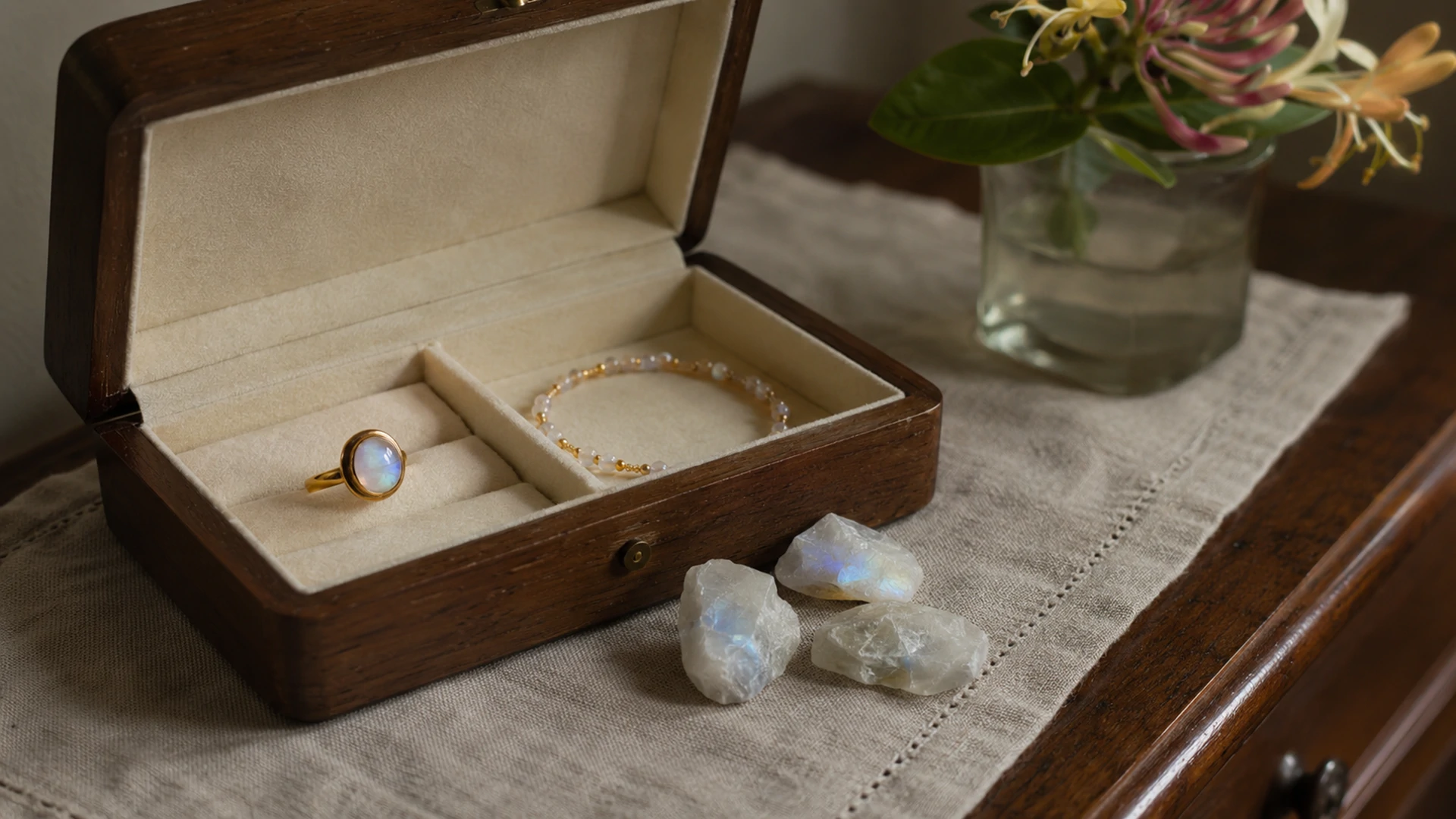
Moonstone is one of the most quietly powerful stones in any magical toolkit, and if you were born in June, it carries a layer of meaning that goes well beyond its general correspondences. Along with pearl, Moonstone is one of June's two Traditional birthstones — both appeared on the original 1912 list codified by the American National Retail Jewelers Association, and both carry centuries of cultural weight that long predates that formal assignment. Alexandrite joined the month's roster decades later in 1952 as a Modern addition. Moonstone's claim to June is older and deeper than it's often given credit for. This article is going to help you understand it, use it, and make it yours.
What Moonstone Means as the June Birthstone
June sits at a hinge point in the year. In the Northern Hemisphere, it holds the summer solstice — the longest day, the fullest expression of solar energy — but it opens in the sign of Gemini and closes in Cancer. That dual quality is important. Gemini (May 21 – June 20) brings sharp intellect, social fluency, and a restless drive to process everything through language and thought. Cancer (June 21 – July 22) brings emotional depth, intuition, and a powerful need to feel safe. Moonstone as one of June's Traditional birthstones bridges exactly that tension: it is a stone of emotional intelligence, of knowing without being able to fully explain how you know, and of trusting the inner life that Gemini can sometimes talk over.
Historically, Moonstone's link to June runs through its lunar rulership. The stone's adularescence — that moving, billowing glow inside the crystal — was understood by ancient Roman and Greek cultures as captured moonlight. Pliny the Elder wrote about it in the first century CE, noting that its inner light shifted with the phases of the moon. In Hindu tradition, Moonstone is considered a sacred stone made of solidified moonbeams, associated with the moon god Chandra and given as a traditional wedding gift. By the time the 1912 birthstone list was formalized, Moonstone was already culturally embedded as a June stone — pearl took the primary position alongside it, but Moonstone's lunar resonance with the month had been established across civilizations for well over a thousand years before that list existed. For a deeper look at how birthstone traditions developed across history, Birthstones: History, Magic, and How to Use Yours is worth reading alongside this article.
What makes Moonstone distinctly itself — as a June stone, not just a lunar one — is adularescence. That inner light isn't surface shimmer; it's caused by the way microscopic layers of feldspar within the stone scatter light as it passes through. Ancient cultures didn't have the mineralogical vocabulary for this, but they recognized what it expressed: something alive inside the stone, something hidden that reveals itself only under the right conditions. That quality maps precisely onto what Moonstone does magically. For June-born practitioners, it most often surfaces themes of emotional clarity, intuitive accuracy, and the willingness to let feeling be a legitimate source of knowledge rather than noise to manage. The stone doesn't import a foreign energy into your practice. It reflects back what's already in you, the way its inner light reflects back the moon.
Moonstone's core magical correspondences support all of this directly. It is ruled by the Moon and the element of Water. Its primary domains are intuition, emotional balance, cycle awareness, the subconscious mind, feminine energy, and psychic receptivity. It is strongly associated with new beginnings — particularly the kind that require you to trust something you can't yet fully see. For June birthdays landing in Gemini, Moonstone offers grounding in feeling when the mental chatter gets loud. For those landing in Cancer, it deepens and steadies the emotional sensitivity that is Cancer's greatest strength and sometimes its greatest vulnerability.
Moonstone's Hardness, Care & Origins
Moonstone is a feldspar mineral, sitting at 6 to 6.5 on the Mohs hardness scale. That puts it in a useful middle range — durable enough for daily wear in a protected setting, but worth treating with some care. The main vulnerability isn't surface scratching so much as internal cleavage: moonstone has natural fracture planes inside it, and a sharp knock against a hard edge can chip or crack the stone along those lines. Rings in active daily use are fine; just avoid situations where the stone is likely to take a hard impact. Avoid ultrasonic cleaners entirely — the vibration can exploit those internal planes. Skip sudden temperature changes too. For regular cleaning, mild soap and lukewarm water with a soft cloth is all you need.
Sri Lanka produces the finest moonstone by wide consensus — the classic variety with a floating blue adularescence against a near-colorless or white body has come from Sri Lanka for centuries, and it remains the historically dominant source. India produces moonstone too, typically with a more pronounced body color and an orange or brown adularescence rather than blue. Madagascar and Tanzania both yield high-quality material. Small deposits exist in the United States as well, mostly in Virginia and New Mexico. If you're sourcing deliberately for magical work, Sri Lankan moonstone is worth seeking out for the clearest expression of the stone's traditional optical character — that blue interior glow is the quality Pliny was writing about, and it's the closest visual equivalent to what ancient cultures were calling captured moonlight.
How to Use Moonstone as Your Birthstone in Magic Rituals
Charging and Carrying Your Birthstone
The most foundational practice for any birthstone is charging it to your personal frequency and then keeping it in consistent contact with your energy field. For Moonstone specifically, the most potent charging method is lunar: place your stone on a windowsill or outside on the night of a full moon, ideally in direct moonlight. Hold the stone before you set it down and state — out loud or clearly in your mind — what you want it to attune to. For June birthdays, effective anchors include emotional clarity, trust in intuition, or simply the intention that the stone align with your highest self. Leave it overnight. If you can do this on the full moon closest to your birthday, the resonance is even stronger. Once charged, carry it in a left pocket or wear it against your skin. The left side of the body is traditionally the receptive side — the side that draws energy in — so carrying it there supports the stone's role as an amplifier of your inner perceptive faculty rather than a broadcaster outward.
Silver Candle Ritual for Intuitive Clarity
Moonstone pairs most naturally with a silver candle, which shares its lunar rulership and its association with psychic awareness, reflection, and the subconscious. For this ritual, choose a quiet evening — ideally when the moon is waxing or full. Set your silver candle in a holder and place your charged Moonstone directly in front of it, close enough that the candlelight catches the stone's adularescence. Before you light the candle, hold the stone in both hands and breathe slowly and deliberately for several breaths, letting your mind quiet. When you feel settled, light the candle and simply watch — the light moving through the Moonstone, the flame's reflection in it. Let your mind drift rather than direct. This ritual works as a form of scrying: questions held loosely in mind during this kind of open, receptive focus often yield answers that come not as words but as sudden knowing. Sit with it for ten to twenty minutes, then ground yourself before blowing the candle out. Record anything that came up, even if it doesn't immediately make sense. If you want to charge your candle before the ritual for added intention, do so by anointing it with jasmine or sandalwood oil, both of which share Moonstone's lunar and intuitive properties.
Summer Solstice Threshold Ritual
June contains the summer solstice, and for Cancer-born or Gemini-born practitioners this threshold is cosmically significant — it's a moment when the year tips from expansion into depth, from light reaching outward into light beginning to turn inward. A solstice intention ritual with Moonstone honors that threshold directly. On the evening of the solstice, sit outside if possible — or near an open window — just after sunset. Hold your Moonstone in your dominant hand. The solstice is a moment of balance between the solar and the lunar, the visible and the hidden, so this ritual is specifically about naming what you want to cultivate in the second half of the year: not goals, but qualities. Name the emotional or intuitive qualities you want to deepen between now and the winter solstice. Speak them into the stone, pressing your intention into it with each breath. Then place the stone at the threshold of your home — on a windowsill facing the direction of the setting sun, or on your doorstep — and leave it there overnight. Bring it in at sunrise. This charges the stone with the solstice transition energy and makes it a carrier of your half-year intention.
Third Eye Activation Practice
Moonstone carries a genuine correspondence with the third eye chakra — the energy center at the center of the forehead associated with intuition, psychic perception, and inner vision. This makes a third eye placement practice not just appropriate but quite potent for June birthdays, who are often navigating the tension between Gemini's analytical mind and Cancer's deep gut-knowing. Lie down in a quiet space. Place your charged Moonstone gently on your forehead, at the point between and slightly above your eyebrows. Close your eyes. Breathe steadily and direct your attention inward and upward — not straining, just orienting. Notice whatever arises: images, sensations, emotional impressions, color. Don't analyze during the practice; just observe. Stay for ten to fifteen minutes. When you finish, sit up slowly and spend a few minutes writing down whatever you noticed before the analytical mind has a chance to dismiss it. Done regularly — weekly or at each moon phase — this practice builds the kind of sustained intuitive access that Moonstone as a birthstone is specifically designed to support in June-born practitioners.
Dream Work and Subconscious Integration
Moonstone has one of the strongest traditional associations with dream work of any crystal, and this is deeply supported by its lunar rulership — the Moon governs the subconscious, sleep, and the imagery that surfaces when the waking mind relaxes its grip. For June birthdays, particularly those born under Cancer, the dreamscape is often already an active space. Moonstone can help you access it more deliberately. Keep a charged piece of Moonstone under your pillow or on your nightstand within arm's reach of where you sleep. Before you go to bed, hold the stone for two to three minutes and state a clear question or theme you want your dreams to address — not too specific, but directional. Something like: what do I need to understand about this situation, or what am I not seeing clearly right now. Then set it down and let sleep come naturally. Keep a journal and pen on your nightstand and write immediately upon waking, before you do anything else — even before checking your phone. The first few minutes of waking are when dream memory is most accessible. Over time, consistent Moonstone dream work tends to produce a recognizable symbolic language personal to you, which is one of the most practically useful things you can develop as a practitioner.
New Moon Altar Practice for Emotional Renewal
The new moon is Moonstone's most potent lunar phase for fresh-start work, and for June-born practitioners it carries an additional layer — Cancer is ruled by the Moon, so Cancer season new moons are especially charged for emotional renewal and course-correction. Set up a small altar or dedicated surface for this practice. At the center, place your Moonstone. Around it, add any elements that feel personally meaningful: a candle in white or silver, a small bowl of water, flowers, or a written intention. On the night of each new moon, sit with this altar for a few minutes in stillness, holding the stone. Use this time not to ask for things but to release: name one emotional pattern, one fear, or one narrative about yourself that you want to let go of in this lunar cycle. Speak it clearly and then set the stone down, letting the stone hold the release while the moon's new cycle begins. Refresh the altar monthly. This practice builds a consistent ritual rhythm that trains your will and emotional intelligence simultaneously — which is exactly what Moonstone as a June birthstone is meant to support.
Wearing & Carrying Moonstone for Daily Protection
Jewelry. Because Moonstone is linked to emotional balance and the smooth movement of intuitive energy, wearing it against the skin is one of the most straightforward ways to keep its influence active in your daily life. Rings and pendants are the most popular choices, and both work well — a ring on the left hand keeps it in the receptive energy field, while a pendant resting near the heart or throat supports the emotional and communicative qualities the stone carries. For Gemini birthdays especially, a Moonstone pendant worn at the throat can help bridge the gap between what you feel and what you're able to express, which is a tension Geminis know intimately. The Art Nouveau period gave Moonstone a significant cultural moment: jewelers like René Lalique built entire collections around it in the late 19th and early 20th centuries, drawn specifically to its quality of hidden inner light. That framing — the stone as a mirror for something luminous that lives beneath the surface — translates directly into creative and self-expression work. Wearing Moonstone while writing, making art, or doing any practice where you need to access what's not yet fully formed is a legitimate and historically grounded use.
In the Home. Moonstone placement follows its water and lunar correspondence. Bathrooms are a natural fit — the element of water makes this a space where Moonstone's energy flows easily, and placing a piece near the sink or bath supports emotional cleansing as part of your daily hygiene routine without any formal ritual required. Windowsills that receive moonlight are also excellent placements, keeping the stone passively charged. If you have a bedroom that gets anxious or energetically cluttered — the kind of space where your mind won't quiet down — a Moonstone on the nightstand helps settle the emotional atmosphere and supports restful sleep, drawing on the same subconscious and dream correspondence established earlier.
Travel and transition. Moonstone's oldest recorded protective use is for travel over water — ancient Roman sailors carried it for safe passage at sea, a correspondence that Pliny the Elder documented in the first century CE. In modern practice, this extends to any travel involving uncertainty or emotional vulnerability: moving to a new city, flying alone for the first time, navigating an unfamiliar environment. Carrying Moonstone in your bag or jacket pocket keeps its steady influence close without requiring active attention.
Relationships and commitment. In Hindu tradition, Moonstone was given as a sacred wedding gift, tied specifically to the moon god Chandra and the belief that the stone carried lunar blessing into a marriage. This is a distinct tradition from the broader cross-cultural pearl wedding gift custom — it's specifically lunar-deity-linked, rooted in the idea that Chandra governs the emotional and cyclical tides of a relationship. Working with Moonstone around new relationships, commitments, or any partnership where you need to stay emotionally clear and genuinely present draws on this tradition directly. Set a charged piece on your altar before important conversations. Carry it during decisions that involve trust. The stone's correspondence with emotional honesty makes it particularly useful when a relationship is in a moment of change rather than equilibrium.
Moonstone Crystal Combinations: What Pairs Well
Moonstone and Labradorite — Both stones carry a moving, iridescent optical quality that reflects their shared domain: the liminal, the in-between, the threshold between the seen and the unseen. Labradorite governs transformation, psychic shielding, and the magic of transition — it adds a protective layer around the intuitive field that Moonstone opens. Together they create a pairing that is receptive but not exposed: you deepen your inner perception while Labradorite keeps the boundary intact between your energy and what's coming in from outside.
Moonstone and Selenite — Selenite shares Moonstone's lunar rulership and its connection to higher consciousness and emotional clarity. Where Moonstone opens and deepens, Selenite clarifies and elevates. Paired together, they make an excellent combination for any practice that requires you to receive intuitive information and then discern it clearly — understanding not just what you're feeling, but what it means. This is particularly useful for June Gemini birthdays who need both the emotional access and the mental clarity to do something with it.
Moonstone and Rose Quartz — Moonstone governs emotional intelligence; Rose Quartz governs love and the softening of emotional armor. The correspondence overlap here is in the heart — both stones work gently rather than forcefully, and both support the kind of emotional openness that makes genuine connection possible. For Cancer-born June practitioners especially, this pairing amplifies the natural warmth and relational depth of the sign without pushing into emotional overwhelm. Rose Quartz supplies the loving quality; Moonstone supplies the discernment to feel without losing yourself.
Moonstone and Amethyst — Amethyst is a stone of spiritual insight, psychic development, and the calming of mental noise. Moonstone and Amethyst share a psychic correspondence but operate differently: Moonstone works through feeling and the subconscious, Amethyst works through spiritual elevation and clarity of higher perception. Together they give you both channels — the gut and the crown — which is a powerful combination for dreamwork, meditation, or any divination practice. For Gemini birthdays whose busy minds can interrupt intuitive reception, Amethyst's quieting effect pairs particularly well with Moonstone's receptive quality.
Moonstone and Black Tourmaline — This is a pairing built on productive contrast rather than overlap. Moonstone is receptive, lunar, and emotionally open — which means it can occasionally leave a sensitive practitioner feeling a little ungrounded or energetically porous. Black Tourmaline is deeply protective, grounding, and energetically boundaried. Carrying both together — or placing Black Tourmaline beside Moonstone in a space — means you get the full depth of Moonstone's emotional and intuitive access without the vulnerability that sometimes comes with it. The Tourmaline holds the boundary while the Moonstone holds the depth.
Moonstone and Lepidolite — Lepidolite is a lithium-bearing stone with a natural calming, stabilizing influence on the emotional body. It works on anxiety, emotional flooding, and the kind of cyclical emotional patterns that can feel impossible to break. Moonstone, working through cycles and the subconscious, can sometimes surface emotional material that needs steady processing rather than immediate action. Lepidolite provides exactly that steadying quality — it keeps the nervous system regulated while Moonstone does its deeper work. For June Cancer birthdays who experience emotional intensity, this pairing is one of the most practically supportive combinations available.
June's Three Stones: How Moonstone Fits
June is one of the few months with three distinct birthstones, and understanding how they differ is useful — especially if you're deciding which to work with or how to combine them. Pearl is June's other Traditional stone, and the practical contrast is worth knowing: pearl sits at just 2.5 to 4.5 on the Mohs scale, making it genuinely delicate — susceptible to acids, perfumes, and the abrasion of everyday wear. Moonstone at 6 to 6.5 is meaningfully more durable in daily use. For practitioners who want a Traditional June stone they can wear consistently without worry, Moonstone is the more practical choice. Both stones carry feminine energy and a connection to emotional depth, but they reach it differently — pearl through organic creation and the symbolism of something precious formed through sustained pressure, Moonstone through lunar correspondence and the quality of inner light made visible.
Alexandrite is June's Modern stone, added to the official list in 1952. The contrast here is starker. Alexandrite is one of the rarest and most expensive gemstones in the world — its color-change optical property (green in daylight, red under incandescent light) reflects a magical correspondence with transformation, duality, and the willingness to appear differently depending on context. It is a stone of ambition and perceptual flexibility. Moonstone is none of those things. It is the most affordable of June's three stones, the most historically rooted, and the most accessible for consistent daily practice. A practitioner choosing between them isn't choosing between better and worse; they're choosing between a stone that pushes toward transformation and one that deepens what's already present. For most June birthdays working on intuition, emotional clarity, and inner knowledge, Moonstone is the right starting point — and the Traditional designation is the honest one.
You Were Born for This Stone: Making Moonstone Your Own
Moonstone earned its place as one of June's Traditional birthstones not through arbitrary assignment but through a correspondence between its lunar nature and everything June represents — the emotional richness of Cancer, the restless intelligence of Gemini, and the threshold moment of the solstice when the year pivots from outward expansion to inward depth. The stone's adularescence isn't just visually beautiful; it's a physical expression of the quality it carries — light that moves, shifts, and reveals differently depending on the angle. That's exactly what Moonstone helps you do with your own inner life.
What makes Moonstone resonate as a June birthstone rather than just a lunar stone anyone can use is that it was assigned to the month before modern birthstone lists existed — through Roman documentation, Hindu sacred tradition, and centuries of cultural association with lunar feminine power. If you were born in June, the seasonal, astrological, and lunar qualities that Moonstone embodies are already woven into your fundamental frequency. You don't need to build a relationship with the stone from scratch. You're picking up a conversation that was already started. That's why the practices in this article will tend to work faster and go deeper for you than for someone using Moonstone outside their natal correspondence.
Whether you choose to carry Moonstone daily, work with it at each new moon, pair it with Labradorite for protected intuitive access, or use it in your dream work to surface what the waking mind keeps buried — every one of these practices is an act of trust in your own inner knowledge. Moonstone is not doing the work for you. It's reflecting back a capacity you already have and helping your will direct it with more precision. That's what all good magical tools do. And when the tool is your birthstone, that reflection is already calibrated to you.
If you want to explore how Moonstone sits within the broader landscape of birthstone magic — and how every month's stone carries this same kind of layered, personal significance — Birthstones: The Complete Guide to Every Month's Stone is the place to go next.