Orange Calcite: Restarting What Went Flat
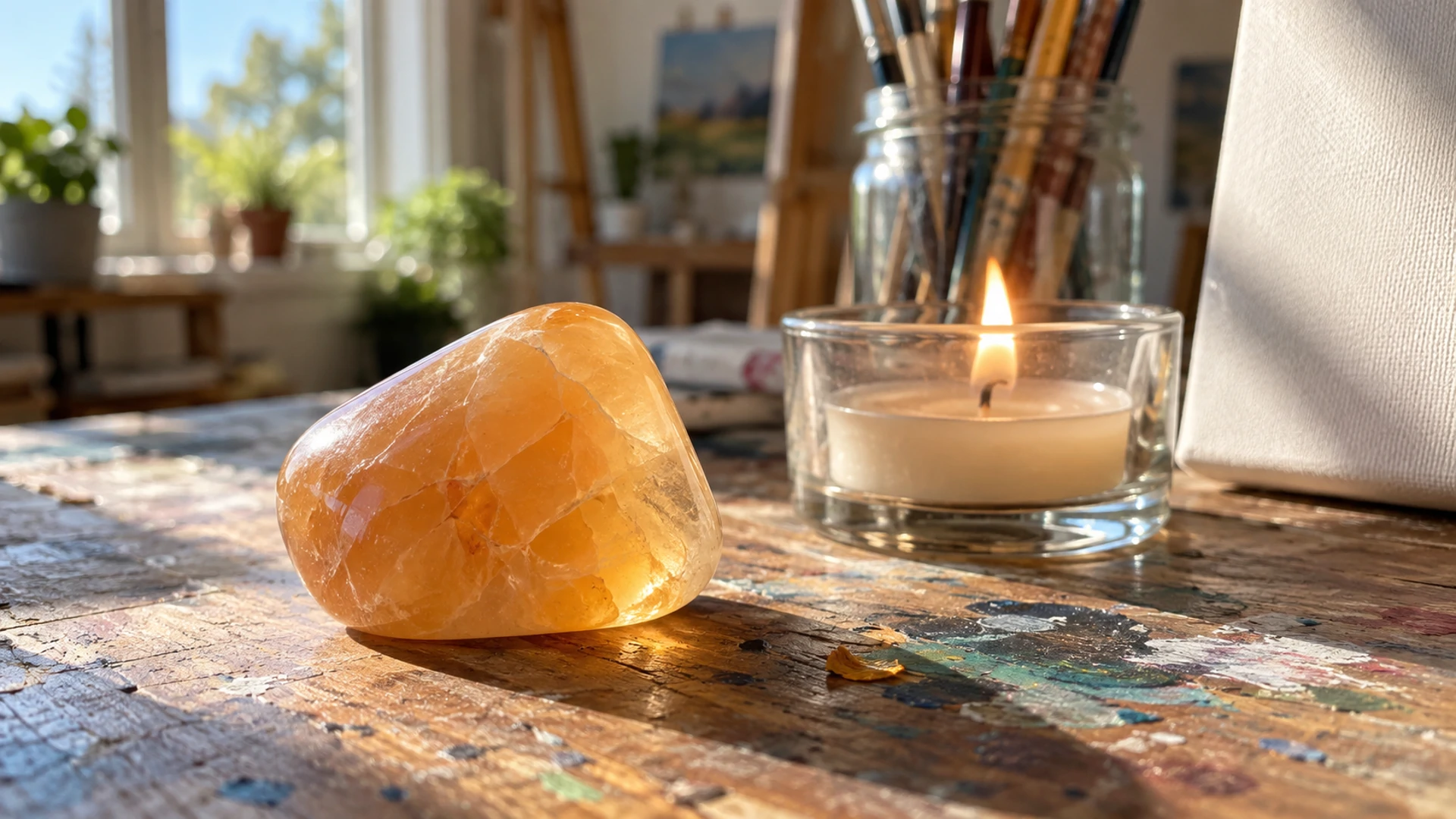
Orange calcite is the Empowerment stone you reach for when a project has quietly gone cold — not because you failed, but because the momentum drained out somewhere along the way. Its specific function is creative reactivation: reigniting enthusiasm and forward motion in work that has stalled.
Restarting What Went Flat: Why Orange Calcite Belongs in Empowerment
The Empowerment category spans a wide range. Some stones in it are sharp and decisive. Carnelian is about immediate activation — the spark that overcomes hesitation and pushes you into bold action right now. Garnet specifically rebuilds motivation after a defeat or setback, restoring drive when failure has taken the floor out from under you. Orange calcite belongs to a quieter register in this family. Its mechanism is creative reactivation — and that distinction matters.
Creative reactivation isn't the same thing as starting from zero or recovering from failure. It's what happens when a project that once had real energy has gone flat — not because it was bad, not because you gave up, but because life interrupted it, or because you worked on it past the point where your enthusiasm could sustain the pace. The fire didn't die dramatically; it just went out while you weren't watching. Orange calcite is the stone for relighting it. Think of it less as a spark and more as a pilot light — consistent, warm, and specifically suited to getting something running again rather than igniting it for the first time.
The correspondences map directly onto this function. Orange calcite is a sacral chakra stone, and the sacral chakra governs creative energy, pleasure, desire, and the felt sense of wanting to make something. When creative work stalls, it's often not a mental block — it's a sacral block, a disconnection from the enjoyment and appetite that made the project worth starting. The stone's warm, orange-to-honey color mirrors this: it carries the quality of gentle heat rather than intense fire.
The element is Fire and the ruling celestial body is the Sun — a combination that reinforces warmth and productive vitality rather than urgency or aggression. The Sun's energy here is the kind that grows things steadily, not the kind that burns them. Zodiac associations fall on Leo and Cancer, two signs that share a love of creative expression and deep personal investment in the things they build — Leo through pride and creative ambition, Cancer through emotional attachment and care. Orange calcite sits at that intersection: a stone that works best when you genuinely care about what you're trying to restart, not when you're forcing yourself through something that holds no meaning for you.
That's what earns it its place in the Empowerment category rather than, say, Healing. It doesn't soothe or repair. It reactivates. The distinction is in the direction of the energy — not inward to mend something, but outward and forward, toward the work itself. If your creative project needs a gentle push back into motion, this is the stone calibrated for exactly that.
Soft and Sunny: Choosing and Handling Orange Calcite
Orange calcite is one of the stones where authenticity is worth paying attention to at purchase. The market has a lot of dyed material — chalcedony, agate, or other calcite varieties treated to produce a bright, saturated orange. The giveaway is usually the color itself: artificially dyed pieces tend toward a vivid, almost neon orange that looks uniform all the way through. Natural orange calcite is softer and more variable than that. Its color tends toward honey, apricot, or warm amber — sometimes paler in some areas, slightly more saturated in others, with a translucency that shifts in the light. That variation is normal and actually a good sign.
Color aside, natural orange calcite can also appear in shades closer to peach or light tangerine depending on the source material and how much manganese or iron is present. There's no single "correct" shade. What you're looking for is organic variation rather than synthetic uniformity. Tumbled pieces will often show slightly different tones across the same surface. Raw or rough pieces will show the natural layering and crystalline structure that dyed material usually obscures. If a piece looks too perfect and too consistent — especially at a low price point — treat that as a prompt to ask about treatment.
On care, orange calcite is genuinely fragile. It sits at Mohs 3 on the hardness scale, which means it scratches easily and should be stored away from harder stones — kept in its own pouch or a soft-lined compartment rather than tossed into a collection tray with quartz or tourmaline. Physical handling should be gentle. This is not an everyday-carry stone in the way that a Mohs 7 stone can be — if you want to carry it in a pocket, wrap it.
Water is where the real risk lies. Calcite dissolves slowly with prolonged water exposure — not dramatically fast, but consistently enough that you'll see surface dulling and eventual structural damage if it's soaked regularly. Brief, unavoidable contact is unlikely to cause immediate harm, but never intentionally submerge it and never use it to make a gem elixir or infused water. Acidic cleaners are equally damaging: vinegar-based products will etch the surface visibly, so skip any natural cleaning solution that contains acid. The safest regular method is the simplest one — a soft dry cloth to wipe the surface clean, and nothing more. For energetic cleansing, sound, moonlight, or brief smoke exposure work well without any physical risk to the stone.
Three Practices for Reigniting a Stalled Project
The Restart
Use this when a specific creative project has been sitting untouched for long enough that returning to it feels uncomfortable — when you know you want to finish it but can't find the thread back in.
Pick up the orange calcite and hold it in your dominant hand. Open the project — the document, the canvas, the draft, whatever form it takes — and just look at it for a moment without trying to work yet. Let the stone sit in your hand while you read back what you already made. This isn't a working toward a product right now; it's a re-acquaintance. After a few minutes of looking, write one sentence or make one small mark — anything that counts as touching the work again. The goal of this practice isn't output; it's re-establishing contact. Doing this on a Sun hour or on a Sunday reinforces the solar quality of the work, but timing matters less than doing it consistently. Set the stone down only after you've made that one small act of re-entry.
The Morning Spark
Use this during a sustained creative block — not as a last resort, but as a deliberate daily reset done at the start of the day, before the weight of the block has a chance to settle in.
Keep the orange calcite on your bedside table or somewhere you'll see it before you've fully shifted into the day's other demands. In the first few minutes after waking, hold it briefly and name — aloud or written down — one small, specific thing you want to make or move forward with today. Not a grand intention, not a whole project goal: one concrete thing, small enough to be done in twenty minutes if everything goes well. Pair this with a lit orange candle if you want to amplify the sacral energy; even a tealight counts. The practice works because it asks you to name something real and specific while your defenses are still low — before the inner critic has fully clocked in. Repeat daily for at least a week rather than treating it as a one-time fix.
The Desk Companion
Use this as ongoing passive support during any period of creative work — not in response to a specific block, but as an environmental condition you build into your workspace.
Place the orange calcite somewhere on or beside your creative workspace where you'll see it without it being in the way. This is placement rather than ritual: you're creating an ambient condition that keeps the sacral energy of creative want gently present while you work. You don't need to pick it up or interact with it deliberately every session. Its function here is to act as a quiet environmental anchor — a reminder at the edge of vision that the space is for making things. If you work digitally, a tumbled piece beside your keyboard works well. If you work at a physical studio or desk, a raw chunk or a small cluster near your tools. Pair it with something from the same elemental family if you like — a small piece of carnelian for immediate activation energy alongside the calcite's steadier warmth — but orange calcite alone is enough. Cleanse the stone once a month using sound or smoke so it stays clear rather than accumulating the ambient heaviness of a space where you also experience frustration.
A Modern Favorite Without Ancient Lore
Orange calcite doesn't carry a deep ancient history. This is worth saying plainly, because some stones in crystal practice have centuries of documented use — written into grimoires, carved into amulets, ground into pigment, buried with the dead. Orange calcite isn't one of them. Its appearance in metaphysical writing is relatively recent, a product of the broader mid-to-late twentieth century wave of interest in crystal healing rather than an inherited tradition from antiquity.
Calcite as a mineral family is genuinely ancient — it's one of the most abundant minerals on Earth, appearing in limestone, marble, and chalk, used since prehistoric times in building, pigment, and lime production. But the specific orange variety, singled out by color and worked with under that name for its particular sacral-and-solar correspondences, is a modern categorization. There's no ancient Egyptian text about orange calcite, no medieval grimoire entry, no indigenous tradition documented around this specific variety. The honest framing is that it's a contemporary tool with a short written history but a real, specific function — and that's enough. A stone doesn't need thousands of years of paperwork to do useful work in your practice.
What orange calcite does have is a clear mechanism that tracks to its physical and elemental qualities: the warm color, the soft material quality, the sacral and solar resonances, the gentle rather than aggressive energy. Those aren't invented. They're built on real properties of the stone and coherent correspondence logic. The modern crystal-healing tradition that identified these is legitimate practice — it's just honest to say it's modern rather than dressing it up as something older than it is.
Empowerment for the Creative Restart
What makes orange calcite worth knowing in the Empowerment category is its specificity. Most of the stones in this space deal in courage, stamina, or recovery after failure — qualities that matter, but don't cover everything. Orange calcite covers the gap that those miss: the creative stall, the project that went cold, the enthusiasm that needs something gentler than a warrior stone to get it moving again. That's a real and common experience, and it has a tool.
If you want to see where orange calcite fits alongside the other Empowerment stones — and how all seven stone-magic categories relate to each other — the full picture is in The Crystal Compendium: Seven Paths to Stone Magic.