Yellow Sapphire: Wealth Guided by Wisdom
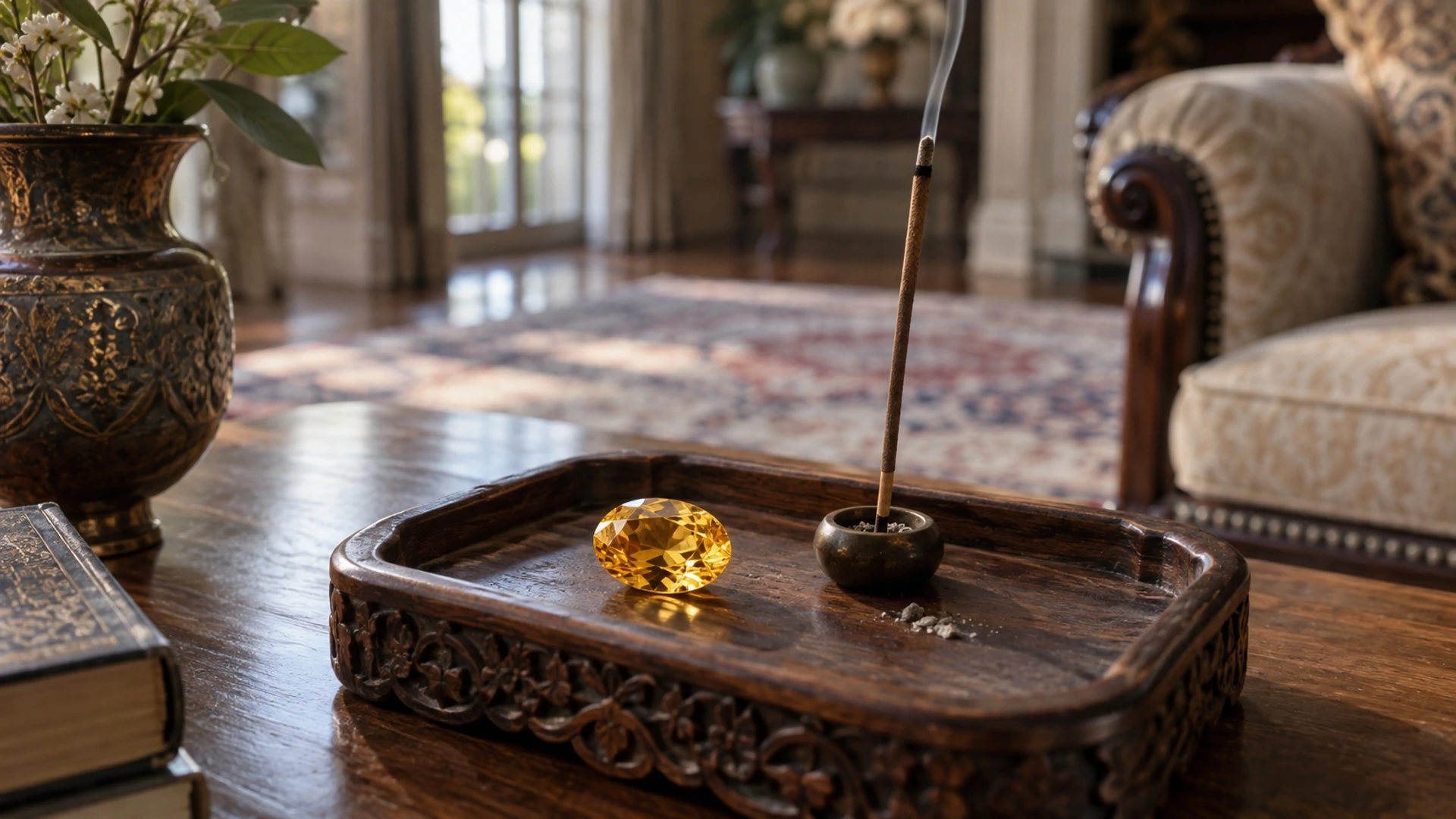
Yellow Sapphire is one of the most ethically specific stones in the Abundance category — it doesn't just draw wealth, it asks you to earn it through wisdom and right conduct. In Vedic astrology, where this stone carries its deepest tradition, that distinction is the whole point.
Wealth Guided by Wisdom: Why Yellow Sapphire Belongs in Abundance
Yellow Sapphire is corundum — the same mineral species as blue sapphire and ruby — colored yellow by trace iron. At Mohs 9, it's one of the hardest gemstones on the planet, second only to diamond. That physical density is worth keeping in mind as you work with this stone, because it mirrors something about its energetic character: Yellow Sapphire is not light or spontaneous in the way some abundance stones are. It's heavy, deliberate, and precise.
The stone's strongest and most documented tradition comes from Vedic astrology, where it is called Pukhraj or Pushparaga and holds a specific, non-interchangeable place among the Navaratna — the nine sacred gemstones, each assigned to one of the nine Vedic planets. Yellow Sapphire is the gemstone of Jupiter, known in Sanskrit as Brihaspati or Guru. In this tradition, Jupiter governs not just wealth but the wisdom, ethical conduct, and expansive generosity that cause wealth to flow correctly. This is a meaningful distinction from how abundance stones are typically framed in Western crystal practice, and it's worth naming honestly rather than flattening the two frameworks together.
That framing gives Yellow Sapphire its specific mechanism in this cluster: wealth through wisdom — expansion guided by ethics and right conduct rather than raw manifestation or chance. Compare this directly to how other stones in the same category work. Green Aventurine operates through luck and chance-based opportunity — it positions you to catch a lucky break, but it doesn't ask anything of your values or decision-making. Citrine works through spontaneous manifestation — active, radiant generation of wealth and opportunity through confidence and joy. Yellow Sapphire works differently. It slows the process down and routes it through discernment. The wealth it supports is the kind that arrives because you thought carefully and acted rightly.
In the Western correspondence framework — which most of this site uses as a default — Yellow Sapphire is assigned to the solar plexus chakra, the fire element, and the Sun. These aren't wrong associations, but they're secondary to the Vedic framing, which is where this stone's actual historical and spiritual depth lives. In Vedic astrology, Yellow Sapphire is specifically a Jupiter stone, worn to strengthen Guru's influence in the natal chart and invite the expansion, prosperity, and wisdom that Jupiter governs. Traditional Vedic practice recommends consulting an astrologer before wearing Yellow Sapphire to confirm that Jupiter's placement in your chart is favorable — because a strengthened Jupiter can amplify whatever that planet is already doing, for better or worse. That level of specificity is unusual in the Western crystal world, and it speaks to how seriously this stone is taken in its home tradition.
Harder Than Its Imitators: Choosing Yellow Sapphire
Yellow Sapphire is one of the most heavily counterfeited astrological gemstones available. The substitutes are usually citrine or yellow topaz — both far more common, both far less expensive, and both visually close enough to pass under casual inspection. This matters enormously if you're working with Yellow Sapphire for its specific Vedic correspondence, since no amount of intention-setting compensates for holding the wrong stone.
The easiest physical test is hardness. Yellow Sapphire is corundum at Mohs 9 — it will scratch quartz (Mohs 7) and topaz (Mohs 8) cleanly, while neither can scratch it. Its density is also noticeably higher than either substitute: genuine corundum has a specific gravity around 4.0, compared to roughly 2.65 for quartz-based citrine. In the hand, a genuine Yellow Sapphire of any significant size has a weight that neither citrine nor topaz quite matches. If you're buying for Vedic use specifically, Ceylon material — mined in Sri Lanka — is consistently regarded as the most desirable for astrological purposes, prized for its clarity and the particular warm, clean yellow of the best Sri Lankan specimens. Burmese and Thai material also circulates, but Ceylon sapphire carries the strongest reputation in this tradition.
In terms of care, Yellow Sapphire is one of the lowest-maintenance gemstones you can own. Corundum at Mohs 9 is resistant to virtually all everyday damage — scratching, chipping from routine contact, and water exposure. You can rinse it, wear it in the shower, and clean it with warm water and a soft brush without any concern. It has no toxicity issues with skin contact. The one thing to note is that most commercial Yellow Sapphire has been heat-treated to improve color, which is standard practice in the gemstone trade and doesn't affect its energetic or physical properties. If you're purchasing for Vedic purposes, some traditions prefer untreated material — ask your seller directly about treatment status, and buy from a reputable source who can provide that information.
Three Practices for Wisdom Before Wealth
The Guided Ledger
Use this practice when you're facing a financial decision that feels compelling on the surface but hasn't yet passed through the filter of your own values.
Hold your Yellow Sapphire in your dominant hand and sit with a blank piece of paper in front of you. Write the decision or opportunity at the top, then draw a vertical line down the center. On the left side, list everything that makes this choice feel right according to your stated values — not your desires, your values. On the right side, write every way this choice might compromise those same values, even subtly. Don't rush. Yellow Sapphire's correspondence to Jupiter's wisdom current is activated by the deliberateness of this process, not by speed. When both columns are complete, place the stone on the paper and sit quietly for a few minutes. The practice isn't about the columns perfectly balancing — it's about making the ethical weight of the decision visible before you act. If you want to reinforce the working, light a gold candle and let it burn through the session.
The Guru's Counsel
Use this when a wealth-related opportunity or decision has arrived faster than your ability to assess it clearly, and you need to slow down before you respond.
Set your Yellow Sapphire at the center of your altar or workspace and sit comfortably across from it. Begin during a Jupiter hour if you can time it — Thursday morning especially. Breathe slowly until your thinking quiets, then address Jupiter directly and simply: state the situation, state what you don't yet know, and state what you're asking for help to see. This isn't a petition for an outcome — it's a request for clarity. Spend at least ten minutes in silence after speaking, holding the stone loosely in both hands. Write down whatever surfaces without editing it. Some of what appears will be practical; some may feel like a value you'd forgotten you held. Review what you've written before you make any response to the opportunity. The practice works by building a deliberate gap between stimulus and response — and that gap is where Yellow Sapphire's wisdom operates.
The Expanding Circle
Use this for prosperity intentions that are meant to extend beyond your own benefit — a business that serves a community, a financial goal tied to supporting others, or wealth you want to share once it arrives.
Place your Yellow Sapphire at the center of a small circle you've drawn or laid out with salt or cord. Around it, place one stone representing each person or group you intend this prosperity to reach — a photograph, a written name, or a symbolic object works equally well. Light bay laurel as incense if you have it, since bay carries a strong solar and Jupiterian correspondence for recognition and achievement. State your intention aloud, naming each person or purpose represented in the circle. Then move the Yellow Sapphire outward from the center to touch each representation in turn before returning it to the center. This practice encodes the expansive, outward-moving quality of Jupiter's abundance — wealth understood not as accumulation for its own sake, but as something that grows by circulating. The stone stays at the center of the circle afterward, anchoring the intention.
The Gemstone of the Guru
Yellow Sapphire's most important historical anchor isn't a Western one. The Garuda Purana, one of the eighteen Mahapuranas — the major texts of the Puranic corpus in Hindu tradition — explicitly describes pushparaj (Yellow Sapphire) as the gemstone of Jupiter. This is not folk usage or regional variation: it is canonical textual documentation of a correspondence that has been embedded in Vedic astrological practice for a very long time. The Navaratna tradition, which assigns one of the nine sacred gemstones to each of the nine Vedic planets, places Yellow Sapphire specifically and consistently at Jupiter's position — not as one option among several, but as the stone.
This distinction matters for how you work with Yellow Sapphire compared to every other stone in the Abundance cluster. Most of the stones in this category carry Western correspondences built from folk magic, early modern herbal traditions, and contemporary crystal-healing synthesis. Yellow Sapphire carries something older and more specifically structured: a named planet, a named sacred text, a tradition with its own internal logic about when to wear the stone, how to have it set, and what planetary condition makes it appropriate for a given person. You don't need to be a practitioner of Vedic astrology to work with Yellow Sapphire meaningfully, but knowing this tradition exists — and that it runs parallel to rather than inside the Western framework — keeps you honest about where the stone's correspondences actually come from.
Abundance Guided, Not Grasped
Yellow Sapphire's place in the Abundance category is secure, but its mechanism is its own. Wealth through wisdom — expansion guided by ethics and right conduct — makes this stone a natural fit for anyone whose relationship to money involves questions of integrity, right use, or long-term consequence rather than just acceleration or magnetism. That's a specific kind of abundance work, and it calls for a specific kind of stone.
If you want to see how Yellow Sapphire sits alongside the other Abundance stones — and how the Abundance category itself connects to the six other paths of stone magic — The Crystal Compendium: Seven Paths to Stone Magic is the place to start.