Spinel: Strength Returning, Not Being Built
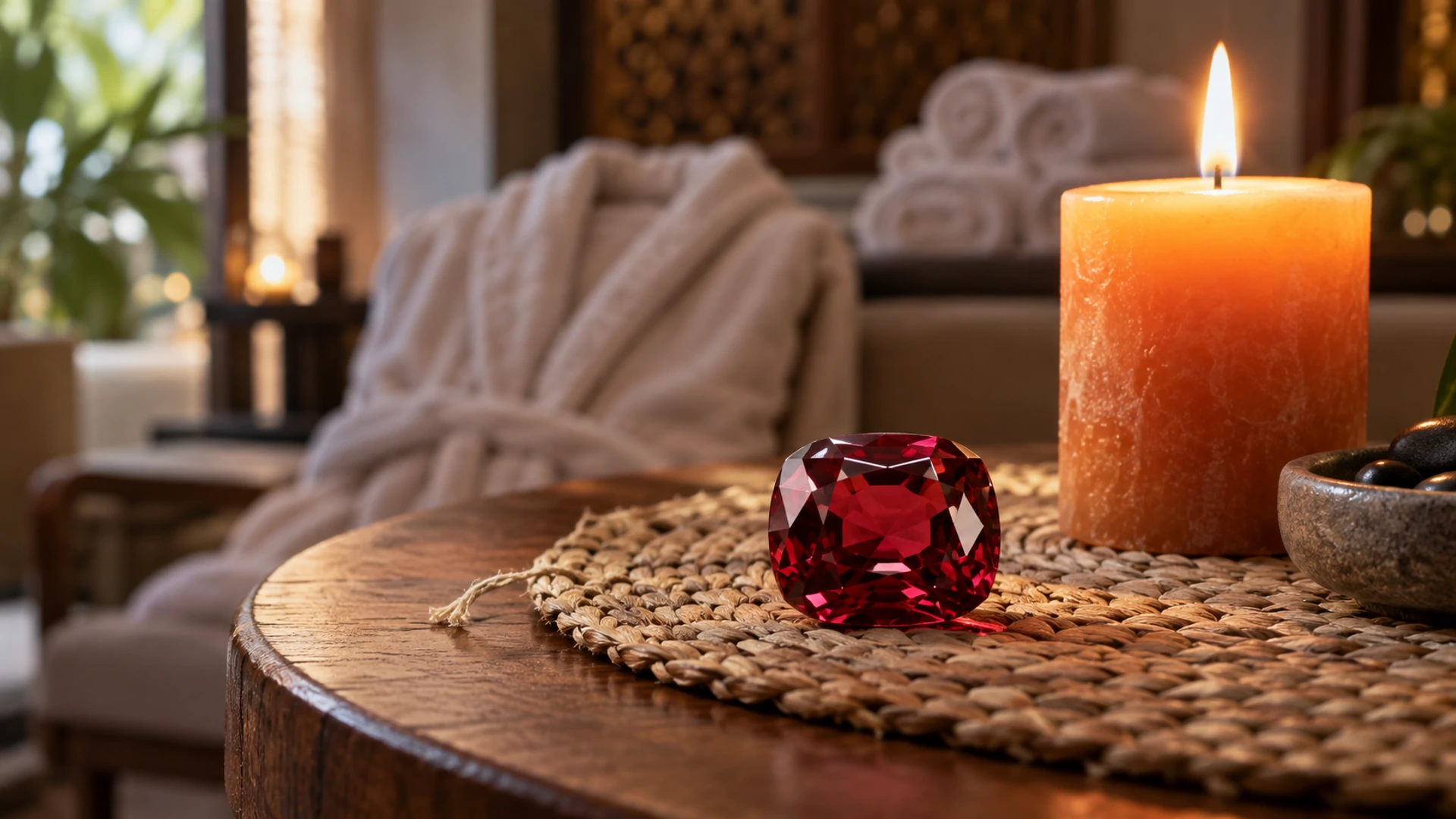
Spinel sits in the Empowerment category for one specific reason: it works with strength that already exists in you and was temporarily taken by illness, burnout, or emotional exhaustion. It does not build new courage or spark fresh ambition. It restores what depletion interrupted.
Strength Returning, Not Being Built: Why Spinel Belongs in Empowerment
The empowerment category holds stones with distinct mechanisms. Some stones activate. Some rebuild. Some reclaim. Spinel does something quieter and more specific than any of those: it helps the body and spirit recover vitality that was already present before something depleted it. That distinction is worth sitting with for a moment, because it changes how you use the stone and what you expect from it.
Consider how Sunstone works — its mechanism is reclaimed personal sovereignty, specifically for those who have been self-sacrificing or over-giving, restoring the ability to want things for yourself. That is a different problem than the one Spinel addresses. Sunstone is for energy that was voluntarily given away over time. Spinel is for energy that was taken involuntarily — by fever, by grief, by sustained stress that finally landed in the body. The distinction matters because conflating them leads to reaching for the wrong tool at the wrong moment.
Similarly, Golden Tiger Iron offers sustained endurance over the long haul, the composite staying power of three stones built to carry you through weeks or months of demanding work. That is stamina built and maintained in the middle of an active life. Spinel is not for the middle of an active life. It is for the aftermath — the period when you are no longer in the crisis but are not yet fully yourself again, and you need something to support the returning rather than push you forward.
Mineralogically, Spinel is magnesium aluminum oxide, forming in octahedral crystals that appear in an unusually broad color range: red, pink, blue, violet, orange, brown, and black, depending on the trace elements present. Red Spinel gets its color from chromium — the same trace element responsible for the color of ruby. This shared chemistry is the root of centuries of misidentification. The two minerals look almost identical in rough form, share similar hardness, and occur in the same geological environments. The difference requires a gemologist's eye, or a refractometer.
Spinel's correspondence to the root chakra makes immediate sense in the context of recovery: the root chakra governs the body's most fundamental sense of security and physical stability — the sense that the ground is solid beneath you, that you can stand. After illness or prolonged exhaustion, that basic felt sense of being in a functional body is often what goes first. Spinel's solar plexus correspondence adds the layer of will — not ambition, but the simpler will to recover, to eat, to rest, to try again tomorrow. Both are correspondences that name exactly what depletion takes.
The planetary correspondence most strongly associated with Spinel is the Sun, which governs vitality, life force, and the body's own regenerative capacity. Working with a Sun-governed stone for recovery is consistent with the logic of inviting the Sun's restorative current into work that is fundamentally about physical renewal. The element is fire, not in the combustive sense of Carnelian's immediate activation or Garnet's rebuilding of motivation after defeat, but fire in the sense of warmth returning to a hearth that nearly went cold.
The Stone That Fooled Crowns: Choosing Spinel
The single most useful thing to know when identifying Spinel is that it is singly refractive, while ruby is doubly refractive. This optical difference — measurable with a refractometer in seconds — is the reliable gemological tool for separating the two minerals, even when color, hardness, and origin are nearly identical. To the naked eye, a fine red Spinel and a fine ruby can be indistinguishable. For centuries, they were. The fact that a gemological instrument can resolve what courts and treasuries could not for thousands of years is a reminder that close observation is always more reliable than assumption.
For practice purposes, the question of natural versus synthetic matters more with Spinel than with some other stones. Synthetic Spinel is extremely common — it is widely used as an affordable stand-in for other birthstones in mass-market jewelry, and it is produced in large quantities in nearly every color. If you are buying a piece specifically for magical work and the question of natural origin matters to your practice, ask directly. A reputable seller will be able to confirm whether a piece is natural Spinel, lab-created Spinel, or something else entirely. There is nothing wrong with synthetic Spinel as a material, but it is worth knowing what you have.
Natural Spinel occurs in a genuine range of colors, and for recovery work, any color will carry the stone's central mechanism. Red and pink Spinel, colored by chromium and manganese respectively, are the most recognizable. Blue Spinel, colored by iron and cobalt, tends toward a quieter, deeper tone than the electric blue of some other stones. Black Spinel, opaque and grounding, edges into protective territory that overlaps with its empowerment core. For physical recovery specifically, red or orange-tinged Spinel will feel most aligned with the root and solar plexus work described above. For emotional exhaustion, blue or violet Spinel can support the process with a cooler, calmer register.
On care: Spinel sits at Mohs 7.5 to 8, which makes it genuinely durable for everyday wear. It is water-safe, has no toxicity concerns, and does not require any special storage conditions beyond keeping it away from harder stones that could scratch it — a straightforward precaution that applies to any stone not at the top of the hardness scale. Cleaning with a soft cloth and mild soap is fine. Ultrasonic cleaners are generally tolerated by Spinel, though if a piece has visible surface fractures or inclusions, erring toward a gentle hand-wash is always the safer choice.
Three Practices for Letting Strength Come Back
The Quiet Return
Use this practice in the early stage of recovering physical strength after an illness, when your instinct to push forward would actually work against the recovery itself.
Hold a piece of Spinel in your non-dominant hand while lying or sitting comfortably — the position that requires the least effort from your body at this moment. Light a orange candle nearby if you are able, and let your attention settle on the warmth of the stone in your palm rather than on any goal or timeline. The practice here is not visualization of full health; it is recognition of where you are today and permission for the process to be exactly as slow as it needs to be. Breathe into the base of your spine — the root, the ground — and let the stone be a focal point for the return of sensation, appetite, and presence. Five to ten minutes is enough. Do this daily during recovery, without expectation of a dramatic shift, and let the accumulation carry the work.
The Unhurried Rebuild
Use this when you are recovering from emotional exhaustion rather than physical illness — the kind that builds quietly over months and only becomes visible when you have nothing left to give.
Place Spinel on your solar plexus while lying down and rest your hands loosely on either side of it. Burn a small amount of frankincense nearby — not as an elaborate ritual component, but for its grounding, clarifying quality in the air around you. If you have access to a Sun planetary hour, this is a natural fit, though it is not a requirement. The intention is not to feel better immediately but to give the solar plexus — the seat of will and self-determination — something to anchor to while it recharges. Stay here for fifteen to twenty minutes. You do not need to hold a thought or maintain a visualization. The practice is simply the contact, the time, and the permission not to be further along than you are.
The Recognized Reserve
Use this when you are further into recovery and beginning to notice your own strength returning, but part of you keeps doubting it — keeps assuming you have to rebuild from nothing rather than trusting what is quietly coming back.
Sit with Spinel held in both hands. No candle is required here, though a red candle can mark the space if you want a focal point. The practice is a simple audit of what has returned: name, silently or aloud, three things your body or mind can do today that it could not do at the bottom of your depletion. Not as gratitude performance, but as genuine inventory. Spinel's role here is as a tangible reminder that the stone's mechanism is return, not construction — and so is yours. The strength was always there. It is not something you are earning back; it is something that is finding its way home. Let the weight of the stone in your hands be a grounded confirmation of that.
The Great Imposter of the Crown Jewels
For most of recorded history, Spinel was not Spinel. It was ruby. The error was not a matter of carelessness — it was simply that no reliable method existed to distinguish the two minerals until the science of crystallography began to develop in the 18th century. Royal treasuries, wealthy merchants, and court jewelers across Asia and Europe all made the same mistake, consistently, for centuries.
The most famous example is the Black Prince's Ruby, a roughly 170-carat polished red stone that has sat at the center of the British Imperial State Crown since the 17th century and was believed to be one of the finest rubies in the world. It is Spinel. The Timur Ruby, a stone of over 350 carats now part of the Royal Collection and inscribed with the names of the Mughal emperors who owned it, carries its name as a historical artifact rather than a mineralogical description. It is also Spinel. Both pieces were examined and correctly identified as Spinel only well after they had already accumulated centuries of significance under the wrong name.
The formal separation of Spinel from ruby as distinct mineral species came in 1783, when the French mineralogist Jean-Baptiste Louis Romé de l'Isle applied the emerging tools of crystallography to demonstrate that the two stones had different crystal structures. Ruby, as a variety of corundum, forms in trigonal crystals. Spinel forms in octahedral crystals with cubic symmetry. The two systems are distinct and measurable, and once the method existed to observe them reliably, the centuries of confusion began to resolve. What did not change was the beauty or power of the stones themselves — only the label. If anything, the misidentification underscores something interesting about Spinel: it was never less than what it appeared to be. It simply was not what anyone called it.
The Strength That Was Already Yours
Spinel's specific mechanism — recovery of existing strength rather than construction of new strength — gives it a place in the Empowerment category that no other stone in that group occupies. The category needs this. Not every moment of needing empowerment is a moment of starting fresh or pushing through. Sometimes empowerment is recognizing that the capacity was never gone, only temporarily inaccessible.
If you want to understand how Spinel sits alongside the other stones in this category, and across all seven categories of stone magic, The Crystal Compendium: Seven Paths to Stone Magic is where that full picture lives. That is the right next step if you are building out a practice and want to see how these stones work together, not just individually.