Basil: The Pot by the Door and the Till
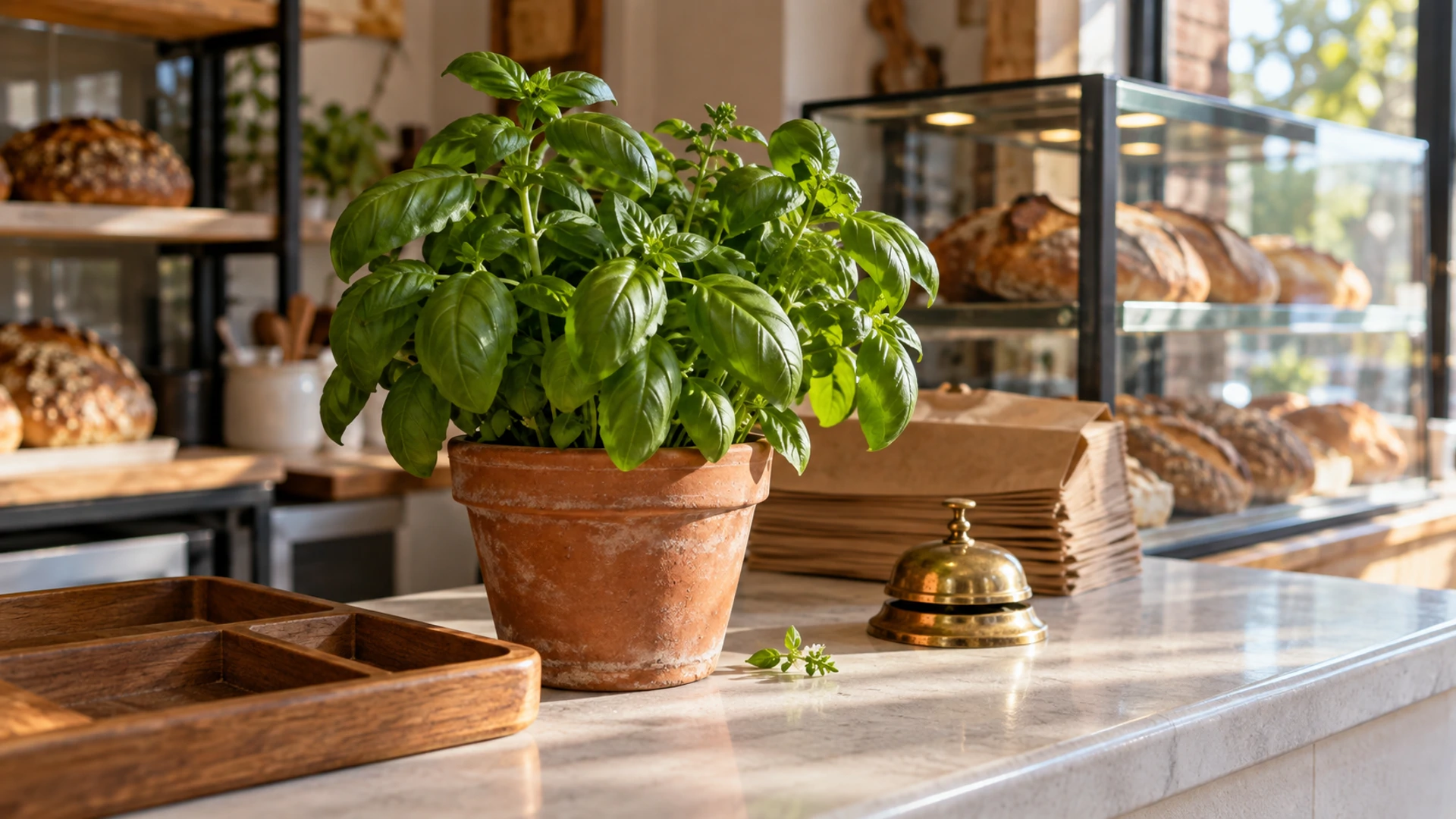
Basil is a kitchen herb kept by the door or register and used in floor washes to build steady abundance for a home or a business. Love is its second face, close behind prosperity and rooted in the same warmth that draws people toward a threshold.
Steady Abundance: Basil's Place in Prosperity
Basil's prosperity angle is not about pulling in a windfall or accelerating what's already moving. It builds. The folk logic behind setting a pot by the front door or scrubbing the threshold with a basil wash is about creating the conditions for money to keep arriving and stay, day by day, the way a well-run household stays fed. That quality puts basil in a specific lane among prosperity herbs. Mint is the herb of circulation, quick money that flows in and keeps moving. Cinnamon brings speed and drawing power, pulling opportunity toward you fast. Basil builds steadily where those two speed money in, and it's especially suited to the home, the shop floor, and wherever money changes hands regularly.
Its ruler is Mars. Culpeper places basil in Scorpio under Mars, and Cunningham gives it Mars and fire as well, which is a stronger agreement than you get with many herbs. Tuesday is its day. That Mars signature is easy to miss when you're looking at a fragrant kitchen plant, but it tracks: Mars doesn't only rule aggression and iron. It rules the energy to act, to build something, to keep going. The steady-accumulation quality of basil in prosperity work is Mars as consistent effort rather than Mars as force. That's also where basil's love secondary starts to make sense. Mars rules desire, and the love tradition around basil is warm and deeply felt rather than cool or intellectual.
The love secondary is real and worth noting. Basil sits in the Prosperity and Success category, but its history inside European and literary tradition is wound through with romantic attachment. That double thread, abundance and affection, makes it a good fit for workings about a home and everything a home holds: income, relationships, and the general sense that a household is doing well. When the goal is that the house thrives, basil speaks to more than the money coming in.
A Pot of Basil, a Lover's Head, and a Scorpion
The most striking piece of basil's literary history comes from Boccaccio's Decameron, where a young woman named Lisabetta discovers that her brothers have murdered her lover. She finds the body, severs the head, buries it in a large pot of basil, and tends it obsessively, watering it with her tears. The basil grows lush and fragrant. Her brothers eventually take the pot from her, find what's inside, and flee. Lisabetta dies of grief. Keats retold the story in his 1820 poem "Isabella, or the Pot of Basil," keeping the macabre tenderness of the original. That story is the anchor for basil's love secondary, and it gives the herb a depth that pure kitchen cheerfulness doesn't capture. There's grief in it, and devotion, and the specific kind of love that doesn't let go.
Culpeper recorded something considerably stranger: a belief, circulating in his time, that basil breeds scorpions. He was skeptical of it himself, which is worth noting, but he wrote it down. The suggested mechanism was that smelling basil too much would cause scorpions to breed in the brain. It reads like folklore that got attached to the plant partly because of the Mars rulership and partly because of basil's intensity of scent. Culpeper placed basil under Mars in Scorpio, and Scorpio's emblem is the scorpion, so the association has a certain internal logic even if the biology is entirely wrong. It's the kind of correspondence that shows how the old herbalists thought: plant, planet, sign, and symbol all folding into each other. In Hoodoo, basil takes a different direction entirely, going into money-drawing floor washes for homes and businesses, a thoroughly practical use that has nothing to do with scorpions and everything to do with drawing prosperity in through the door.
Sweet Basil, Not Tulsi
The basil used in prosperity and love workings is sweet basil, Ocimum basilicum, a member of the mint family. It is not holy basil, also called tulsi (Ocimum tenuiflorum), which is a different species with its own deep significance in Hindu devotional practice, where it is sacred to Vishnu and tended as a living deity in many households. Tulsi's role belongs to that tradition. Sweet basil is what you find at a grocery store, at a garden center, or growing in a kitchen window box, and it is the plant behind every practice described here.
Sweet basil is easy to keep alive. It wants warmth, bright light, and consistent water at the soil level rather than on its leaves. Pinching off flowers as they form keeps the plant bushy and extends its life. Growing your own gives you a steady supply of fresh leaves and keeps the working continuous rather than requiring you to restock dried herb. The essential oil is skipped during pregnancy. For a more ceremonial approach to working with basil and money together, the basil tea ceremony for money walks through a full ritual practice.
Three Basil Workings for the Home and the Shop
A Pot of Basil by the Register
This working is for anyone who wants a continuous prosperity presence in a home or business rather than a one-time ritual.
Choose a healthy, living sweet basil plant and set it near your front door at home or beside the register in a shop. Before you place it, hold it in both hands and state clearly what you want it to do: draw steady income, keep the household provided for, bring customers through the door. Water it regularly and tend it with attention, pinching off flowers to keep the plant strong. Each time you care for it, you're refreshing the working. If the plant dies, replace it. The point is the living, growing presence, not a preserved object. A pot of basil that's thriving is doing its job. One that's been ignored and gone to seed has stopped working, and the fix is simple: start again with a new plant and the same intention.
The Money Floor Wash
This is the Hoodoo practice of washing the floor of a home or business with a basil infusion to draw money in and keep it flowing through the space.
Bring a large handful of fresh basil leaves to a simmer in a pot of water, then let it steep until the water cools. Strain out all plant material until the liquid is clear. Add the infusion to your wash water and use it to mop the floors, working from the back of the space toward the front door, so the energy moves outward and draws toward the entrance. For a shop, pay attention to the threshold itself and the area just inside the door. Tuesday is the natural day for this working, and timing it to a Mars hour gives the working an added edge. The wash can be done weekly or whenever the space feels stagnant. It does not replace cleaning, it layers intention on top of it.
A Leaf in the Wallet
This is a small, portable version of basil's prosperity work, suited to anyone who wants to carry the intention with them rather than anchor it to a place.
Tuck a fresh or dried basil leaf into your wallet, behind your cards or against the fold where your cash sits. Set your intention when you place it: that money comes to you steadily and that what you have doesn't slip away without purpose. When the leaf crumbles or dries beyond recognition, replace it with a fresh one and reset the intention as you do. The renewal is part of the practice, not a sign that something went wrong. Keep it simple and keep it going.
Abundance That Stays in the House
Basil earns its place in the Prosperity and Success category not because it works fast or dramatically, but because it's consistent. It suits the kind of abundance that accumulates quietly, the kind where a household is steadily fed and a business steadily busy, month after month, without the peaks and crashes that flashier workings can bring. That quality makes it the right herb for a home, a family kitchen, and any place where money needs to arrive reliably rather than all at once.
If you want to see basil alongside the other eleven prosperity herbs and all six of the other categories of plant magic, the place to go is the witch's herbarium on plant magic, which covers the full range from protection to divination and puts each herb's angle in context with the rest.