Blessed Thistle: A Blessing With Spines
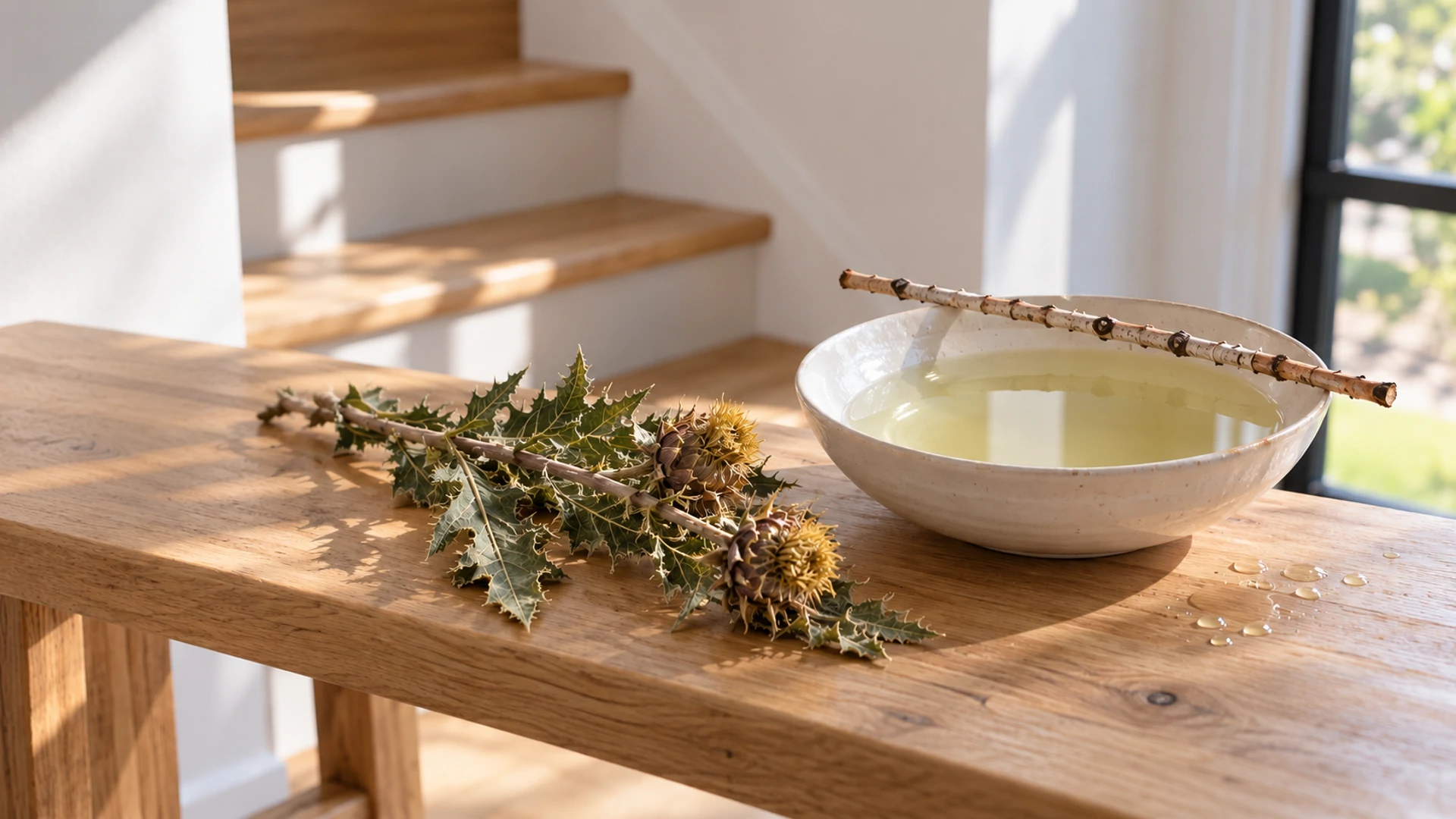
A spiny monastic herb named for St. Benedict, blessed thistle is used in baths and sprinkled washes to lift a hex and keep it from settling back.
Unhexing: Blessed Thistle's Place in Banishing
Not every banishing herb works the same way, and the difference matters. Nettle breaks a curse outright, snapping what should not hold. Agrimony takes what was sent and returns it to its source. Blessed thistle does something distinct: it unhexes. It lifts the hex and keeps it from settling back. That quality of lifting and holding clear is its signature, and it runs through every working you build around it.
Its secondary category is Protection and Warding, which makes sense when you understand how unhexing works. Removing something without sealing the space leaves a gap. Blessed thistle's protective quality fills that gap, keeping whatever was lifted from drifting back in. It also shares a naming pattern with two other herbs: angelica root, known in Hoodoo as Holy Ghost root, and vervain, called the holy herb, both carry that same vocabulary of sanctified protection. Blessed thistle sits squarely in that company. The blessing is not decorative. It is part of the work.
Culpeper places blessed thistle under Mars in Aries, and Cunningham agrees on Mars, pairing it with fire. The day it corresponds to is Tuesday. Cunningham lists purification and hex-breaking as its primary magical uses, which aligns exactly with what the herb's history and reputation bear out. Mars gives it the force to dislodge what has taken hold. Fire gives it the quality of burning off residue rather than just pushing it aside. For a banishing herb, that combination is specific and useful: not slow, not passive, but not so aggressive that it tears through your own space to do its job.
Which Thistle Is Blessed?
The name matters here because thistles are a large and varied group, and more than one of them carries folk and ceremonial significance. Blessed thistle is Centaurea benedicta, also known by its synonym Cnicus benedictus and by common names including holy thistle, St. Benedict's thistle, spotted thistle, and Carduus benedictus. It belongs to the daisy family, Asteraceae. Milk thistle, Silybum marianum, is a different plant entirely, with a distinct botanical profile and a reputation built mainly on its liver-related medicinal use rather than on magical practice. The Scottish emblem thistles, Onopordum acanthium and Cirsium species, are also unrelated. Buying the right plant starts with the correct Latin name on the label.
The "blessed" in its name traces to St. Benedict, the 6th-century founder of Western monasticism, whose Rule shaped European monastic life for centuries. Blessed thistle became a prized herb in medieval monastic gardens, where it was cultivated and used in remedies against plague. That history of being grown under religious protection, and grown specifically as a remedy against dangerous illness and harm, fed its reputation as something sanctified and cleansing. St. Benedict's medal is one of the most recognized protective objects in Catholic tradition, pressed into doorframes and carried as amulets against evil. The herb that carries his name inherits some of that protective weight.
Shakespeare named it. In Much Ado About Nothing, Margaret teases Beatrice with a suggestion to take "distilled Carduus Benedictus" and lay it to her heart, a joke that would have landed for an Elizabethan audience familiar with the herb's medicinal prestige. The Scottish thistle legend, in which Norse raiders betrayed their position by crying out after stepping barefoot on thistles during a nighttime approach, often placed at the Battle of Largs in 1263, belongs to thistles generally and is legend rather than recorded history. It is not specific to blessed thistle, and conflating the two muddies what is actually known about this plant's tradition.
Handling the Spines
The aerial parts of the plant are what you work with: the leaves, stems, and flowering heads, dried. Wear gloves when handling them, because the spines are genuine and they catch. People with allergies to daisy-family plants, including ragweed and chamomile, may react to blessed thistle, so that is worth knowing before you work with it extensively. Large amounts taken internally cause vomiting, and the herb is avoided entirely during pregnancy. The workings described here are all external, used on your body, your bath water, or your home, so none of those internal concerns apply to how it is used in practice.
Three Workings to Lift a Hex
The Unhexing Bath
Use this when you are dealing with a hex or crossed condition and want to lift it from yourself directly.
Make a strong infusion of dried blessed thistle by steeping the aerial parts in hot water for at least fifteen minutes. Strain it carefully through a cloth to remove all plant material, including any small spiny fragments. Bathe normally first, then pour the cooled thistle infusion over yourself as a final rinse, working from head downward. As you pour, hold in your mind what you are washing off. Do not towel it away aggressively; let it dry on the skin where you can, especially on the back of the neck and the tops of the feet. Tuesday is the natural day for this kind of work, and working during a Mars hour sharpens the intention further. Repeat across three Tuesdays if the condition has been persistent.
Thistle Water Sprinkled Through the House
Use this after a banishing of any kind, when you have cleared something out and want to make sure it does not drift back in.
Prepare the same cooled, strained infusion as for the bath. Move through every room of your home starting at the back and working toward the front door, using your fingers or a small branch to flick and sprinkle the water into the corners, across thresholds between rooms, and along windowsills. Corners and thresholds are where energy pools and where unwelcome things tend to settle if given the chance. Speak clearly as you go, even if only in your head, naming what is not welcome to return. The infusion does not need to be heavy on surfaces; a light misting in each space is enough. Finish at the front door, sprinkle the threshold, and step outside briefly before coming back in. This seals the movement: you are walking back into a cleared space rather than carrying the remnant of what you removed back through the door with you.
A Thistle Sachet at the Threshold
Use this as an ongoing preventive measure, placing it once and leaving it to work quietly over time.
Pack a small cloth sachet tightly with dried blessed thistle and hang it above or beside your front door, on the interior side. The herb does not need to be fresh or highly fragrant to function here; its correspondence and your intention carry the working. Replace it every few months, or sooner if the house feels like it needs refreshing. This is the Protection and Warding side of blessed thistle at work: not lifting an active hex but standing guard so that what has been lifted does not find its way back.
Spines Around a Blessing
Blessed thistle's name is not softening language. The spines are real, and so is the blessing. What makes it worth understanding clearly is exactly that combination: a plant governed by Mars, oriented toward purification and uncrossing, that carries the word blessed in every form of its name. Within the Banishing and Hex-Breaking category it occupies a distinct position. It does not break, return, or drive out. It lifts and holds clear, which is its own kind of strength.
If you want to see blessed thistle alongside the other seven banishing herbs and across all six remaining categories of plant magic, the place to do that is seven paths through plant magic, where each herb's angle is set against the full range of what the tradition holds.