Rowan (Sorbus aucuparia) in Magic: Correspondences, Uses & Safety

Rowan is one of those plants that makes an impression the moment you start researching it. Whether you know it as the mountain ash, the witch tree, or simply Sorbus aucuparia, this slender tree with its clusters of flame-red berries has been considered powerfully protective across dozens of cultures for thousands of years. In modern magical practice, Rowan is a go-to for warding, psychic defense, and breaking malevolent workings — and once you understand why it carries that reputation, you'll know exactly how to put it to work. This guide walks you through everything you need: Rowan's spiritual meaning, its full correspondence profile, how to use it in your practice, where it came from historically, and what you need to know to work with it safely.

The Spiritual Meaning of Rowan

Rowan's magical identity is built around one central idea: sovereign protection. Not passive defense, not a gentle shield — but an active, authoritative refusal to let harm through. When you bring Rowan into your practice, you are not hiding. You are declaring that your space, your body, and your energy are yours, and that nothing uninvited is welcome. That is a very specific kind of power, and Rowan has been associated with it longer than most plants in the Western tradition.


Part of what makes Rowan so compelling spiritually is its visual language. The tree produces clusters of brilliant red-orange berries that ripen in late summer and early autumn, and at the base of each berry sits a tiny five-pointed star — a pentagram formed naturally in the flesh of the fruit. In folk magic, that star has been read as the tree's built-in seal of protection, a mark that identifies it as inherently magical. You don't need to impose symbolism onto Rowan. The symbolism is already there, growing wild on mountainsides and hedgerows across the Northern Hemisphere.


Rowan also sits at an interesting threshold spiritually. It has strong ties to the Otherworld — the realm of spirits, ancestors, and unseen forces — not because it opens you to that realm carelessly, but because it gives you the clarity and the armor to stand at that boundary without being overwhelmed. In that sense, Rowan is a tree of the wise traveler, not just the defensive practitioner. It sharpens second sight, enhances prophetic dreaming, and supports divination work by helping you access visionary states with your wits fully intact. You go in clear, you come back clear.


Energetically, Rowan carries a fierce, bright quality — solar but with an edge. It is not warm and welcoming in the way chamomile is warm and welcoming. Rowan is more like sunlight through cold mountain air: clarifying, invigorating, and completely uncompromising. That energy is what makes it so effective against psychic attack, unwanted spiritual attachment, and the kind of murky, creeping negativity that accumulates when your boundaries have been down too long.

Rowan Correspondences and How They Shape Its Magical Uses

Correspondences are the system of symbolic and energetic relationships that connect a plant to specific planets, elements, deities, and magical intentions. When you understand Rowan's correspondence profile, you stop guessing about whether it fits a given working — you just know. Here is what those correspondences are and why they matter.


Here's the full correspondence profile at a glance:

  • Planet: Sun
  • Element: Fire
  • Gender: Masculine
  • Deities: Thor, Brigid, Hecate, the Dagda
  • Magical properties: Protection, psychic shielding, hex-breaking, divination enhancement, warding, strength
  • Associated crystals: Black Tourmaline, Amethyst, Labradorite, Clear Quartz
  • Chakra: Solar Plexus (Manipura), Third Eye (Ajna)

Rowan's solar and fire nature explains its protective potency. Fire correspondence in herbal magic typically signals plants that are active, assertive, and quick to move — they don't sit and absorb, they repel and burn through. Rowan is firmly in that category. Its energy goes outward. When you use it in a warding working, you aren't just setting a wall; you're setting a wall that pushes back. That makes it particularly well-suited to situations where a gentle boundary isn't enough — hexes, psychic harassment, persistent unwanted spiritual presences, or workings where someone is actively directing harmful energy your way.


The Sun rulership adds another dimension. Solar plants are connected to clarity, authority, and willpower. They strengthen your sense of self and reinforce your personal sovereignty. This is why Rowan works so well paired with divination: it doesn't just open your psychic awareness, it keeps your personal center stable while that awareness expands. You're not dissolving into the vision. You're holding your ground while the vision comes to you. That's a meaningful distinction if you've ever felt unmoored or anxious after deep psychic or trance work.


The associated crystals reflect these same themes. Black Tourmaline is one of the strongest protective stones in the crystal toolkit, reinforcing Rowan's warding energy. Amethyst and Labradorite both support psychic clarity and intuitive shielding, making them natural complements when you're using Rowan in divination or spirit work. Clear Quartz amplifies intention, which is useful any time you're building a Rowan-based working that needs an extra push. Combine these crystals with Rowan wood, berries, or leaves on your altar and you're working with a coherent, mutually reinforcing energetic system.

How to Use Rowan in Magic

Rowan is one of the most versatile protective plants you'll work with. The berries, leaves, bark, and wood each have their uses, and there are multiple methods for incorporating the tree into your practice depending on what you have access to and how you prefer to work.


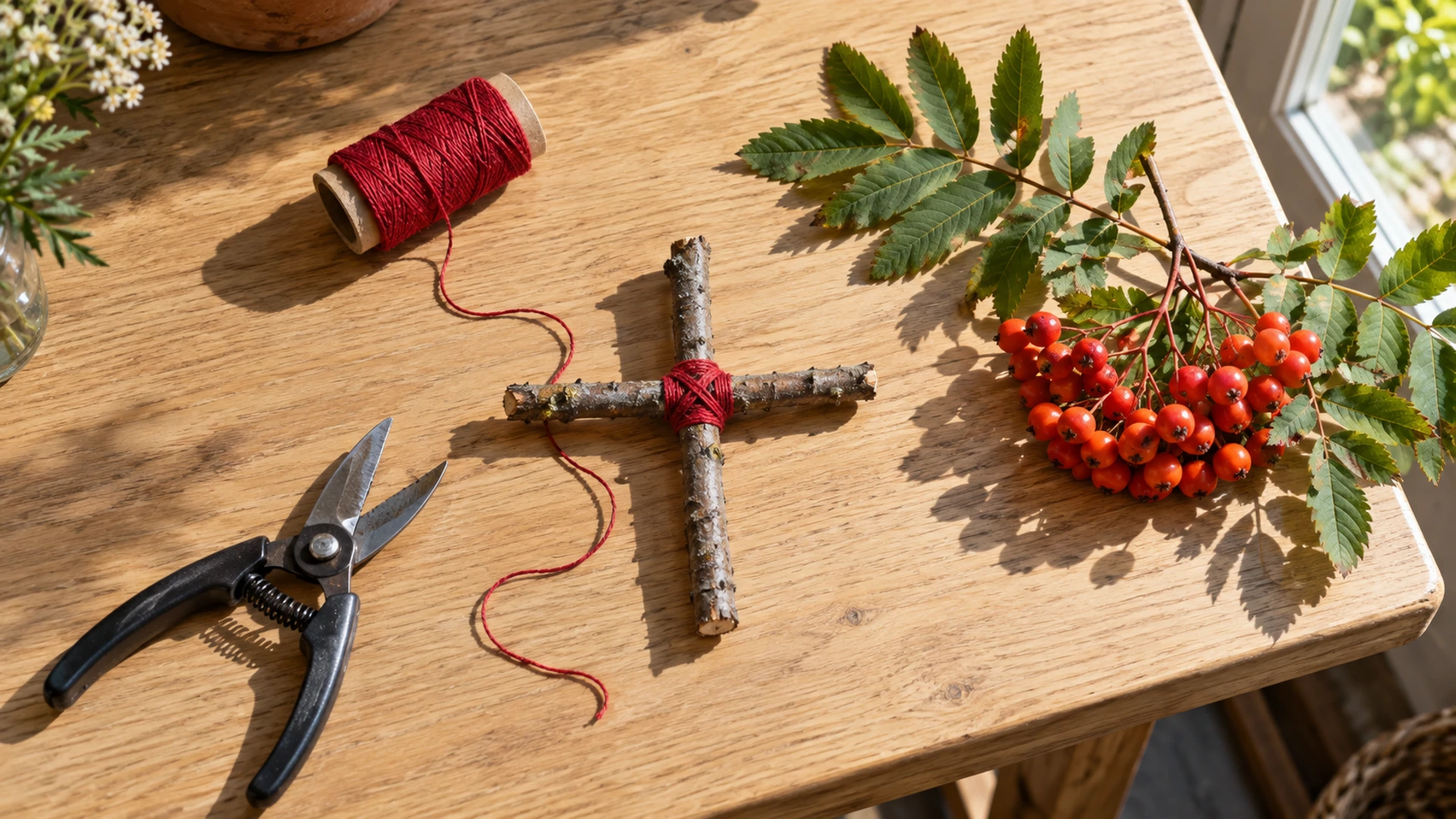
Rowan wood and carved charms. Traditionally, the most powerful use of Rowan is working with the wood itself. Small branches, twigs, or carved pieces of Rowan wood have been used as protective amulets across Celtic and Norse traditions for centuries. If you can source ethically harvested Rowan wood, binding two twigs into an equal-armed cross with red thread is one of the oldest and most straightforward protective charms in British folk magic. Hang it above your door, place it in your car, or carry it in a pouch. The combination of the wood and the red thread (red being a color of protection and vitality) creates a layered ward that does not require any elaborate ritual to be effective — your intention is what activates it.


Dried berries in sachets and spell bags. Dried Rowan berries are excellent in protection sachets. Combine them with rosemary, rue, or angelica root for a powerfully warding blend. Place the sachet near your front entrance, under your pillow for psychic protection during sleep, or in a space that feels energetically compromised. When combining Rowan berries with other protective herbs, let the intention guide the recipe — Rowan as the anchor of strong warding, then layer in herbs for their specific complementary properties.


Incense and smoke. Dried Rowan leaves and bark can be burned as loose incense on a charcoal disc. The smoke is protective and clarifying. Use it to cleanse a space before divination, to seal a room against unwanted influence, or to open a ritual circle. Rowan smoke is particularly effective before tarot readings, scrying, or any kind of spirit communication — it creates the magical equivalent of a clean, well-lit room, where nothing unwanted can hide in the corners. If you're burning Rowan wood chips, the scent is subtle and slightly astringent, which suits its no-nonsense protective nature perfectly.


Candle work. Rowan berries or dried crushed leaves can be used to dress a candle for protection spells. Use a black candle for hex-breaking or warding against specific threats, or a white candle for general purification and psychic shielding. Roll the dressed candle in finely ground Rowan material, set your intention clearly, and burn it with focused will. The act of preparation itself is part of the working — Rowan rewards deliberate, unhurried intention.


Rowan berry ink and sigil work. Rowan berries, when boiled and strained, produce a dark reddish liquid that has historically been used as a magical ink. If you work with sigils, petitions, or written spells, writing your intention in Rowan berry ink adds the tree's protective and psychic-enhancing energy directly into the written working. This is a more advanced application but a deeply satisfying one — you are literally drawing with the plant's own energy.


Altar and boundary work. Rowan branches can be laid along the perimeter of a ritual space or altar to define and protect the boundary. In outdoor workings, pressing Rowan stakes into the ground at the corners of your working area creates a strong protective frame. Indoors, small bundles of dried Rowan placed at each corner of a room serve the same purpose. This kind of spatial protection is straightforward but remarkably effective, especially when you reinforce it with clear verbal or mental statements of intent as you place each piece.

Rowan in Magical History

Rowan's reputation in magic is old, widespread, and strikingly consistent across cultures that developed their practices independently. That consistency is one of the strongest arguments for Rowan's genuine energetic properties — when people across different continents and centuries reach the same conclusions about a plant, that is worth paying attention to.


Celtic and British Isles traditions. In Celtic cultures, Rowan was one of the most sacred trees, known in Irish as caorthann and in Scottish Gaelic as caorann. It was planted near homesteads specifically to ward against witchcraft, evil spirits, and malevolent fairy influence. Carrying Rowan was believed to protect travelers. Equal-armed crosses made from Rowan twigs bound with red thread were hung above doorways and inside cattle barns to protect livestock — a practice that survived in rural Scotland and Ireland well into the twentieth century. In Welsh mythology, Rowan (called cerdinen) appears in connection with prophetic vision and the power of the Otherworld, reinforcing its role as a tree of both protection and sight.


Norse tradition. In Norse cosmology, Rowan has a direct mythological role: it is the tree that saved Thor's life when he was swept away by the river Vimur in the underworld. The first Rowan tree was said to have grown from a red glove dropped by the goddess Sif, and the tree was associated with Thor's protective power. Rowan branches were hung in homes as wards against lightning and misfortune. The connection to Thor — a deity of strength, storm, and protection — reinforces every quality the tree is used for in modern practice. Working with Rowan in a Norse-influenced context and calling on Thor is entirely coherent and historically grounded.


British folk magic and cunning craft. In English folk magic and the broader tradition of the cunning folk — the community healers and magical practitioners of pre-modern Britain — Rowan was a staple of the apothecary. It appeared in anti-witchcraft measures, in protective charms for the home, and in workings designed to break curses or reveal hidden malevolent magic. The berries were sometimes strung into necklaces for protection, echoing similar practices found in Norse and Celtic contexts. The yarrow-and-Rowan pairing appears in several British folk charms for warding and clarity, two plants whose protective and psychic properties were understood to complement each other naturally.

Safety and Cautions When Working with Rowan

Rowan is a relatively safe plant to work with magically, but there are a few things you should know before you bring it into your practice — especially if you're planning to work with it in any form that involves ingestion or skin contact.


The berries are mildly toxic when raw. Raw Rowan berries contain parasorbic acid, which can cause nausea, vomiting, and digestive upset if eaten in significant quantities. Cooking or drying the berries breaks down this compound and renders them safe — rowan jelly and rowan berry wine are traditional British foods precisely because processing neutralizes the toxin. For magical purposes, if you are handling dried berries, standard hygiene is sufficient: wash your hands after handling and don't put raw berries in your mouth. Do not allow children or pets to consume raw berries from ornamental or wild Rowan trees.


Do not consume Rowan as a tea or tincture without proper preparation. Some practitioners want to ingest herbs as part of their magical work — teas, infusions, tinctures. With Rowan, raw or improperly processed plant material should not be used internally. If you want to work with Rowan in an ingestible form, use commercially prepared, properly dried and processed Rowan berry products from reputable herbal suppliers, and always consult a qualified herbalist or healthcare provider before ingesting any new plant material, especially if you are pregnant, nursing, or managing a health condition.


Ethical wildcrafting. If you are harvesting Rowan from the wild or from a tree in your garden, be mindful of sustainable practice. Take only what you need, leave plenty of berries for wildlife (birds in particular depend heavily on Rowan berries in autumn and winter), and always ask the tree's permission in whatever form feels meaningful to your practice before harvesting. Ethically sourced material carries better energy into your workings — that is not just a spiritual sentiment, it is a reflection of the respect and intentionality that make magic effective in the first place.


Rowan smoke is generally well-tolerated but, as with any incense or smoke-based practice, ensure you are working in a well-ventilated space. Those with respiratory sensitivities, asthma, or smoke allergies should use caution with any plant-based incense including Rowan, and may want to explore non-smoke alternatives like placing dried plant material in a sachet or on the altar without burning it.

Continue Building Your Herbal Practice

Every herb you work with belongs to a broader category — cleansing, protection, attraction, or banishment — and knowing where a plant sits in that framework is what turns a shelf of dried botanicals into a real practice. If you're ready to see how Rowan fits alongside the other foundational herbs, read Herbs in Magic: A Beginner's Guide to Magical Herbalism. It maps out the four core categories of herbal magic and walks you through the key plants in each one.

Start where you are, follow what calls to you, and trust that your practice will deepen with every plant you come to know.


FAQ - Rowan in Magic for Beginners

What is Rowan used for in magic?

Rowan is primarily used for protection, warding, and psychic shielding. It's one of the most reliable plants in the Western magical tradition for deflecting hexes, repelling malevolent spirits, and creating strong energetic boundaries around people, homes, and ritual spaces. It also supports divination and psychic clarity.

What parts of the Rowan tree are used in magical practice?

The berries, leaves, bark, and wood are all used. Rowan wood is carved into protective charms and amulets. Dried berries go into sachets and spell bags. Leaves and bark can be burned as protective incense. The berries can also be used to make a magical ink for sigil work and written spells.

Is it safe to burn Rowan as incense?

Yes, burning dried Rowan leaves, bark, or wood chips as loose incense is generally safe. As with any smoke-based practice, work in a well-ventilated space. People with asthma, respiratory conditions, or smoke sensitivities should exercise caution and may prefer using Rowan in non-combustible forms such as sachets or altar arrangements.

Are Rowan berries poisonous?

Raw Rowan berries contain parasorbic acid and can cause nausea and digestive upset if eaten in quantity. Cooking or thoroughly drying the berries neutralizes this compound. For magical work involving handling dried berries, simply wash your hands after and avoid ingesting raw berries. Do not let children or pets eat raw Rowan berries.

What is the easiest Rowan charm a beginner can make?

The simplest and most traditional Rowan charm is an equal-armed cross made from two small Rowan twigs bound together with red thread. Set your protective intention clearly as you tie the knots, and hang it above your front door. This charm has roots in Celtic and British folk magic and remains one of the most straightforward warding tools you can make.

Which crystals work well with Rowan in protection magic?

Black Tourmaline, Amethyst, Labradorite, and Clear Quartz all pair naturally with Rowan. Black Tourmaline reinforces its warding energy. Amethyst and Labradorite support psychic clarity and shielding, which complements Rowan's divination-enhancing properties. Clear Quartz amplifies intention in any working. Place these on your altar alongside Rowan material for a coherent, mutually reinforcing setup.

Can I use Rowan in divination work?

Absolutely. Rowan is one of the best plants to work with when you want to enhance psychic clarity without losing your sense of personal grounding. Burn Rowan incense before a tarot reading or scrying session, place dried Rowan on your divination altar, or carry a small piece of Rowan wood while you work. It sharpens intuitive perception while keeping your center stable — so you access visionary states with your wits fully intact.

What deities are associated with Rowan?

Rowan has strong associations with Thor (Norse tradition, where the tree is linked to his protective power), Brigid (Celtic fire goddess of healing and magic), Hecate (goddess of thresholds and protection), and the Dagda (Irish deity of strength and wisdom). If you work with any of these deities, Rowan is a meaningful offering and a coherent addition to your altar or ritual work.
June 15, 2026

About the Author — Claire

Claire is a New York-based magical practitioner and folklore researcher with years of study spanning mythology, astrology, tarot, herbalism, and grimoire traditions. She approaches magic as a disciplined practice rooted in will and intention — and writes about it with the same depth, honesty, and enthusiasm she brings to her own craft. Whether you're just starting out or deep in your practice, her articles give you real knowledge you can actually use.

More about the author →