Fennel: The Nine Herbs Charm's Midsummer Door Herb
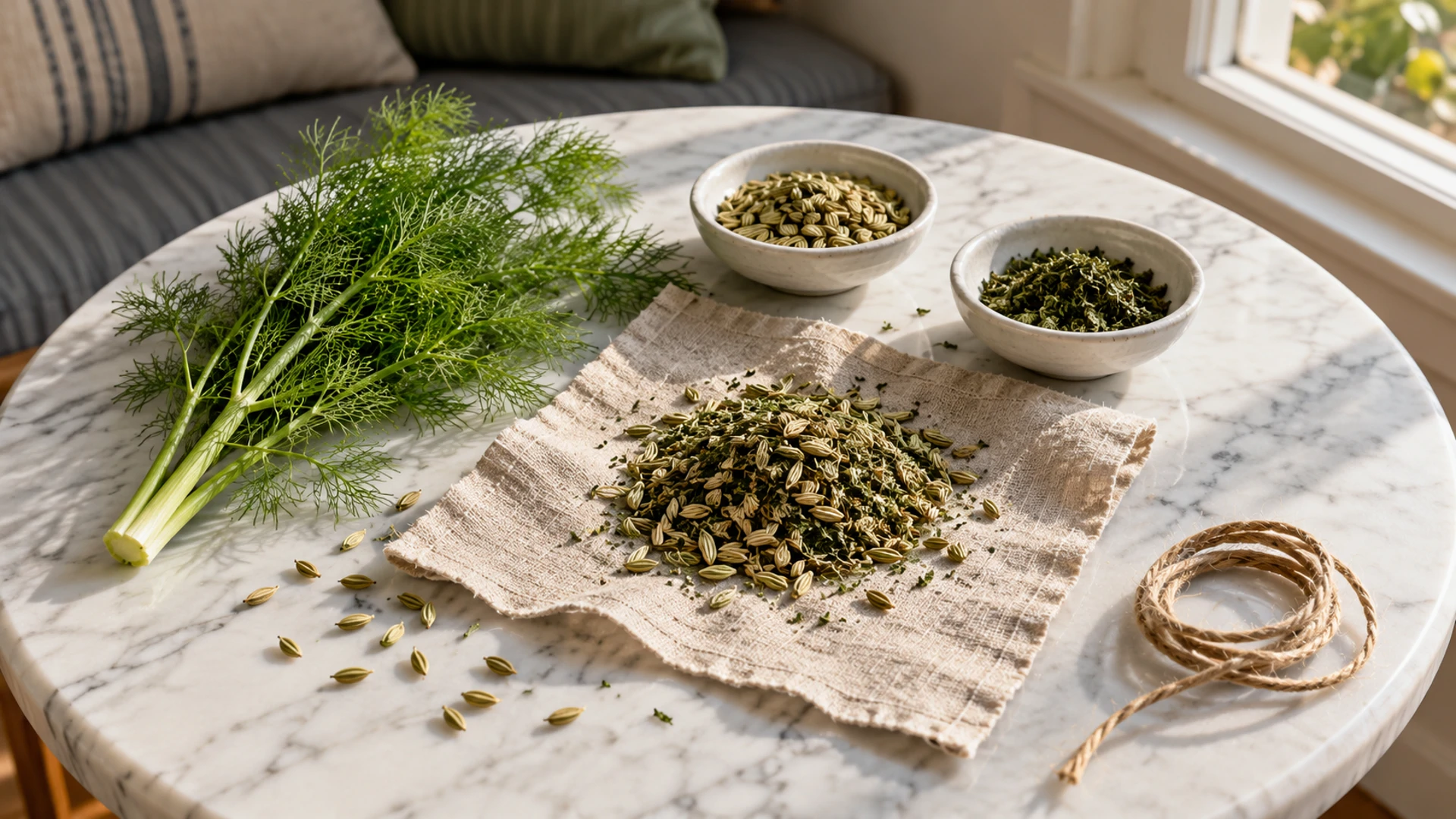
Fennel is a feathery, anise-scented herb hung over doors at Midsummer and laid along thresholds, one of the nine plants of the Anglo-Saxon Nine Herbs Charm, where it and chervil are called a most mighty pair.
Guarding the Way In: Fennel's Place in Protection
Fennel's magical identity is specific: it guards the threshold. Not the nursery, not the traveler's bag, not the interior of the house — the doorway itself, the point where outside meets inside. That precision matters when you're choosing what to hang, scatter, or tuck, because protective herbs are not interchangeable. Dill, fennel's close culinary cousin in the carrot family, leans toward the cradle, protecting the household's youngest and most vulnerable members. Fennel was hung at the door itself, working alongside St. John's wort, the Midsummer solar ward gathered at the height of the sun and placed over doors and windows against evil spirits and lightning. The two herbs share the same festival and the same placement, but they hold different angles: St. John's wort is solar and blazing, gathered on the night of June 23rd for its solar force. Fennel is the Mercurial threshold herb, governing the passage.
Its correspondences place it under Mercury — Culpeper specifically assigns it to Mercury in Virgo, and Scott Cunningham aligns it with Mercury and fire, Wednesday being its day. That Mercurial quality makes sense for a threshold herb: Mercury governs doorways, passages, crossings, and the movement between spaces. A plant that guards the way in is naturally a Mercurial plant. Fire as its element gives it a warding edge rather than a simply calming one — this is an herb that holds a boundary, not one that soothes what lies beyond it. Its secondary correspondence falls under Healing and Peace, a quality rooted in its documented use in traditional European medicine.
What fennel does not do is cover every protective angle at once. If you need a ward that seals a situation and keeps it locked in place, Solomon's seal does that work. If you need the fierce enforcing smoke of Scottish saining, juniper is your herb. Fennel's strength is simpler and more specific: it marks where your space begins and holds that line through the Midsummer season and beyond. That specificity is what makes it useful. You know exactly what you're working with.
A Most Mighty Pair: Fennel in the Nine Herbs Charm
The Nine Herbs Charm comes from the Lacnunga, an Old English manuscript dated to the 10th or 11th century. It is one of the most detailed surviving documents of Anglo-Saxon plant magic, naming nine herbs against poison and infection and calling on their powers in verse. Mugwort is addressed first, as the oldest of herbs. Fennel sits later in the charm alongside chervil, and the two are hailed together — a most mighty pair. The charm does not separate them or assign them individual tasks; they are invoked as a unit, their combined virtue treated as greater than either alone. That pairing has carried through into modern practice, and it is the basis for the sachet below. The Lacnunga also names chamomile, nettle, and crab apple among the nine, making fennel part of a genuinely old protective and healing tradition rather than a later interpolation.
The Midsummer door custom, hanging fennel fronds over doors around June 23rd and 24th, belongs to a wider European pattern of using aromatic plants at the summer solstice turning point to ward the household through the year's second half. Fennel was hung in this context alongside St. John's wort, and the two appear together in enough sources to treat them as a traditional pairing at Midsummer. One naming note worth keeping clear: giant fennel, the plant whose hollow stalk Prometheus used to carry stolen fire from the gods to humanity in Greek myth, is not the same plant. Giant fennel is Ferula communis, a different genus in the same carrot family. Ferula is also the genus that gives us asafoetida, the pungent banishing resin. Foeniculum vulgare, the fennel of the Nine Herbs Charm and the kitchen garden, has its own lineage separate from the Prometheus myth entirely.
Seeds, Fronds, and a Look-Alike to Fear
The most important practical fact about fennel is not about how to use it — it is about how not to source it. Fennel belongs to the carrot family, Apiaceae, and that family includes poison hemlock, one of the most lethal plants in the temperate world. Hemlock and fennel can grow in the same places, and both have feathery leaves and hollow stems. Fennel's anise smell is a strong signal, but smell alone is not a reliable identification test; hemlock also has distinctive purple blotching on its stems, but you cannot count on that either. The rule is simple: buy fennel from a reputable herb supplier or grow it from seed in your own garden. Do not forage it unless you have expert-level plant identification skills and are working alongside someone who does too. The stakes of getting it wrong are not manageable.
The parts you work with in fennel magic are seeds, fronds, and stalks. Whole dried stems are the most useful form for charm work — they hold their shape, dry well, and carry the scent. Fronds are what you hang over a door. Seeds are what you scatter or seal into a sachet. Ground fennel from a spice jar will work in a pinch, but the whole seed holds its energy better and is easier to handle intentionally. On safety: culinary fennel is safe for adults in normal amounts. The essential oil is a different matter — it is avoided in pregnancy and should not be used for or around infants. For threshold work, where you are burning fronds, hanging them dry, or using seeds in a sachet, these precautions are not relevant. They apply to concentrated oil preparations, not to the herb in its everyday forms.
Three Fennel Workings for the Threshold
Midsummer Fronds Over the Door
This working is timed to the Midsummer turning point, the night of June 23rd and 24th, when the tradition of hanging aromatic herbs over the door is oldest and strongest.
Cut or buy fresh fennel fronds a day or two before Midsummer. If you want to follow the traditional pairing, add a sprig of St. John's wort to the bundle. Hold the bundle between your hands before you hang it and bring your full attention to the doorway: what it protects, who comes through it, what you want to stay out. Then hang it above your front door, fronds facing down, secured with twine or wire. Leave it through the year until the next Midsummer, when you take it down, thank it, and burn it or compost it before hanging a fresh bundle. If the fronds fall or deteriorate significantly before then, replace them without ceremony and without treating it as an omen. The working is in the hanging and the intention, not in the fronds lasting perfectly.
A Line of Seeds Along the Sill
This is a quieter working for windowsills and doorsteps — less seasonal than the Midsummer hanging, and suited to times when you want to renew or reinforce a threshold without waiting for the solstice.
Take a small handful of whole fennel seeds and hold them in your palm. Set your intention clearly: this line marks where your space begins, and what is unwelcome does not cross it. Then lay the seeds along the full width of the threshold — windowsill, doorstep, or both — starting from one edge and finishing at the other without lifting your hand mid-way. Do this on a Wednesday or during a Mercury hour, which aligns the working with the herb's own planetary current. Sweep the seeds up after a week, or when they've been disturbed by weather or foot traffic, and renew them with fresh seeds and a fresh statement of intent. You are not trying to create a permanent physical barrier; you are marking the space and reinforcing it each time you renew it. The act of renewal is part of the working.
The Mighty Pair Sachet
This sachet draws directly on the Nine Herbs Charm's pairing of fennel and chervil as a most mighty pair, treating the combination itself as the working rather than either herb alone.
Combine a teaspoon of whole fennel seeds with a teaspoon of dried chervil in a small cloth sachet — linen or cotton, white or undyed if you have it. Hold the sachet and call to mind the pairing as an ancient one, two herbs invoked together across more than a thousand years of protective tradition. Tie the sachet closed with three knots. Carry it in a pocket or bag for personal protection, or hang it near your front door inside the house, just behind the threshold. Replace it after three months or when the scent fades noticeably.
Nine Herbs, One Doorway
Fennel guards the way in. That is its specific angle within the broader work of protection, and it is a precise and durable one — rooted in the Lacnunga's Nine Herbs Charm, in the Midsummer door customs of medieval Europe, and in the Mercurial governance of passages and crossings. It does not replace the herbs that seal, the herbs that enforce, or the herbs that repel what approaches. It marks the threshold and holds it, and that work has genuine weight.
If you want to see how fennel sits alongside the other thirteen herbs in the Protection and Warding category, and how those relate to the six other paths through plant magic — banishing, love, prosperity, divination, healing, and cleansing — the witch's herbarium and seven paths is where to go next.