Thuja: The Cedar That Isn't a Cedar
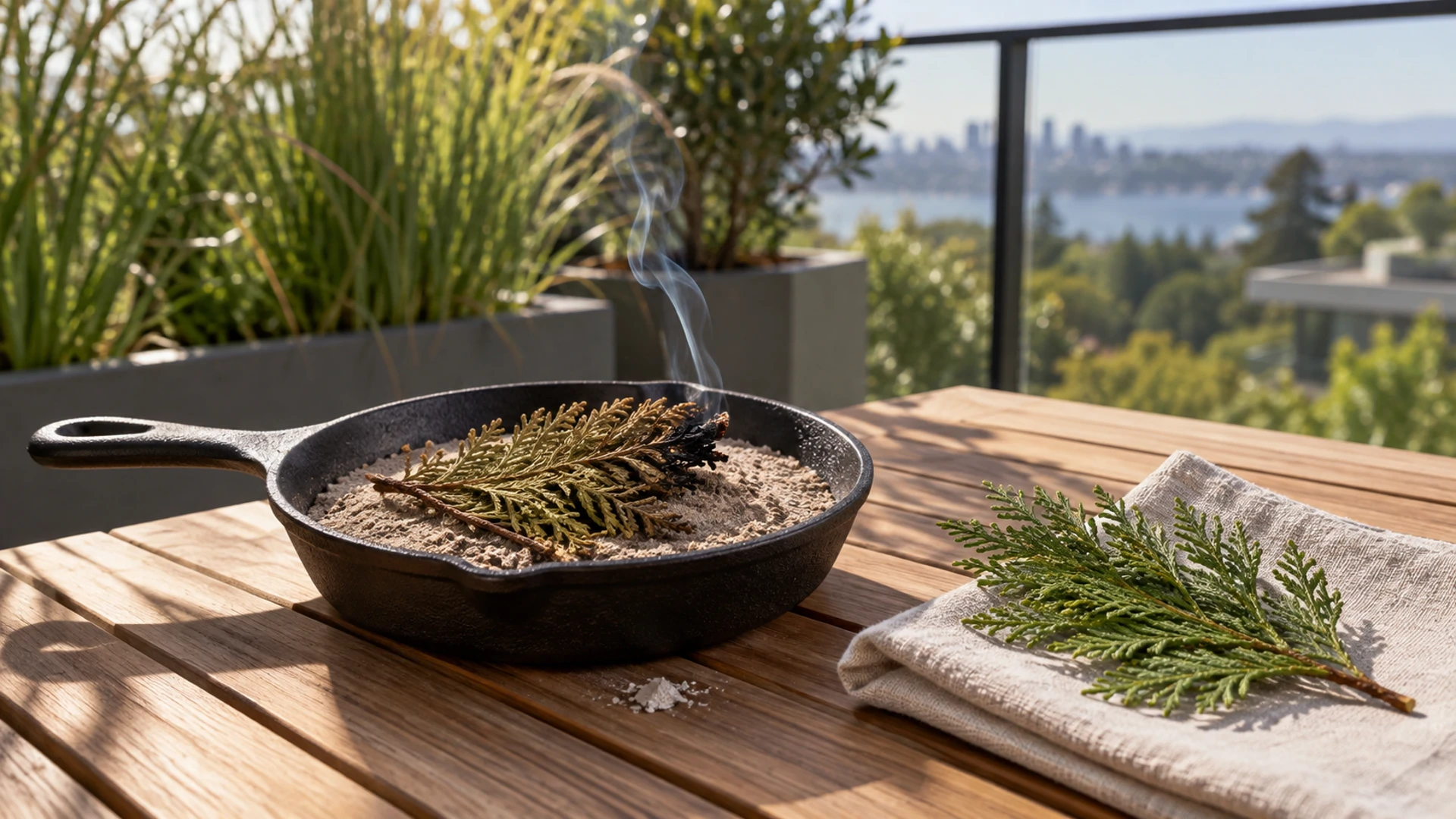
Thuja is the North American "cedar" of most cedar smoke bundles — burned for purification, hung over doorways for protection, and one of the four sacred medicines of Anishinaabe teaching alongside tobacco, sage, and sweetgrass.
Sacred-Medicine Smoke: Thuja's Place in Cleansing
Thuja's specific angle in cleansing work is what you might call sacred-medicine smoke. Where white sage performs a forceful clearing — a strong, total reset of a space's atmosphere — thuja offers something lighter: a resinous, faintly sweet purifying smoke with deep roots in Anishinaabe practice. It doesn't overwhelm a room. It moves through it. The smoke carries a quality of ceremony without demanding the heavy air of a full ritual reset, which is part of why it works well at the beginning of a practice session, when you want the space to feel attended to rather than scoured.
Pine, by contrast, brings renewal — a cold, fresh clearing that cuts through staleness and carries midwinter's promise of continuing life. Thuja's register is warmer and more resinous than that, closer to the sacred-medicine tradition it comes from. Its secondary category is Protection and Warding, expressed through the old practice of hanging fronds over a doorway, which is one of the simplest and most durable uses of this plant in folk practice. The smoke cleanses, the hung frond guards. Both are available from a single plant.
Correspondences for thuja are worth stating honestly. Culpeper and Cunningham treat "cedar" generically, and thuja has no distinct historical planetary ruler of its own. Modern practice borrows cedar's Sun and fire — but that is a borrowed convention, not a tradition native to this plant. If you work within a planetary framework and want to use that attribution, it's available to you. Just know where it comes from. Beyond that borrowed Sun and fire, no planet, day, chakra, or zodiac sign has any real claim on it.
Arborvitae, Giizhik, and the Other Two Cedars
Thuja is not a true cedar. That's the first thing worth knowing, because the confusion runs deep. There are two species in common use: Thuja occidentalis, called northern or eastern white cedar, and Thuja plicata, called western red cedar. Both belong to the cypress family (Cupressaceae). True cedar — the cedar of Lebanon, Atlas cedar, deodar — belongs to the pine family (Pinaceae) and is a completely different tree. The Old World sacred timber is what you find in the Epic of Gilgamesh and Solomon's temple. Thuja is what you find in North American hedgerows and smoke bundles. Eastern red cedar, which is commonly burned as "cedar" in ceremonial contexts across North America, is actually a juniper (Juniperus virginiana), not a cedar at all. Thuja and eastern red cedar together make up the overwhelming majority of what is sold and burned as "cedar" on this continent. The arborvitae hedge lining suburban driveways is a cultivar of T. occidentalis — the same plant.
In Anishinaabemowin, cedar is called giizhik, and it is one of the four sacred medicines of Anishinaabe teaching. The other three are tobacco, sage, and sweetgrass. Cedar is used for purification, protection, and healing within that tradition. On the Pacific Northwest Coast, western red cedar held a different but equally central role: it supplied canoes, plank houses, bark clothing, baskets, and ceremonial regalia, and is widely called the tree of life by the peoples of that region. These are the traditions of those nations, developed over generations. They belong to those communities. Knowing about them enriches a practitioner's understanding of where this plant comes from and what it has meant to people for a very long time — which is different from adopting those ceremonies as your own practice.
The name arborvitae — Latin for "tree of life" — carries its own story. It is traditionally tied to the winter of 1535 to 1536, when Iroquoian people at Stadacona, near what is now Quebec City, taught Jacques Cartier's scurvy-stricken crew to brew a remedy from a tree they called annedda. The men who had been ill recovered. Cartier brought specimens back to Europe, and the tree was named arborvitae in recognition of what it had done. Most historians identify annedda as T. occidentalis, though some argue for balsam fir, and that debate has never been fully settled. What is not in dispute is that Indigenous knowledge saved those men's lives. The name the Europeans gave it afterward is a tribute to that, even if the name stuck to the plant and the people behind the knowledge were largely forgotten in the retelling.
A Frond From the Hedge, and Why It Stays Outside the Body
Neither thuja species is threatened. This matters practically, because it means you don't need to source from a specialty supplier or worry about environmental impact the way you would with some cleansing plants. A garden arborvitae hedge — and there are millions of them, planted as windbreaks and privacy screens across North America — is an easy, low-impact source of fronds. Cut a small amount at a time. Anishinaabe teaching calls for harvesting only a small portion, with thanks offered to the plant. That teaching belongs to that tradition, and practitioners outside it may choose to follow a similar ethic as a matter of respect and good practice. The fronds dry quickly at room temperature in a few days, away from direct sun, and hold their scent well.
Safety with thuja is specific and important. The foliage and oil both contain thujone, a convulsant compound. This means thuja is never taken internally — not as a tea, not as a tincture, not in any preparation meant to be consumed. It should be avoided entirely during pregnancy and by anyone with epilepsy. The essential oil is never used undiluted on skin. On the practical side: thuja is harmful to pets, and this isn't a mild caution. Keep dried fronds and any oil well out of reach of cats and dogs, and don't burn thuja in a small, enclosed space with animals present. For smoke cleansing in a ventilated room with the window open, the fronds are fine. The plant is not dangerous to handle; it's the concentrated oil and internal use that carry real risk.
Three Workings With Arborvitae
Smoke From a Hedge Frond
Use this when you want a lighter purifying smoke at the start of a working — something that attends to a space without resetting it entirely.
Cut two or three small fronds from a garden arborvitae, saying something brief in thanks as you do. Lay them flat and let them dry for at least two to three days until the foliage feels papery. Open a window before you begin. Place the dried fronds in a fireproof dish — a cast-iron skillet or a ceramic bowl with sand in it both work — and light the edge of one frond with a match, then blow it out quickly so it smolders rather than flames. Move the dish slowly around the space you're cleansing, letting the lighter, resinous smoke drift into corners and along doorframes. When you're done, let the fronds burn out completely in the dish, or press them out against the sand and compost them. Keep the window open for a few minutes after to let the smoke settle.
The Frond Above the Door
Use this as a steady, passive protection at a threshold — the secondary warding role thuja has carried in folk practice for a long time.
Take a fresh green thuja frond, a small one, and attach it above the inside of your front door using a tack, a loop of twine, or a small nail. You don't need to dry it first — a fresh frond will slowly dry in place, which is part of the working. As you hang it, hold in mind what you want it to stand for: a threshold that stays clear of whatever you don't want to carry inside. Replace the frond when it browns and loses its color entirely, composting the old one rather than throwing it in the trash. If you have pets, hang it high enough that they can't reach it — both for safety and because it's doing its work best where it's undisturbed.
A Small Wood Charm
Use this when you want a quiet, carried reminder of protection and purification rather than a periodic ritual.
Find a small piece of thuja wood — a pruned branch segment works, or a piece of rough-cut wood from a lumber supplier. It doesn't need to be carved or shaped. Hold it in both hands and let your intention settle into it: this is a marker of what you're aligning yourself with. Keep it on your altar, in a pocket, or in a bag you carry regularly. It asks nothing of you in the day-to-day; it's simply there, doing the slow, steady work that protective wood has always done.
The Lighter Smoke of the Northern Cedar
Thuja's place in the Cleansing and Purification category is as a sacred-medicine smoke: a lighter, resinous purifying smoke with roots in Anishinaabe practice that most Western practitioners are only beginning to understand in its full context. It's not the heavy reset of white sage, not the cold renewal of pine, not the consecration of frankincense. It is its own thing — and knowing that distinction makes it more useful, not less. When you light a thuja frond, you're working with the specific qualities of that plant rather than reaching for a generic cleansing smoke.
One last note worth carrying away: when you buy a North American cedar bundle without further specification, you are almost certainly holding thuja, eastern red cedar (a juniper), or a blend of both — not true cedar. That's not a problem; it's simply the plant world being more specific than the label. For a deeper look at thuja alongside the other eleven cleansing plants and the six other paths through plant magic, the Witch's Herbarium: seven paths is the place to go next.