Comfrey: Knitbone, the Herb That Mends
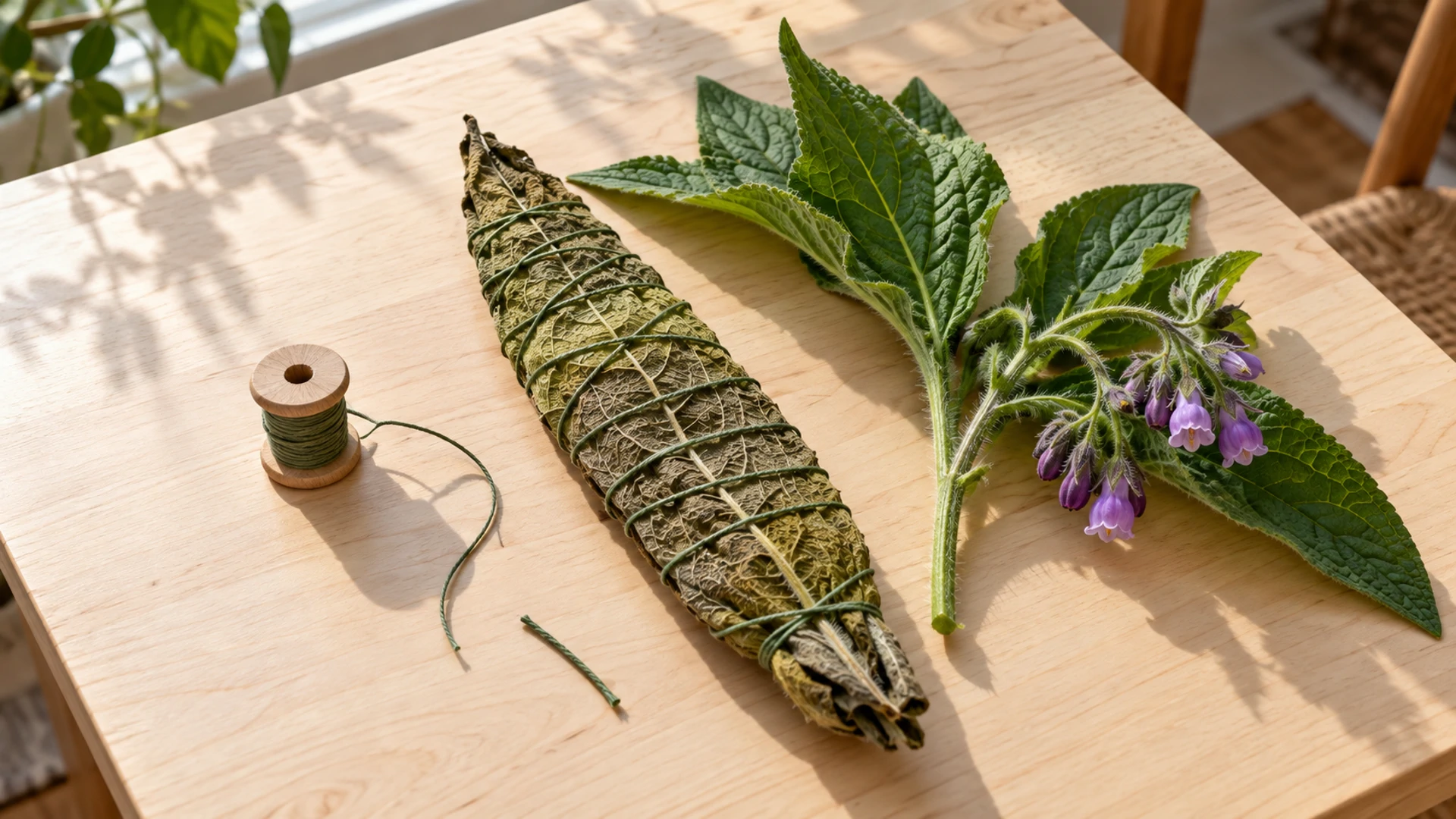
Comfrey (Symphytum officinale) is a broad-leaved Saturn herb whose dried root goes into mending charms during periods of recovery or rebuilding, and whose leaf is tucked into luggage as a protective talisman for safe travel — carried rather than consumed.
Mending: Comfrey's Place in Healing
Among the Healing & Peace herbs, each one arrives at the category from a different direction. Chamomile soothes a person toward sleep. Lavender brings all-round calm and peace. Lemon balm gladdens and lifts low spirits. Borage restores nerve and lifts heaviness. Cypress consoles in grief. Comfrey's angle is different from all of them: it works on what has come apart. A broken routine, a friendship under strain, a body slowly getting back on its feet — these are comfrey's territory. It doesn't soothe or gladden so much as knit.
That mending quality extends into its secondary category, Protection & Warding, specifically through safe travel. The idea of comfrey as a traveling companion runs alongside the mending work: you carry it because a journey puts things at risk, and comfrey's root is something that holds together what might otherwise come loose. These two faces, mending and protecting the traveler, belong to the same plant and the same underlying logic.
Comfrey's correspondences are Saturn and water. Culpeper placed it under Saturn in Capricorn; Cunningham gives it Saturn and water as well, and Saturday as its day. That Saturn rulership is a natural fit. Saturn governs slow, patient time — the kind of time that mending actually takes. There's no rushing a Saturn working, and comfrey doesn't rush. It is the herb for the long stretch of recovery and repair rather than for the sudden turning point.
Grown Together: Symphytum and Knitbone
The Latin genus name Symphytum means "grown together," which tells you exactly what this plant's reputation was built on. Its folk names knitbone and bruisewort record centuries of use in poultices applied to sprains, broken bones, and bruised flesh — the root was pulped or prepared into compresses to help damaged tissue repair. That practical history is where comfrey's magical identity comes from. A plant used for generations to help broken things heal becomes, in the logic of magical herbalism, a plant that carries that same virtue into ritual work. The name does the heavy lifting: knitbone says it plainly.
Cunningham records a specific practice with comfrey that steps away from the healing angle and into protection: tucking a piece of comfrey into luggage before a journey, to keep both the bag and the traveler safe. It's a simple, physical act of placing the herb with the thing you want protected.
Comfrey, Foxglove, and a Root for Charms
One identification issue with comfrey deserves real attention. Young comfrey leaves have been confused with foxglove (Digitalis purpurea), which is deadly, and the confusion has caused fatalities. The leaves look similar at certain stages of growth — broad, softly hairy, growing in a basal rosette before the flower stalk appears. For magical work, the straightforward answer is to buy comfrey dried from a reputable herb supplier, where it has already been identified correctly. If you want to grow or gather your own, that requires knowing both plants with certainty, not just a general familiarity with one of them.
The working forms are the leaf and the root, used in charms, sachets, and bound workings. Both are available dried. The root is the denser, more substantial material and tends to anchor long-term charm work; the leaf is easier to fold, bind, and tuck. Comfrey contains pyrrolizidine alkaloids that damage the liver, so it is not taken internally — it belongs in your charm bag, not your teacup.
Three Comfrey Workings for Mending
A Mending Root Charm
This working is for a sustained period of recovery or rebuilding — the weeks or months when you are putting something back together and need an anchor for that intention.
Take a piece of dried comfrey root and wrap it in a small square of undyed cloth — natural fiber, whatever you have. As you wrap it, hold in mind what you are mending: a relationship returning to steadiness, a practice you are rebuilding, a body in the slow work of recovery. Tie the cloth closed with a simple knot. Keep the bundle on your altar, or carry it in a pocket or bag for the duration of the work. Begin this on a Saturday or during a Saturn hour, so the timing aligns with the herb's own planetary current. When the period of mending has passed, return the root to the earth.
A Leaf Bound With Thread
This is a working for a friendship or bond that has frayed — not broken beyond recognition, but strained enough that it needs tending.
Take a dried comfrey leaf and a length of thread in a color that feels right for the bond you are repairing — green for growth, white for clarity, whatever reads as true to you. Hold the leaf flat and begin winding the thread around it slowly, from one end to the other, saying aloud or in your mind the name of the person and the specific thing you want to see repaired between you. Wind until the thread runs out or until you feel the intention is set. Tie off the end and fold the leaf gently so the thread holds. Place it on your altar and leave it there while the repair is under way. When you feel the bond has strengthened, bury the leaf outside.
A Leaf in the Luggage
This is a straightforward protective practice for any journey, following Cunningham's recorded use of comfrey as a traveler's talisman.
Tuck a single dried comfrey leaf into your suitcase or travel bag before you leave — not loose where it will crumble, but slipped between layers of clothing or placed in a small sealed envelope. The intention is simple: the leaf travels with you and keeps both you and your bag under the herb's protective presence for the duration of the trip. Remove it when you return home.
What Grows Back Together
Comfrey is the mending face of Healing & Peace — the herb for the long, patient work of repair. It sits in a category with herbs that approach rest and restoration from different directions, and its distinctness is worth holding onto. You reach for comfrey not when you need to be soothed or gladdened, but when something has genuinely come apart and you want to carry an intention through the slow work of putting it back together.
If you want to see comfrey alongside the other herbs in this category and across the full range of magical plant work, seven paths through plant magic is the place to go — it covers all nine healing and peace herbs and the six other categories of the herbarium.