Indigo Candle Magic: The Color of Knowing Before You Understand Why
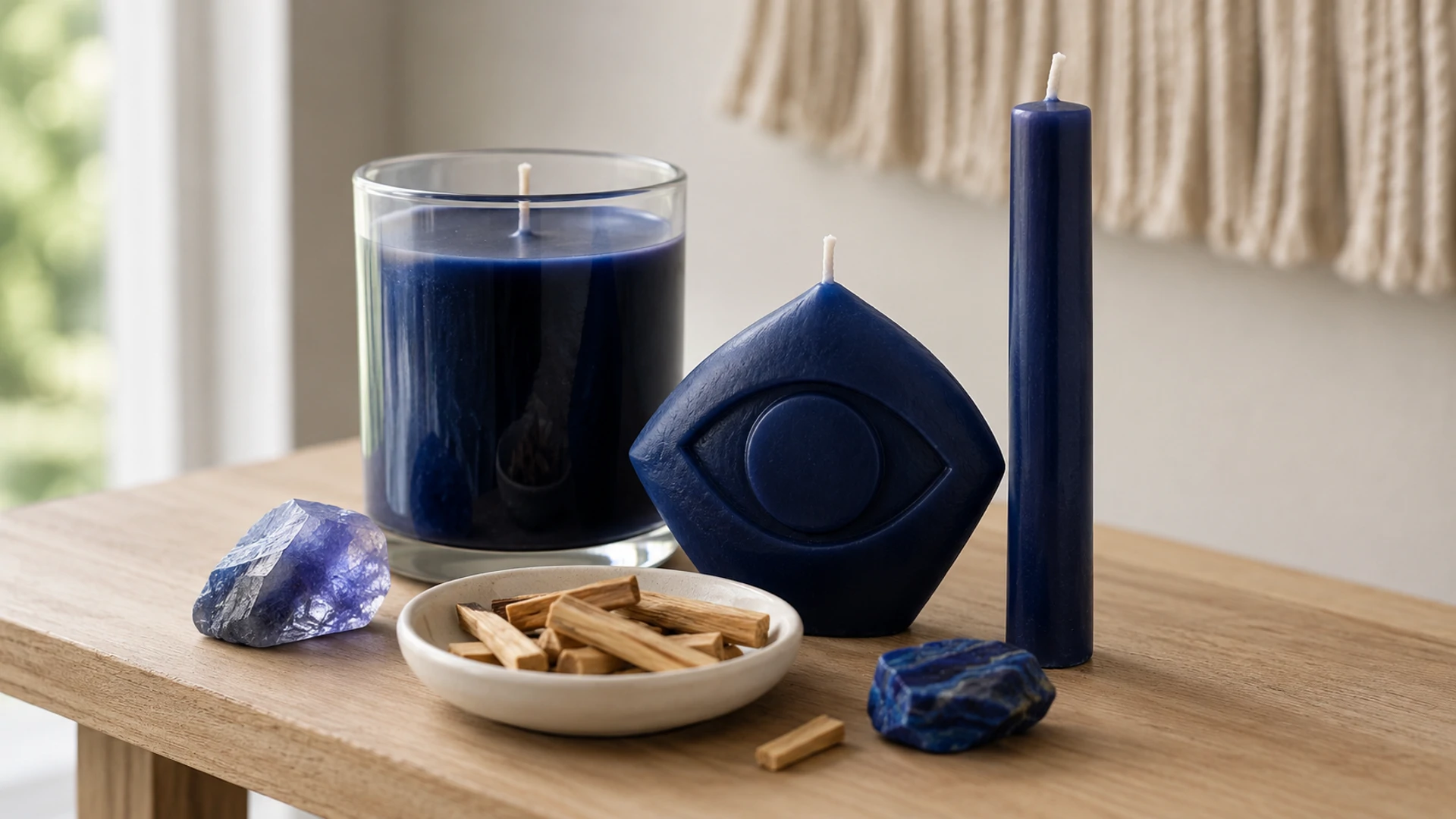
Indigo is the color of the part of you that already understands something before your conscious mind has caught up to explain it. It sits at the edge of visible light, deeper than blue, not quite violet, and that position on the spectrum is not incidental — it describes exactly what indigo does in magical practice. This is the candle you light when you need to access insight that lives below ordinary thought, to strengthen your inner compass, to open yourself to psychic perception with enough grounding to actually use what comes through. Indigo candle magic is demanding work, and it rewards practitioners who bring real discipline and willingness to sit with what they find.
Where Thought Gives Way to Knowing
Indigo Between Blue and Violet
Indigo occupies a genuinely distinct position between two powerful color currents. On one side, blue candle magic works through communication, emotional healing, and conscious clarity — and in its darkest shades, navy blue begins edging toward the subconscious territory of the third eye. Indigo picks up exactly where that dark navy edge leaves off, fully committed to the interior world blue only glimpses. On the other side, purple candle magic carries the third eye into pure spiritual authority — the commanding frequency of established higher knowledge. Indigo sits between these two, receiving visionary material from beneath and transmitting it upward toward understanding. This is an active synthesis, not a neutral middle ground. It holds blue's orientation toward clarity and purple's reach toward transcendence simultaneously, which makes it uniquely suited to one specific challenge: not just receiving psychic information, but knowing what to do with it.
Historical Depth
The dye plant Indigofera tinctoria was so precious across ancient trade routes that it was called "blue gold," moving from South Asia through Persia and Egypt long before synthetic pigments existed. Cultures that had no direct contact with one another independently linked the resulting deep blue-violet color to divine wisdom transmitted through lineage, to the unseeable world underlying ordinary reality, and to states of perception that exceeded normal waking consciousness. The Hindu tradition's association of this hue with the Ajna — the sixth chakra, the seat of inner vision — is one well-known example of a pattern that appears across independent traditions, not a singular cultural invention. This historical consistency tells you something real about how human beings have consistently understood this color's frequency.
The Bridge Quality
What makes indigo distinctly useful in practice is that it doesn't collapse either into blue's communicative mode or purple's commanding mode. It functions as a bridge, translating the looser, associative material of deep intuition into something you can actually work with consciously. A tarot reader who lights indigo before a session isn't just creating atmosphere — they're priming their own perception to move past analytical interference into the state where symbolic associations come through cleanly. A meditator using indigo isn't passively waiting for something to arrive. They're strengthening the faculty that receives, discerns, and integrates. This is active, demanding inner work. Indigo candle magic is the practice of developing the inner capacity for spiritual knowing — not collecting impressions, but building the ability to trust them.
Indigo's Correspondence Profile
Indigo's correspondence profile reflects a color that operates at depth — its planetary rulers, element, and associated allies all point toward the interior world and what can be brought back from it into usable form.
Here's the full correspondence profile at a glance:
- Planet: Saturn (primary), Jupiter (secondary)
- Element: Water (primary), Air (secondary)
- Gender: Feminine
- Deities: Hecate, Thoth, Isis, Morpheus
- Magical properties: Psychic vision, intuition, inner truth, spiritual authority, uncovering hidden knowledge, deep meditation
- Associated crystals: Lapis lazuli, fluorite, tanzanite, azurite, sodalite
- Chakra: Third Eye (Ajna)
Saturn and Jupiter as Dual Rulers
Saturn governs indigo as primary ruler, which tells you immediately that this color's power isn't soft or passive. Saturn is the planet of discipline, structure, and karmic accountability. In the context of psychic development, what this means practically is that real intuitive skill is built through consistent practice, rigorous self-honesty, and the willingness to sit with discomfort rather than reaching for easy answers. Practitioners who approach indigo work casually tend to get chaotic results — not because the color punishes them, but because Saturn's frequency rewards commitment and accountability. This is also where the comparison to grey candle magic becomes useful. Grey also operates through Saturn, but it uses that planetary current toward concealment and neutralization — it hides things from view. Indigo's Saturn does the opposite: it forces what's hidden into visibility, dragging obscured truth through to perception. Both work through Saturn's discipline; one conceals, the other reveals.
Jupiter as secondary ruler brings the other essential quality. In blue's correspondence, Jupiter contributes philosophical expansion and a reaching quality toward broader knowledge. In indigo, Jupiter's contribution is more specific: it's the authority that comes from trusted inner sight. The confidence that your psychic perception is real and reliable — not arrogance, but earned inner standing — is a Jupiterian quality working through indigo's frequency. You can work indigo during a Saturn hour for deep disciplined work, or during a Jupiter hour when the emphasis is on expanding that inner authority and trusting what arrives.
Water and Air
Water as primary element governs the subterranean current of indigo's work. In blue's correspondence, Water connects to emotional healing and the flowing quality of communication — it sits close to the surface. In indigo, Water goes deeper, into the parts of the inner world that exist entirely outside conscious awareness until something draws them up. The psychic flow indigo activates isn't about feeling more — it's about accessing layers that ordinary attention can't reach. Air as secondary element provides the mental clarity needed to interpret what Water brings up. The combination is significant: pure Water alone in psychic work can become overwhelming, unprocessed, difficult to translate. Air keeps the work anchored in discernment, making indigo useful for divination specifically because you're not just opening to receive, you're also developing the capacity to understand what you received.
The Third Eye Chakra
The Ajna chakra sits between and slightly above the eyebrows, and across traditions — Hindu, Buddhist, Sufi, and various Western esoteric streams — it is consistently identified as the seat of non-physical perception. This isn't a metaphor for being thoughtful or perceptive in an everyday sense. The third eye in a magical context refers specifically to the faculty that receives information through channels other than the five ordinary senses. Lighting an indigo candle and directing intention toward the Ajna is a way of formally signaling to your own mind and will that this is the faculty you're working with — you're choosing to operate from that register for the duration of the working.
The Deities
The four deities associated with indigo each approach its core frequency from a different angle, and it's worth keeping those angles distinct rather than treating them as interchangeable.
Hecate's aspect here is specifically her power to illuminate what is concealed — not her role as guardian of crossroads, not her binding authority, but the torchbearing quality. She is the one who moves through the dark and makes things visible that were invisible before. Call on her when the working is about bringing hidden knowledge to the surface.
Thoth holds the record of what is real beneath the surface of ordinary events. In Egyptian theology he is the divine scribe, the keeper of truth — not truth as opinion or belief, but as the actual structure of what happened and what is. In indigo work, Thoth represents the rigorous quality of inner knowing: the kind of perception that doesn't distort what it sees.
Isis brings visionary capacity as an active magical skill. Her sight in mythology isn't passive — she uses it to locate, reconstruct, and restore. In indigo work, her aspect is the practitioner who perceives accurately and then acts on what they've seen with competence. She's especially relevant when the goal is to put psychic insight into practical use.
Morpheus governs the threshold between waking consciousness and the deeper state where psychic material surfaces most freely. Dream magic, trance work, and the hypnagogic edge between awareness and sleep are his territory. An indigo candle lit before sleep or trance work calls in his current specifically.
The Crystals
Each of indigo's associated crystals does distinct work, and knowing which one to reach for matters.
Lapis lazuli here specifically stimulates third-eye activation and higher perception. In blue candle work, lapis tends to be framed around ancient wisdom and truth-telling in speech. In indigo work, the angle shifts: lapis is about opening the aperture of inner sight, not communicating what's seen but seeing it clearly in the first place.
Sodalite's particular value in indigo work is integrative. When psychic material arrives — during meditation, divination, or dream — sodalite helps keep that material usable rather than overwhelming. It bridges the visionary and the rational, which is exactly what indigo's Water-Air combination is trying to do at the elemental level. This is distinct from sodalite's role in communication-focused workings, where it's used to bring logic to speech.
Tanzanite activates multi-dimensional awareness in a way that's especially well-suited to visionary and trance work. It shifts perception into registers that ordinarily stay closed — useful when you're working at the deeper edge of indigo's range.
Azurite deepens meditative states and sharpens the visionary faculty itself. It's historically linked to oracles and seers across several traditions, which makes it a natural companion for sustained indigo meditation practice.
Working With Indigo
Plain Candle Work for Meditation and Psychic Development
The simplest indigo working requires nothing beyond the candle and your own focused attention. Settle into a comfortable seated position, place the lit candle at eye level or slightly below, and let the flame become a soft point of focus — not stared at intensely, but rested on. State your intention clearly before you begin: what you're working to develop, what you want to perceive, or what specific question you're bringing into the space. Then don't force it. Indigo operates in the gap between effort and reception. The working happens when you stop reaching and start listening. Stay with it for as long as it remains productive, then close the session deliberately — blow out the candle with clear intention, or snuff it if you plan to return to it.
Dressing and Inscribing
For indigo specifically, the most aligned oils are mugwort for activating psychic vision (note that mugwort is contraindicated in pregnancy), frankincense for spiritual clarity and elevation, and sandalwood for grounding meditative states so they remain stable rather than scattered. For directional logic, dress from base to tip for drawing in and opening perception, or tip to base for releasing mental interference and clearing the channel. The full technique is covered in the candle dressing guide.
For inscribing, words like CLARITY, VISION, or TRUTH carved into the wax before lighting set the working's focus plainly. A personal sigil works equally well — one built around a specific psychic intention you've already formulated. Sigil construction itself is its own practice; what matters here is that the inscription is specific and chosen with intention rather than applied generically. The full range of inscription techniques is in the candle inscribing guide.
Charging With Indigo
Charging the candle itself before a working follows the same visualization technique described in the candle charging guide — hold the candle, breathe into the intention, and visualize deep indigo light filling the wax from the center outward until the whole candle feels saturated with that frequency before you light it.
Charging objects with an already-burning indigo candle is a distinct technique worth describing separately because it works differently. Place a crystal, piece of jewelry, or other object near the flame — close enough to be within the candle's immediate field, not so close it's at risk. State your intention clearly: what you want this object to carry, specifically in relation to psychic work or meditation. Then hold your attention on the flame and visualize indigo light moving from it into the object, slowly filling whatever you're charging. This method is especially effective for items you intend to wear or keep near your body during divination or meditation sessions — the object becomes a carrier of that receptive, perception-sharpening frequency even when you're not actively working a candle.
Divination Rituals
Lighting indigo before a tarot reading, scrying session, pendulum work, or any other divination practice does something specific and practical: it signals to your own mind that you're shifting out of analytical mode. The analytical state — useful for planning, problem-solving, critical thinking — works against divination, which requires a looser, more associative quality of attention. Indigo's frequency supports that shift. Light the candle a few minutes before you begin, let the room settle into the candle's light, and give yourself a moment to breathe and arrive in the space before picking up your cards or your scrying tool. The candle isn't doing the reading. It's helping you move into the state where you read clearly.
Ceremonial and Ritual Use
In a full ritual setup, an indigo candle placed at the center of the working space anchors the entire working in indigo's frequency — every other element in the ritual operates within that field. In traditions that assign Saturn to the northern direction, placing indigo at the north point pulls in Saturn's disciplined current specifically, useful when the working demands rigorous focus rather than expansive opening. Pairing indigo with a white candle is appropriate when the working begins with purification before the psychic opening — clearing whatever interference is present before activating the perceptive faculty. A silver candle alongside indigo brings lunar energy into the space, amplifying the dreaming and intuitive current specifically, which is useful for trance work, dream magic, or any working that draws on the subconscious rather than direct vision.
For sustained multi-day work — when you're building psychic skill gradually rather than opening a single session — a pillar candle in indigo gives you the burn time and carving surface this kind of working warrants. For single-session divination or focused meditation, a chime candle burns completely in one sitting and keeps the working self-contained.
Indigo is the color for trusting a knowing that arrived before the reasoning did. If you find yourself drawn to it, that pull itself is worth following — this is a color that doesn't work well at arm's length. It asks for real engagement with your own inner perception, and what you build through that engagement compounds over time. If you're exploring the broader color spectrum and how each color positions itself within a full magical practice, the complete candle color guide maps the whole system and shows you where indigo sits relative to every other working frequency.