Opal: The Feeling That Doesn't Fit Words
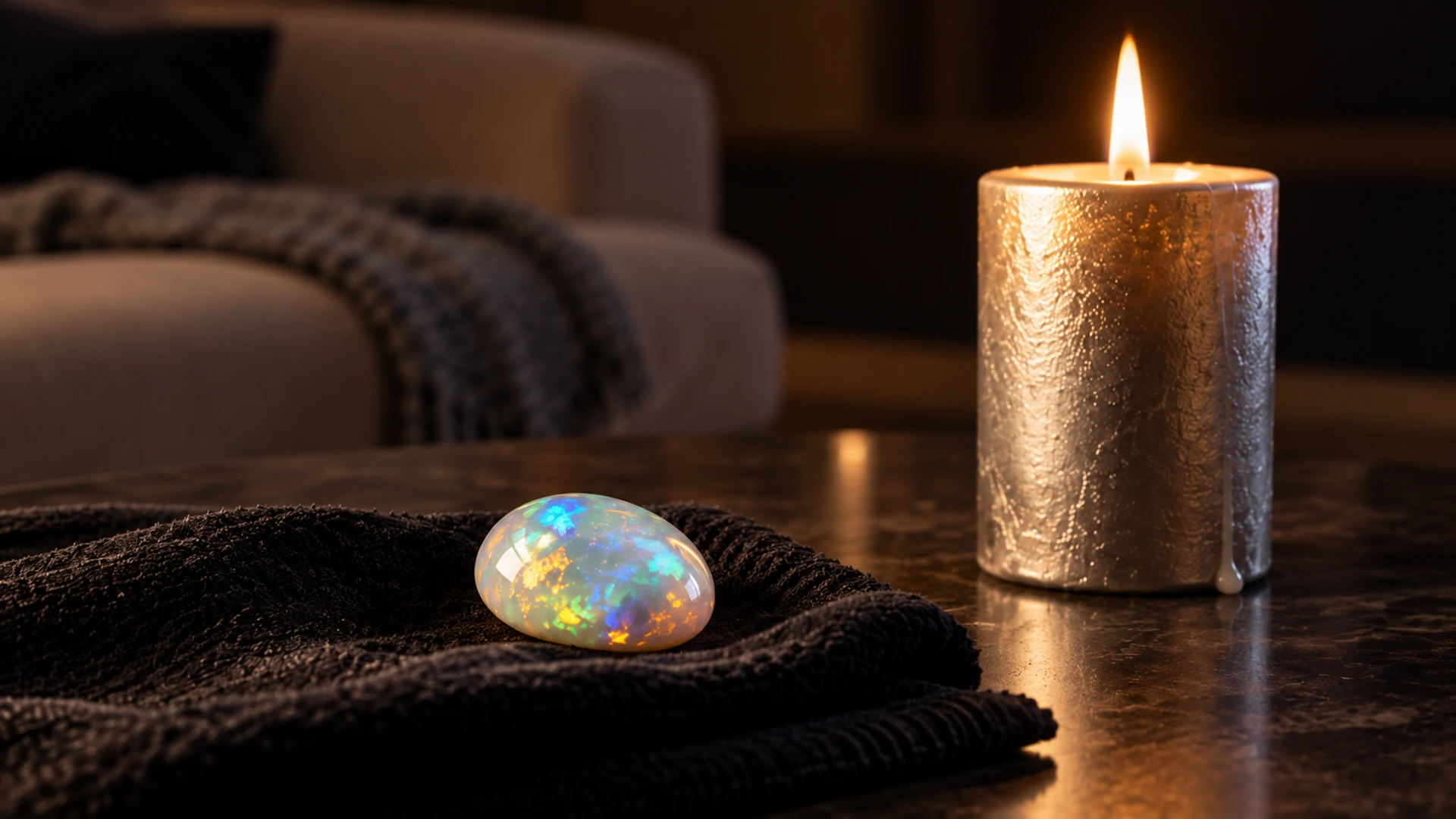
Opal sits in the Healing category not because it soothes or stabilizes in any conventional sense, but because it holds space for feeling that hasn't found language yet. It is one of the few stones whose geological nature and its metaphysical reputation tell exactly the same story.
The Feeling That Doesn't Fit Words: Why Opal Belongs in Healing
Opal is technically not a crystal at all. It's a hydrated amorphous silica, which means it has no repeating internal crystal lattice whatsoever. Where quartz builds itself into precise geometric order, opal sets like a gel, trapping water inside its own structure as it forms. Its signature play-of-color, that rolling shift of blue, green, gold, and violet that moves across the surface as you tilt the stone, comes from light diffracting through millions of microscopic silica spheres stacked in regular layers within the amorphous mass. The color you see is light bending, not pigment. That lack of fixed structure is part of why practitioners consistently describe opal's energy as fluid and non-fixed. It doesn't anchor or define. It moves.
That movement is exactly what makes it useful for a specific kind of emotional work: the kind where you know something is happening inside you but you can't articulate what it is. Grief that hasn't formed into a story yet. Dread with no clear object. A love that feels too large for ordinary language. Opal isn't designed to give shape to those feelings through words or reasoning. It supports creative and intuitive processing, the kind that happens through making something, moving your body, or simply sitting with a sensation until it shifts. This is distinct from what something like chrysocolla does, which heals within relationship patterns specifically: codependency, caretaking burnout, how you've allowed yourself to be treated. Opal isn't targeted at a relational pattern at all. It's for feeling that has no clean verbal shape yet, regardless of where it came from.
There's an honest caution built into how this stone works. Opal can surface intensity. It doesn't process emotion quietly in the background. What was sitting beneath conscious awareness sometimes comes up faster or stronger than expected during opal work, which is why the consistent recommendation is to pair it with a grounding stone rather than use it alone during heavy emotional sessions. This isn't a reason to avoid it. It's a reason to be intentional about how you pick it up.
Opal carries a genuine secondary thread toward intuition and psychic development, and it's worth naming that directly rather than folding it quietly into the Healing framing. The crown chakra is its primary resonance point, with the third eye cited closely alongside it. Pink opal specifically pulls toward the heart chakra, and its emotional register is softer and more inward than the vivid play-of-color varieties. Water and water-element work appear consistently across sources. Venus and Neptune both come up as planetary associations, which maps logically onto opal's twin registers of feeling and imagination. None of these correspondences contradict each other. They point at the same underlying quality from different angles: this stone lives at the edge of what can be known consciously.
Water Inside the Stone: Choosing Opal
Opal's care requirements are shaped entirely by its water content. A typical precious opal holds somewhere between three and twenty percent water by weight within its structure, and that water is not a contaminant to be driven out. It's integral. If the stone loses that water too quickly through prolonged dry heat, direct sunlight for extended periods, or sudden temperature shifts, the internal structure contracts unevenly and develops a network of fine surface cracks called crazing. A crazed opal won't recover. The cracking is permanent. This means ultrasonic cleaners are off the table entirely, as are very hot environments, and storing opal near a window that gets sustained afternoon sun is a genuine risk. If you live somewhere very dry, some practitioners store opals with a damp cloth nearby or in a sealed container with a small amount of moisture. For cleaning, a soft damp cloth is enough.
On the hardness scale, opal sits at Mohs 5 to 5.5, occasionally up to 6.5 depending on the specific variety, which is genuinely soft for a stone this widely valued. Scratches are easy to acquire and difficult to reverse on polished material. Store opal separately from harder stones rather than tumbled together in a bowl or bag. Harder stones, including most quartz varieties at Mohs 7, will scratch an opal's surface on contact if they're not kept apart.
Opal comes in several distinct recognized types, and none of them is more legitimate than another. They're different expressions of the same mineral under different geological conditions. White opal has a pale, milky base body color that lets its play-of-color show in softer pastels. Black opal has a dark background, which creates extraordinary contrast with the colors that flash across it. The dark base doesn't mean opaque, it means the underlying color is deep grey to black, and against that background, the diffracted colors read as vivid and electric. Black opal from Lightning Ridge in New South Wales, Australia, is among the most sought-after gem material in the world. Fire opal is the one that breaks the template most dramatically: it's typically transparent to translucent, warm orange to red in body color, and often lacks the play-of-color entirely. A fire opal with no color play is still a fire opal. It's valued for that warm, saturated body color rather than iridescence. Australia produces the majority of the world's precious opal. Ethiopia has become a significant source more recently, and Mexico is the classic source for fire opal.
When choosing a specimen for healing work rather than jewelry, the play-of-color doesn't determine potency. A modest white opal with clear, shifting color visible when you tilt it under light will work as well as an expensive collector's piece. What matters more is that you're drawn to it, that the color shift reads as alive to you when you hold it. For pieces intended to be worn, doublets and triplets (opal slices backed or capped with other material for protection) are practical options, but be aware they can't be soaked in water, since the adhesive used in their construction isn't waterproof.
Three Practices for What Won't Translate
The Untranslated Feeling
This practice is for moments when you're carrying something emotionally significant that hasn't formed into words or clear thoughts yet, and trying to force it into language is making it smaller rather than clearer.
Hold the opal in your dominant hand and a grounding stone, black tourmaline or smoky quartz work well, in your other hand. Don't try to name what you're feeling. Instead, reach for a creative medium that requires no explanation: draw marks on paper without planning them, move your body without choreography, hum or make sound without words, or simply assign colors to what's present inside you and let your eyes rest on something that matches. Let the opal be the permission to feel without translating, and let the grounding stone be the anchor that keeps you stable while the feeling moves through. Stay with this for as long as feels natural, then set both stones down and drink a glass of water before returning to ordinary tasks. This practice can be done during a Moon hour if you want the timing to support inward, intuitive work.
The Shifting Light
This is a contemplative practice for accepting that emotions aren't fixed states, and that the feeling you're in right now is not the permanent truth of your situation.
Sit in a quiet space with your opal held loosely in both hands or resting on a surface in front of you. Tilt the stone slowly back and forth under a single light source, a candle or lamp, so you can watch the play-of-color move. Notice that none of the colors are painted on the stone. They exist only in relation to the angle of the light, and they change with every small movement. The blue becomes green becomes gold becomes the dark background again as you shift. Spend five or ten minutes simply watching this happen, without trying to extract meaning from it. The practice is the observation itself. What you feel right now is real, but it's also positional. From a slightly different angle, it will look different. This practice pairs naturally with a silver candle lit nearby, consistent with opal's Moon and Neptune associations, but it works just as well in ordinary lamplight.
The Held Intensity
This practice is specifically for the moments when opal's amplifying quality brings something up faster or stronger than anticipated, and you need to move through it rather than shut it down.
Set the opal down on a flat surface in front of you. Don't put it away, but create a few inches of space between you and it. Pick up your grounding stone with both hands and hold it firmly. Feel its weight and temperature against your palms. Press your feet flat on the floor and notice the contact. Breathe slowly, and let the intensity that surfaced remain present without requiring you to do anything with it immediately. The opal on the surface in front of you is still working. The grounding stone in your hands keeps you stable enough to let that work happen without being overwhelmed by it. When the intensity softens to a manageable level, you can pick the opal back up if it feels right. If it doesn't feel right, leave it down. One session doesn't have to complete anything. You can return to the stone another day. Hematite is another excellent grounding option for this particular practice, given its density and Mars association, which can feel stabilizing during moments of emotional overstimulation.
The Novel That Nearly Ruined Its Reputation
In 1829, Sir Walter Scott published Anne of Geierstein, a gothic novel in which an opal talisman changes color in response to its owner's emotions and is directly connected to her death. The detail was invented for the story. It wasn't drawn from existing folk belief or documented tradition. But the novel was enormously popular, and its readership took the omen seriously enough that opal sales across Europe reportedly dropped by roughly half in the years immediately following publication. The damage to opal's reputation in the Western jewelry market was real and measurable, and it came entirely from a single piece of fiction.
What's interesting is how quickly Queen Victoria moved against it. During the same Victorian era in which Scott's shadow lingered, Victoria gave opal jewelry to her own daughters and wore it herself, a fairly direct counter-signal from the most visible woman in Europe. The superstition didn't vanish, but it didn't win either. Opal remained a feature of fine Victorian jewelry throughout the period, prized for its unusual optical quality in an era that had strong appetite for extraordinary natural phenomena. The "bad luck" reputation that still surfaces occasionally in Western culture today traces back to that single novel, not to any ancient or cross-cultural tradition. Ancient Romans valued opal as a symbol of hope and good fortune. The Sanskrit word upala, from which the name ultimately derives, simply means precious stone.
A Feeling Finally Given Shape
Opal's place in healing work isn't about soothing, stabilizing, or naming. It's about giving emotional material a place to exist before it has words. That mechanism, supporting what is felt rather than what is understood, is exactly what makes it irreplaceable in this category, even though it asks more of the practitioner than softer, more contained stones do. You pair it with something grounding not because it's dangerous, but because it's honest about the depth it can reach.
If you want to see how Opal fits alongside the other stones in the Healing category, and across all six other categories of stone work, The Crystal Compendium: Seven Paths to Stone Magic is the place to start.