Aquamarine: Steady Enough to Speak Through the Storm
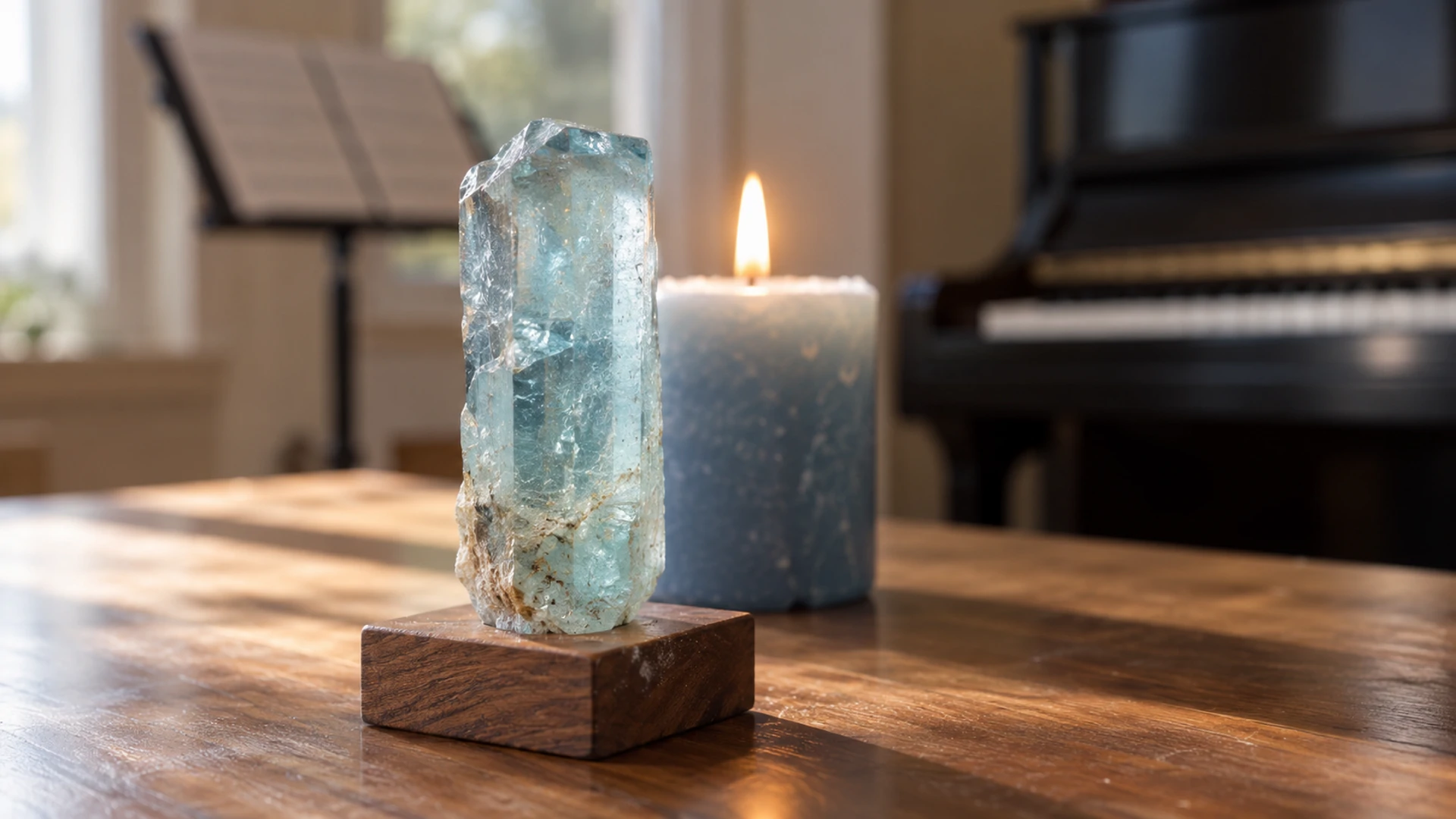
Aquamarine is the stone you reach for when silence isn't an option and your voice needs to hold. Its mechanism isn't about recovering softness — it's about remaining clear-headed when external pressure is real and immediate.
Steady Enough to Speak Through the Storm: Why Aquamarine Belongs in Healing
Aquamarine is the blue-to-blue-green variety of beryl, the same mineral family as emerald, though the two stones reach their colors through entirely different chemistry. Emerald gets its green from chromium or vanadium. Aquamarine's blue comes from iron traces — a subtler element, and a subtler color for it, ranging from the palest sky to a deep, saturated sea-blue depending on iron concentration. Hardness sits at 7.5 to 8 on the Mohs scale. It forms in granite pegmatites and can grow into impressively large crystals — gem-quality aquamarines of several kilograms aren't unusual, which partly explains why it's one of the more accessible high-quality gemstones despite its clarity.
Its primary chakra is the throat. Its element is water. In classical Western magical tradition it falls under Neptune, the Roman god of the sea, an association that runs deeper than just color and will be worth looking at more closely in the history section. These correspondences don't exist as a tidy list you memorize — they're the outline of what the stone actually does when you work with it. Throat chakra means its energy is fundamentally about expression and communication. Water means it moves with pressure rather than breaking against it. Neptune means it carries the flavor of something vast and a little ungovernable being steadied from within.
The place aquamarine belongs in the Healing category comes down to mechanism. Its specific action is calming communication under real external pressure — public speaking, travel, dangerous situations, confrontations where you can't simply opt out. That's different from what most people picture when they think of a throat-chakra healing stone. Compare it directly to blue lace agate, which soothes anxiety in self-expression, especially for relearning to speak after being silenced or dismissed — the gentlest throat-chakra stone in this category. That's inward recovery. Aquamarine is outward steadiness. It isn't about finding a voice that was taken away — it's about keeping the voice you have from breaking when an audience or a situation is bearing down on you.
Aquamarine also carries genuine secondary threads into two other categories, and it's worth naming them plainly rather than pretending the stone fits only one register. Its long history as a love token — passed between partners as a symbol of loyalty and beginning — gives it real resonance in Love & Relationships work. And its ancient role as a protective talisman for travelers and sailors gives it a real secondary presence in Protection. These aren't marketing extensions of its healing function. They're distinct uses rooted in centuries of practice. Aquamarine is primarily a Healing stone, specifically in that steadying-under-pressure mode, but if you're working love or protection spells and reach for it, the tradition supports that choice.
Sea-Colored, Not Sea-Glass: Choosing Aquamarine
The most practical thing to know before buying aquamarine is that most material on the market has been heat-treated. Raw aquamarine often carries a greenish undertone from its iron composition. Gentle heating removes that undertone and produces the clear blue color the gem trade prefers. This is a standard, disclosed practice throughout the industry — not a deception, and not something that affects the stone's magical or energetic properties in any meaningful way. You're still working with genuine aquamarine. The heat treatment simply shifts the color toward what buyers expect. If you specifically want the natural blue-green rather than the treated pure blue, look for raw or rough material labeled as natural or untreated, and expect a greener cast.
Pale blue glass and synthetic spinel are occasionally sold as aquamarine, particularly in cheaper jewelry. Genuine aquamarine is noticeably heavier for its size than glass, and it typically shows subtle natural inclusions under close inspection — faint needle-like structures or veiling inside the crystal that glass can't replicate. If you're buying loose stones for ritual work rather than set jewelry, a jeweler's loupe is worth the few seconds it takes. The inclusions aren't a flaw; they're confirmation. An absolutely flawless, perfectly even pale blue stone at an unusually low price should prompt a closer look.
Care is genuinely uncomplicated for a stone of this quality. At 7.5 to 8 on the Mohs scale, aquamarine is durable enough for daily wear without worrying about scratches from normal contact. It's water-safe — brief rinsing is fine, and given its historical connection to the sea, water cleansing feels particularly appropriate. What to avoid is prolonged exposure to salt water, which can slowly work into surface fractures over time, and harsh chemical cleaners, which can dull the finish of polished pieces. Ultrasonic cleaners are generally fine for clean, unfractured material, but if your stone has any visible inclusions or natural fractures, skip them. Beyond that, store it away from stones harder than itself — diamond and sapphire can scratch it — and it will hold up for years without requiring any special attention.
Three Practices for Steady Water
The Steady Voice
Use this in the minutes immediately before a public-speaking commitment, a difficult presentation, or any moment where you need your voice to stay level under an audience's attention.
Hold your aquamarine in your non-dominant hand and bring it to your throat for a slow breath — in through the nose, out through the mouth, four counts each. During the exhale, feel the stone's temperature against your skin and let that physical sensation anchor you to the present moment rather than the imagined future of what might go wrong. Do this three times. Before the third exhale, say your opening line aloud — quietly if needed, even in a whisper — so your voice has already moved through the air once before the stakes begin. Carry the stone in a pocket during the event itself, touchable when needed. If you want to reinforce the working, blue candle magic aligns well with aquamarine's element and its throat-chakra resonance — lighting one before the practice adds a layer of intentional focus without complicating the working itself.
The Safe Crossing
Use this for travel specifically — carried through the journey itself rather than used only at departure, in keeping with aquamarine's historical function as a talisman of safe passage.
Before you leave, hold the stone and state your destination aloud, plainly and specifically: not a prayer or a request, just a declaration of where you're going and your intention to arrive safely. Then keep it on your body for the duration of the journey — in a pocket or a bag close to you, somewhere you can touch it without ceremony if you want to. On longer journeys, particularly by water or air, handling it briefly during the transit itself extends the intention into the travel rather than leaving it only at the start. If you're traveling at a time that aligns with the Moon hour, that's a natural amplifier for water-ruled workings. When you arrive, set the stone down somewhere intentional in your new space — this closes the working and marks the crossing as complete.
The Held Nerve
Use this before facing a situation that is genuinely uncertain or risky — a medical procedure, a high-stakes negotiation, a confrontation you can't avoid — where what you need isn't manufactured confidence but clear-headed composure.
Sit quietly with your aquamarine resting in both palms, and for a full two minutes do nothing except breathe and notice the stone. Its weight, its temperature, its surface. This isn't visualization work — it's a deliberate interruption of the mental spiral that precedes high-stakes events, using physical sensation as the anchor. After two minutes, bring both hands together around the stone and breathe out a single, slow exhale while consciously releasing the outcome. This is the key movement of the practice: you're not releasing your effort or your care, only your grip on how the event must go. Aquamarine's specific virtue is maintaining clarity when the situation is beyond your control, so the practice is designed to put you in that state before you walk in rather than trying to achieve it once you're already inside the pressure. If you want an herbal support for this kind of work, rosemary burned lightly beforehand brings protective steadiness without sedation — it clears the space without dulling you.
The Sailor's Stone
The relationship between aquamarine and water isn't symbolic — or rather, it didn't start that way. Throughout Greek and Roman maritime tradition, sailors, fishermen, and sea traders carried aquamarine as a working talisman. The belief was specific: the stone could calm storms, ease the dangers of rough crossings, and protect against drowning. Neptune governed the sea, and aquamarine was his stone by color and by nature. A fisher carrying it into the Aegean was invoking a protection tied to the sea's own ruler, not simply making a wish for fair weather.
This body of belief was consistent enough across the ancient Mediterranean world that it persisted without being reducible to a single source or moment. It wasn't a myth attached to one voyage or one culture. It was working knowledge — what sailors carried and why they carried it. The name itself reflects this: aquamarine traces to the Latin for "water of the sea," which tells you what the stone was primarily understood to be. Its clarity, its color, its heft all mapped onto the qualities someone heading into open water wanted to carry: clear-sightedness, calmness, and enough substance to hold its own when conditions turned.
Over time that protective association extended naturally to any traveler crossing uncertain terrain, and eventually to anyone whose path was in some sense unpredictable. But the original root is maritime, and it's worth keeping that specificity. When you use aquamarine as a protective talisman for travel, you're working in a tradition that runs directly back to the Mediterranean fishing fleets and Roman shipping routes. That's a long thread. The stone's modern use as a protective working aid is built on something real and very old.
Calm That Holds Under Real Pressure
What distinguishes aquamarine in the Healing category isn't softness — it's a specific kind of durability. It steadies communication in the face of actual external pressure rather than offering a space to recover from past wounds. That distinction matters when you're choosing a stone for a specific working. If recovery is what you need — returning to a voice that was suppressed, processing what was said to you — there are other stones in this category better suited to that work. Aquamarine is for the moment you're standing in front of the pressure itself and you need to stay clear.
If you want to see where aquamarine sits in the full landscape of crystal magic — how it connects to the other Healing stones, and how the Healing category relates to Protection, Empowerment, Abundance, and the others — the Crystal Compendium: Seven Paths to Stone Magic is where to go next. It maps all seven categories and gives you the full context for working with these stones in combination rather than isolation.