Nuummite: The Sorcerer's Stone from Earth's Earliest Age
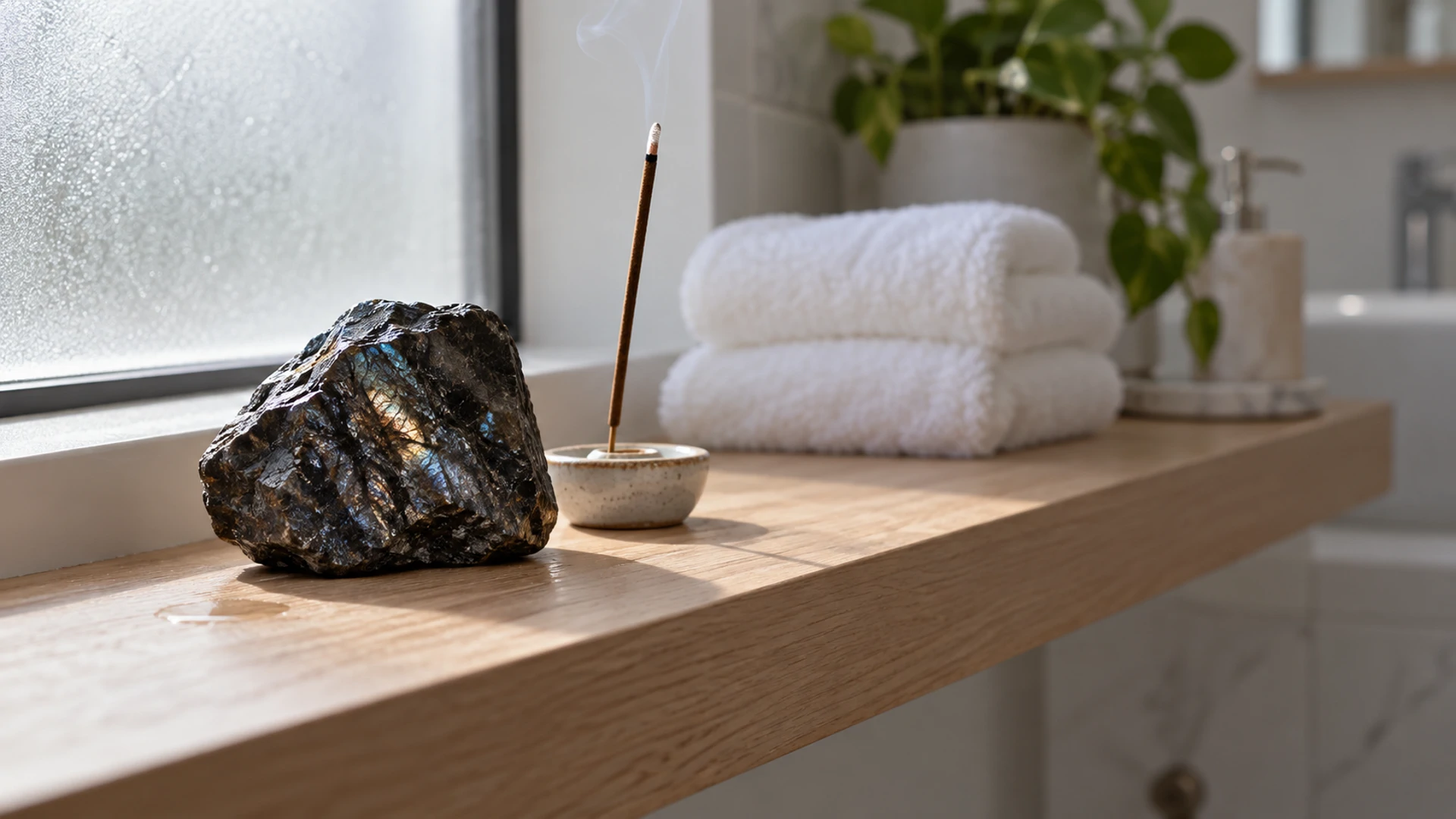
Nuummite is a protection stone with a specific mechanism: it reinforces the core sense of self so thoroughly that manipulation, psychic pressure, and energetic intrusion find nothing to attach to. It doesn't build a wall. It builds you.
The Sorcerer's Stone: Why Nuummite Belongs in Protection
Most of the stones in the Protection category work by creating something between you and whatever is coming at you. Black tourmaline grounds first, then holds a boundary. Black obsidian acts as a mirror, reflecting and revealing rather than absorbing. Shungite absorbs and neutralizes, a property backed by its genuine documented use as a water purifier. These are all valid approaches, and they're externally oriented — they intercept something before it reaches you.
Nuummite works differently. Its protection comes from the inside out. When you carry or work with nuummite, the operative question isn't "what's being blocked?" but "who is doing the blocking?" The stone's reputation, consistent across its relatively short time in Western crystal practice, is that it deepens and stabilizes your sense of self to the point where outside pressures — psychological manipulation, gaslighting, energetic cords, subtle social coercion — can't get a foothold because there's no uncertainty there for them to exploit. Identity, when it's solid, doesn't invite the kind of influence that intrudes on a confused or fragmented sense of self. That is nuummite's specific contribution to the Protection category, and it belongs here precisely because it isn't doing what the others do.
Its correspondences map cleanly onto that function. Nuummite is rooted in the earth element and governed by Saturn, the planet of discipline, structure, and long-held boundaries. Its primary chakra is the root — the seat of groundedness and personal security, the energetic foundation of knowing who you are. Scorpio rules it, which fits: Scorpio's energy is concerned with depth, self-mastery, and seeing clearly without illusion. These aren't decorative associations. Together they point toward a stone whose work happens at the foundational layer of identity rather than at the surface of the auric field.
The third-eye correspondence is secondary but genuine, and worth naming honestly. Nuummite activates both the root and the third eye — an unusual combination that reflects what the stone actually does. Stabilizing the self at the root creates the conditions under which deeper perception becomes available. When you're not scrambling to hold your footing, you can look further. This is why nuummite carries a real secondary thread in intuition and psychic development: it doesn't open the third eye by force, but by clearing the internal static that obscures what's already there. If your primary aim is psychic development, this isn't the first stone you'd reach for. But if self-possession and inner clarity are the foundation you're building, the intuitive layer tends to follow.
One Place on Earth: Choosing Genuine Nuummite
Nuummite is sourced from exactly one place: a remote area near Nuuk, Greenland. This isn't a "primary source" situation the way it is with, say, blue lace agate, which is rare but has a few known localities. Nuummite's geology requires conditions specific to that region's ancient Archean bedrock, and material from elsewhere marketed as nuummite is either mislabeled or fraudulent. The remoteness of the source and the difficulty of extraction are part of why genuine nuummite commands a higher price point than most protection stones — and why authentication matters when you're sourcing it.
The more common sourcing issue isn't dyeing or heat treatment (the concerns that come up with onyx or citrine) — it's outright substitution with lookalike stones. Arfvedsonite and astrophyllite both share nuummite's general character: dark base, elongated inclusions, metallic flash. They're sometimes sold as nuummite through simple misidentification, and occasionally through deliberate mislabeling. If you're buying online, buy from a seller who sources from Greenland specifically and can document it. If you're buying in person, learn what nuummite's flash actually looks like.
The visual signature of genuine nuummite is its labradorescence — the iridescent shimmer that moves across the surface as the stone shifts in light. What produces it is the thin, layered intergrowth of two specific amphibole minerals, gedrite and anthophyllite, arranged in parallel bands within the stone's matrix. The flash reads as distinctly deeper and more dimensional than the lookalikes: it seems to come from within the stone rather than from its surface. Arfvedsonite tends to produce a brighter, more superficial sparkle; astrophyllite's shimmer is warmer and more bronze-toned. Neither has the same internal depth. When you hold a genuine piece, even if you've never seen one before, the flash has a quality that stops you. That's the real tell.
On care: nuummite is water-safe for brief rinses and presents no toxicity concerns for normal handling. It's composed of amphibole silicates, stable and reasonably durable at Mohs 5.5 to 6. That said, as with most dark stones that derive their color from their mineral composition, extended exposure to strong direct sunlight isn't ideal over the long term. Cleanse it with smoke, sound, or a brief rinse, and store it away from harder stones that could scratch it. It doesn't require any elaborate care protocol — nuummite is, appropriately for a stone this old, built to last.
Three Practices for Strengthening the Core Self
The Unshakeable Core
This meditation is for moments when you suspect you're being manipulated, gaslit, or gradually pressured to distrust your own perceptions — particularly in situations where the doubt has been building slowly enough that you're no longer sure what's real.
Sit comfortably in a quiet space. Hold your nuummite in both hands, or place it at the root — resting between your feet or at the base of the spine if you're lying down. Breathe slowly and deliberately, and spend a few minutes doing nothing other than feeling the weight and texture of the stone. Then, without forcing it, recall three things you know to be true about yourself: not opinions, not hopes, but things you simply know. Let those three things settle in the body rather than in the mind. Stay with that settled quality for at least ten minutes. The goal isn't a dramatic shift — it's a small, reliable reset of your internal reference point, the equivalent of recalibrating a compass. Working during a Saturn hour sharpens the discipline of this practice without adding heaviness.
The Ancient Memory
This practice draws on nuummite's third-eye correspondence and its extraordinary age — roughly 3 billion years — to support access to old personal patterns, inherited emotional habits, and long-buried history that may be operating beneath conscious awareness.
Lie down and place your nuummite on the forehead, over the third eye. Close your eyes and spend a few minutes simply breathing before you set any intention. When you feel settled, ask internally — without expecting a verbal answer — what you've been carrying that isn't yours, or what pattern keeps returning that hasn't been named yet. Don't hunt for an answer. Let the stone's weight on the forehead be the only active element. What surfaces often arrives as sensation, an image, or a memory rather than a clear thought. Keep a notebook nearby to write down anything that comes immediately after, before the ordinary mind reasserts itself. This works especially well during a Moon hour when dream-layer material is closer to the surface.
The Empath's Ward
This practice is specifically for people who habitually absorb other people's emotional states or energetic weight — not as a passive tendency, but as something that leaves them depleted after sustained contact with others, whether at a demanding family gathering, a difficult workplace environment, or any situation where other people's needs are centered for hours at a time.
Before you enter the draining situation, hold the nuummite briefly and state — aloud if you can, silently if you need to — one specific boundary: something you will not carry home with you. This doesn't have to be elaborate. "What belongs to them stays with them" is enough. Then carry the stone in a pocket or against the body throughout. The practice isn't passive protection; it's an active reminder, at the body level, that you have a distinct self that exists independently of what the room is feeling. Afterward, set the stone down somewhere separate from your living space for at least an hour — a windowsill, a shelf — before cleansing it with smoke from frankincense or a brief rinse under cool water. That transition matters: it marks the end of the working rather than letting the stone bring the day's residue into your rest space.
A Stone Older Than Almost Anything, Discovered Almost Yesterday
Nuummite formed during the Archean eon, somewhere between 2.8 and 3 billion years ago, when the Earth's crust was still stabilizing into its first substantial landmasses. To put that in perspective: the stone in your hand predates complex multicellular life. It predates the oxygenation of the atmosphere. It formed before the conditions existed that would eventually make it possible for any living thing to hold it. This extreme age is part of why nuummite's reputation in magic skews toward depth work, pattern-level change, and contact with what's fundamental — it carries, in a sense, the record of things that were true before anything else was.
Despite that extraordinary age, nuummite didn't enter the commercial gem and crystal trade until the 1980s. The Inuit people of Greenland, near whose capital Nuuk the stone is found, are widely described as having regarded it as sacred and protective for a very long time, well before any Western mineralogist took an interest. Their relationship with the stone predates its commercial name and its current magical reputation by an unknown but substantial period. The "Sorcerer's Stone" nickname, which nuummite accumulated as it became more widely known in the crystal market, refers to this reputation for deep, transformative, self-strengthening work. It has no connection to the fictional Sorcerer's Stone — or Philosopher's Stone — from Harry Potter; the two are entirely unrelated and share only a borrowed phrase.
The gap between its ancient formation and its recent discovery in the wider world is genuinely unusual. Most stones that carry significant magical reputations have been in human hands for millennia — lapis lazuli was being mined in Afghanistan's Sar-e-Sang region for over 6,000 years before it crossed into European trade. Nuummite's reputation was built, comparatively, in an eyeblink: a few decades of sustained use in Western magical and crystal-healing practice, working backward from a stone whose geological credentials are among the most impressive of anything on a shelf. What it's been given time to accumulate, apparently, is depth. What it hasn't yet accumulated is the kind of layered historical mythology that older trade stones carry. That's an honest framing worth keeping in mind: its magic is real, but its lore is young.
Protection Built From the Inside
Nuummite's specific contribution is one the Protection category genuinely needs: a stone that works from within rather than from without. Where other stones in this grouping intercept, deflect, absorb, or mirror what approaches you, nuummite asks a different question entirely — whether the target of influence is solid enough that there's nothing for influence to catch on. That is a different kind of protection, and for the situations it fits, it's the more lasting one.
If you want to see how nuummite sits alongside the other Protection stones and how the Protection category relates to the six other paths of stone magic — Cleansing, Healing, Empowerment, Abundance, Love, and Intuition — The Crystal Compendium: Seven Paths to Stone Magic is the place to start.