Lapis Lazuli, the September Birthstone: The Courage to Know Your Own Mind
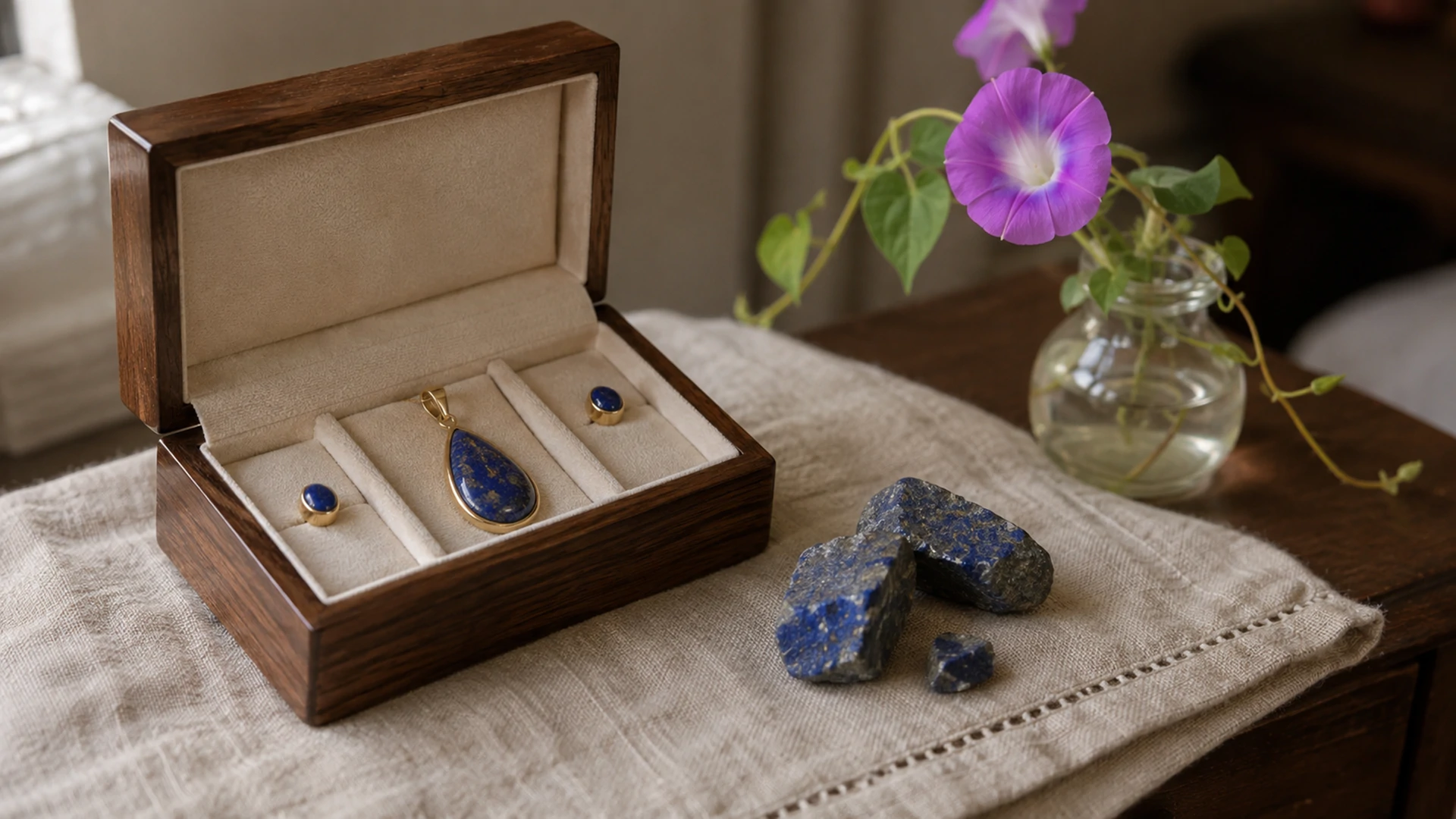
Lapis lazuli has been one of the most prized stones in human history, worn by pharaohs, ground into pigment for Renaissance paintings, and traded across continents for thousands of years. But if you were born in September, this deep blue stone with its flecks of gold pyrite isn't just historically significant — it's personally yours. As a modern September birthstone, lapis lazuli carries a specific energetic resonance with this month's themes: clarity over confusion, truth over performance, and the quiet courage it takes to know your own mind. This article covers what that birthstone relationship actually means, how to use it in ritual and daily life, and which stones deepen its power when paired intentionally.
What Lapis Lazuli Means as the September Birthstone
September sits at a threshold. Summer is ending, the light is shifting, and the year is entering its final arc. In the Northern Hemisphere, this is harvest season — not just agriculturally, but energetically. September asks you to take stock: what did you build this year? What needs to be completed, clarified, or released before winter? Lapis lazuli's core energy answers that question directly. It is a stone of mental clarity, honest self-knowledge, and the kind of focused discernment that separates what is real from what is merely comfortable to believe.
The two zodiac signs that govern September are Virgo (through the 22nd) and Libra (from the 23rd onward), and lapis lazuli speaks to the specific tension each sign carries. Virgo is analytical, detail-oriented, and deeply self-critical — brilliant at seeing what needs improving but prone to overthinking and self-doubt. Lapis lazuli cuts through that internal noise. It sharpens discernment without amplifying anxiety, helping Virgo energy move from endless analysis into grounded, clear action. Libra, on the other hand, is the sign of balance, relationships, and truth-seeking — but Libra's shadow is indecision and a tendency to say what keeps the peace rather than what is actually true. Lapis lazuli is one of the oldest stones associated with truth-telling and authentic expression, which makes it a near-perfect counterweight to Libra's people-pleasing instinct.
Historically, lapis lazuli's assignment to September has roots stretching back to ancient lapidary traditions. The stone appears in early birthstone lists — including the foundational gem-to-month associations drawn from Exodus and Revelation in the Judeo-Christian tradition, where deep blue stones held positions of high sacred significance. There's a telling etymological thread here: the Latin sapphirus and Greek sappheiros, the ancient words that give us "sapphire," almost certainly referred to lapis lazuli in classical and biblical usage rather than the blue corundum we call sapphire today. The two stones shared a name because they shared a color — and for millennia, lapis was the blue stone people meant. In the more formalized Western birthstone lists of the 19th and early 20th centuries, lapis held a recurring association with September before sapphire was standardized as the primary stone by the American National Retail Jewelers Association in 1912. The UK's 2013 official birthstone list brought lapis lazuli back into formal recognition, pairing it directly with sapphire as a co-September stone — a designation grounded in both ancient precedent and the stones' long-shared symbolic identity. Lapis is recognized for the same qualities that made it sacred in ancient Mesopotamia, Egypt, and Persia: wisdom, protection, and the pursuit of truth. For a full exploration of lapis lazuli's magical properties beyond the birthstone context, see the Lapis Lazuli in Magic: Correspondences, Uses & Care guide.
Lapis lazuli governs two specific channels of perception: the third eye, which is the seat of intuition and inner vision, and the throat, which is where knowing becomes saying. That dual correspondence is the stone's most distinctive energetic signature, and it maps directly onto September's central tension. Virgo knows exactly what's wrong but struggles to stop analyzing long enough to act on it. Libra sees the truth clearly but chooses peace over honesty. Lapis doesn't just offer clarity as an abstract quality — it specifically bridges the gap between what you already perceive and what you're able to put into words and act on. When you work with lapis as your birthstone rather than as a stone you simply picked up, that bridge becomes easier to cross. The stone's frequency is already tuned to the month you were born into. You're not building a new connection from scratch — you're reinforcing one that was there before you started.
Lapis Lazuli's Hardness, Care & Origins
Lapis lazuli sits at 5 to 6 on the Mohs hardness scale. That's notably softer than most stones people wear daily — sapphire, its September sibling, rates a 9 — and it matters practically. Lapis can be scratched by harder materials, and the surface will show wear over time if it's treated as casually as a quartz or tourmaline. It's also porous, which means water immersion, perfume, oils, and household chemicals can all damage it. Ultrasonic cleaners are out entirely. Clean lapis with a soft dry cloth and nothing else. The existing care note in this article about avoiding prolonged sun exposure stands — fading is a real concern with lapis, and both heat and direct light degrade the stone over time.
The primary source of lapis lazuli — historically and today — is the Sar-i-Sang mining region in Badakhshan province, northeastern Afghanistan. These mines have been worked continuously for over 6,000 years, making them one of the oldest known active mining sites on Earth. The lapis that inlaid Tutankhamun's burial mask came from Sar-i-Sang. So did the deep blue ultramarine pigment that Renaissance painters used for the Virgin Mary's robes in works by Vermeer and Michelangelo. The supply chain running from those Afghan mountains to the ancient workshops of Mesopotamia, to the pigment grinders of Florence, to your altar today is unbroken. Secondary deposits exist in Chile, the Lake Baikal region of Russia, and Colorado in the United States — but Afghan Badakhshan remains the benchmark for quality, producing the deep, evenly saturated blue with bright pyrite inclusions that has defined the stone's identity across cultures.
How to Use Lapis Lazuli as Your Birthstone in Magic Rituals
Charging and Carrying Your Birthstone
The simplest and most foundational practice is also one of the most effective. Begin by holding your lapis lazuli in both hands. Take three slow breaths and bring your full attention to the stone — its weight, its temperature, the texture of it against your palms. State your intention aloud or internally, something specific to where you are right now: clarity around a decision, honest self-perception, the ability to speak truthfully in a situation where you've been avoiding it. You're not asking the stone to do this for you. You're using the stone as a focal point to crystallize your own will around that intention.
To charge it, place the stone in moonlight overnight — the full moon is ideal for amplification, the new moon for fresh starts — or set it in sunlight for a shorter charge of one to two hours. Avoid prolonged sun exposure, as lapis can fade. Once charged, carry the stone in your left pocket (the receiving side in many traditions) or in a small pouch close to your body. Re-engage with it throughout the day by simply touching it when you need to return to clarity or speak with more honesty than feels easy. This daily contact is the practice. The stone becomes a trained anchor for your focused intention over time.
Blue Candle and Lapis Truth Ritual
This candle ritual is designed for moments when you need to access your own truth — about a situation, a relationship, or a decision you've been circling. Set up a clean space and place your lapis lazuli directly in front of a blue candle, which shares lapis lazuli's correspondence with communication, mental clarity, and the throat chakra. If you want to deepen the working, you can inscribe the candle with a single word — TRUTH, CLARITY, or your own name — before you begin.
Light the candle and spend a few minutes gazing at the flame while holding the stone. Let your mind settle. Then, speak aloud — or write in a journal — whatever has been sitting unspoken inside you. Don't filter it. The combination of candlelight, the stone's weight in your hand, and the act of speaking creates a ritual container that makes honesty feel safer and more possible. When you feel complete, let the candle burn down safely or snuff it and repeat the practice over several evenings until the candle is finished. The repetition is intentional — it trains your will to seek clarity rather than avoidance.
September Threshold Ritual
September is a threshold month — the turn from one energetic season to another. This ritual works best performed at the September equinox (around the 22nd or 23rd), which marks the moment the sun crosses from Virgo into Libra and day and night are briefly equal. It's a natural point for balance-seeking magic, and lapis lazuli's energy of honest discernment is perfectly suited to it.
On the evening of the equinox, sit outside or near a window where you can sense the shift in light. Hold your lapis lazuli and write two lists: what you are carrying into the next season with intention, and what you are choosing to leave behind. Be specific and honest — this is the whole point. Once both lists are written, read the first list aloud while holding the stone, visualizing those intentions anchored in your body. Then burn, tear, or bury the second list as a physical act of release. Keep the stone on your person through the rest of September as a reminder of what you've committed to carrying forward and what you've let go.
Third Eye and Throat Chakra Alignment Practice
Lapis lazuli has a well-established correspondence with both the third eye chakra (the center of intuition and inner vision, located at the forehead) and the throat chakra (the center of authentic communication and self-expression). This is a genuine dual correspondence that makes it particularly powerful for a very specific problem: the gap between what you intuitively know and what you're actually able to say out loud. September people — especially those with strong Virgo or Libra placements — often live in that gap.
Lie down in a quiet space and place one piece of lapis lazuli on your forehead and, if you have a second piece, one at the base of your throat. If you only have one stone, alternate its placement. Breathe slowly and let your attention move between the two points. At the forehead, ask yourself what you already know but haven't acknowledged. At the throat, ask yourself what you've been unable or unwilling to say. Stay with this for ten to fifteen minutes. You don't need to force answers. The practice is about opening the channel between inner knowing and outward expression — which is exactly what lapis lazuli's energy supports in a birthstone relationship.
Dream Clarity Working
Lapis lazuli has a long historical association with prophetic dreaming and accessing deeper layers of consciousness during sleep. Ancient Egyptian and Mesopotamian traditions used it specifically to enhance visionary states, which gives this working solid grounding. This is especially useful for September people during periods of uncertainty, when waking analysis has reached its limit and you need information from a different layer of mind.
Before sleep, hold your lapis lazuli and state clearly what you want clarity on — a specific question, not a vague request. Place the stone under your pillow or on your nightstand directly beside your head. Keep a journal and pen within reach. When you wake, write immediately — even fragments, even things that don't yet make sense. Do this for seven consecutive nights. By the third or fourth night, patterns typically begin to emerge. The lapis isn't sending you messages; it's acting as a focus for your own deeper mind, keeping your intention active through sleep so your subconscious stays oriented toward the question you've asked.
Protective Altar Placement
Lapis lazuli's protective qualities are among its oldest recorded uses — ancient Sumerians and Egyptians used it in amulets specifically to ward off psychic interference, deception, and malevolent energy directed at the mind. On your altar or in your primary magical workspace, place lapis lazuli at the northern point (associated with stability, grounding, and protection in many Western traditions) or directly in the center as an anchor stone. Surround it with objects that represent your September intentions — written goals, symbols of what you're building, or images of what you're protecting.
This placement works on two levels. First, it keeps your stated intentions visible and energetically active in a space you return to regularly, which maintains your will's focus on them. Second, the stone's protective vibration — particularly its historical role in guarding against deception and psychic noise — creates a layer of energetic clarity in the space itself. Cleanse the stone monthly, either with sound (a singing bowl or bell), moonlight, or by placing it on a piece of selenite overnight, and reset your intention when you do.
Wearing & Carrying Lapis Lazuli for Daily Protection
Jewelry
Because lapis lazuli's birthstone correspondence runs along the lines of mental clarity, honest expression, and psychic protection, wearing it at the throat or forehead is the most direct application. A lapis lazuli pendant at the base of the throat keeps the stone in contact with the area it corresponds to, which means it's constantly working within the everyday energetic field you move through. This is especially useful in environments where you're required to communicate clearly under pressure — meetings, difficult conversations, negotiations, or any situation where being heard accurately matters.
Earrings and headbands that keep the stone near the temples or forehead serve the third eye correspondence — sharpening intuitive perception throughout the day and providing a subtle buffer against the kind of mental noise that accumulates in busy, high-stimulus environments. If you spend a lot of time in mentally demanding work, this placement pays off. The protective function lapis lazuli is historically known for — specifically, guarding against confusion, deception, and psychic overwhelm — is active through skin contact regardless of whether you're in a formal ritual context or not. One practical note worth keeping in mind: at Mohs 5 to 6, lapis is genuinely soft for a piece worn on the hands or wrists. Pendants and earrings hold up far better than rings or bracelets over time.
In the Home and Workspace
In the home or workspace, lapis lazuli is well-placed near where you do your most important thinking or communicating — your desk, your home office, or a writing space. A tumbled stone next to your keyboard or a raw piece on your work surface keeps its energy within your immediate field during focused work. In a shared living space, placing it near the main area of conversation or decision-making — the kitchen table, a living room shelf — supports honest, clear communication between everyone who moves through that space.
When traveling or commuting, a small tumbled piece of lapis in a coat pocket or bag carries real historical weight. Ancient Egyptians placed it inside burial masks and amulets to protect the dead on their passage through the underworld — the same protective intent applies in the living world when you're moving through unfamiliar or high-pressure environments. Crowded spaces — airports, transit systems, busy streets — are high in ambient psychic noise, meaning the cumulative mental and emotional output of many people in close proximity. Having a trained focus object on your person helps you stay grounded and mentally clear. There's also something worth sitting with in the physical stone itself: the lapis in your pocket may have come from the same Sar-i-Sang seam that supplied the craftsmen who made Mesopotamian cylinder seals five thousand years ago. That continuity is part of what you're carrying — a link to an unbroken human tradition of treating this stone as something that protects and clarifies the mind. For September people, that's an extension of lapis lazuli's core birthstone function, keeping your sense of self steady no matter what environment you're moving through.
Lapis Lazuli and Sapphire: September's Two Stones
If lapis lazuli is your September stone, it's worth knowing its sibling. Sapphire is the traditionally dominant September birthstone — the one standardized in 1912 and the one most jewelers will point you toward. The two stones share ancient roots deeper than most people realize: the classical words for sapphire almost certainly described lapis lazuli first, and the deep celestial blue both stones carry is the visual thread connecting their long, shared symbolic history of wisdom, truth, and higher perception.
Practically, the differences are significant. Sapphire rates a 9 on the Mohs scale — among the hardest gemstones in existence — which makes it genuinely appropriate for rings and daily-wear pieces in a way that lapis, at 5 to 6, simply isn't. Sapphire is also transparent, refractive, and catches light from within in ways that opaque lapis never will. If formal recognition or durability matters to you, sapphire holds both. But lapis carries something sapphire doesn't: that unbroken, 6,000-year material history from the Afghan mountains, the ancient amulet tradition, the immediate visual presence of night sky compressed into stone. They work well together too. Wearing both in a September working — lapis at the throat, sapphire as a ring or set piece — draws on the full range of what this month's energetic palette offers.
Lapis Lazuli Crystal Combinations: What Pairs Well
Lapis Lazuli and Clear Quartz — Clear quartz is an amplifier with no strong directional energy of its own, which makes it one of the cleanest stones to pair with any crystal that has a specific, defined correspondence. When paired with lapis lazuli, clear quartz magnifies the clarity and truth-seeking energy without distorting it. This is the combination to use when you need your intention to reach further or when you're doing a ritual that needs to hold over an extended period of time.
Lapis Lazuli and Amethyst — Both stones carry a strong connection to higher mind, intuitive perception, and psychic clarity — but they operate at slightly different registers. Amethyst works more through spiritual receptivity and calm; lapis lazuli works through discernment and directed mental focus. Together they create a layered state of open-minded clarity that's particularly useful for meditation, divination, or any work where you need to receive information without filtering it through assumptions before you've had a chance to fully perceive it.
Lapis Lazuli and Black Tourmaline — Lapis lazuli provides mental and psychic clarity; black tourmaline provides a grounding shield that deflects lower-frequency energy at the energetic boundary. Where lapis clears and illuminates from within, black tourmaline blocks interference from without. Paired together, they create a comprehensive protection setup — one that keeps your mind sharp and your inner environment clear while the outer boundary holds. This is an especially strong combination for empaths or highly sensitive people who find that busy environments leave them feeling mentally scattered or emotionally drained.
Lapis Lazuli and Fluorite — Fluorite is one of the premier stones for mental organization — it absorbs and neutralizes chaotic energy, promotes structured thinking, and supports focus during complex cognitive work. Lapis lazuli adds the truth-seeking and expressive dimension that fluorite doesn't strongly carry on its own. Together they're a powerful pair for any situation requiring both clear thinking and honest, articulate output: writing, studying, problem-solving, or preparing for a high-stakes conversation. This is an especially well-suited combination for Virgo energy, which already excels at analysis but sometimes needs support translating that analysis into clear expression.
Lapis Lazuli and Labradorite — Labradorite is the stone of transformation, hidden knowledge, and working at the liminal edge between conscious and subconscious mind. Lapis lazuli brings that material into the light — discerning it, naming it, and helping you communicate what you find. This pairing is particularly effective for shadow work or for any practice that involves surfacing unconscious patterns and making them legible to the waking mind. Labradorite opens the door; lapis lazuli turns on the light so you can see clearly once you're inside.
Lapis Lazuli and Pyrite — This pairing has an interesting internal logic: pyrite is naturally present as flecks within high-quality lapis lazuli itself, which means they already share a mineral relationship. Beyond that, pyrite's energy is activating, confidence-building, and oriented toward willpower and decisive action. Lapis lazuli provides the clarity and honest self-knowledge; pyrite provides the momentum to act on what you know. For Libra energy especially — which can see all sides of a situation clearly but struggle to commit to a direction — this is a meaningful pairing. It closes the gap between understanding and action.
September Is Yours — and So Is This Stone
Lapis lazuli has been treasured across civilizations not because it's decorative (though it is spectacularly that), but because people recognized something functional in it: it helped them think more clearly, speak more honestly, and perceive more accurately. As a modern September birthstone, it carries that same energy in a form that's directly calibrated to the month's themes — the threshold between seasons, the call to take honest stock, and the particular tensions of Virgo's self-scrutiny and Libra's truth-seeking.
What makes this more than general crystal work is the personal dimension. Lapis lazuli was assigned to your birth month because its energetic qualities resonate with the frequency that September itself carries — and if you were born in September, that frequency is already part of your baseline pattern. The rituals, the daily carrying practices, the crystal pairings — all of them are ways of deepening a relationship that already exists. You're not borrowing someone else's stone. You're learning to use yours.
Whether you've just picked up your first piece of lapis or you've been working with it for years, the depth of what this stone offers is worth exploring fully. For a broader view of how birthstones work across all twelve months — including the historical systems behind how these assignments were made — head to the complete guide to every month's birthstone.