Opal, the October Birthstone: Every Color, All at Once
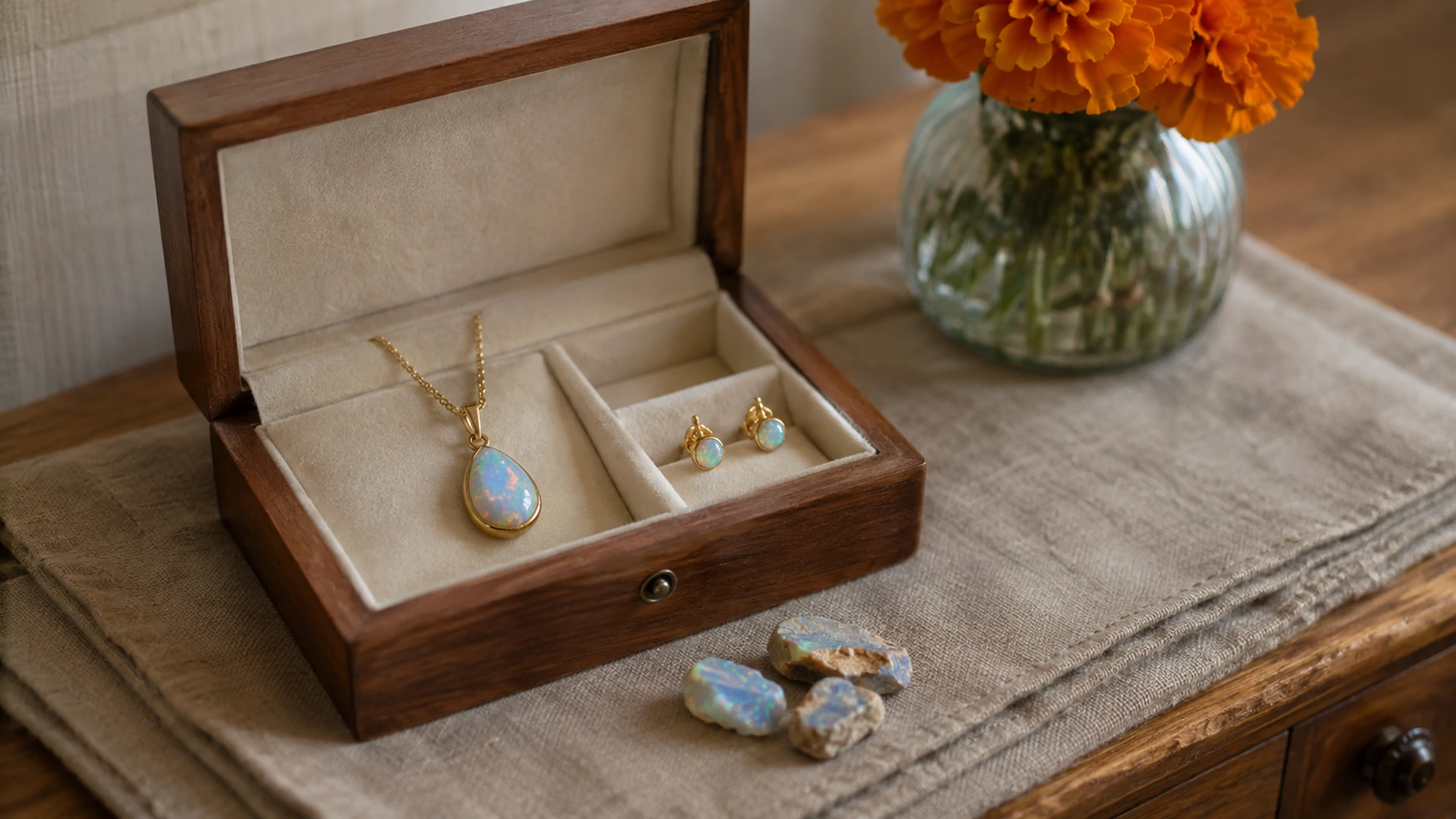
Opal has been October's traditional birthstone for over a century, and it earns that placement in ways that go beyond calendar convention. The stone carries a quality that genuinely mirrors what October is: a month caught between worlds, alive with color, and moving steadily toward darkness. If you were born in October, opal as your birthstone isn't just a pretty association. It's a stone whose core energetic character maps onto your nature in specific, workable ways. This article breaks down what that means and how to use it. October also has two secondary birthstones — Pink Tourmaline and Black Tourmaline — each with their own distinct energetic character, but Opal is where October's full symbolic weight lives.
What Opal Means as the October Birthstone
October sits at the hinge of the year. In the Northern Hemisphere, it's when daylight visibly shortens, leaves hit their most vivid color right before they fall, and the veil between ordinary life and the unseen world is said to thin. The month holds two zodiac signs: Libra (through October 22) and Scorpio (from October 23). That's not incidental to Opal's assignment — the stone bridges both energies in ways that feel almost too precise.
Libra is ruled by Venus and craves beauty, balance, and harmony, but tends to struggle with indecision and avoidance of the harder truths. Scorpio is ruled by Pluto and Mars, built for depth, transformation, and unflinching self-examination, but can tip into obsession, control, and emotional volatility. Opal's play-of-color — the technical name is adularescence, meaning the way light scatters inside the stone to produce shifting spectral fire — is a near-perfect symbol of what both signs need. It shows all colors at once without committing to one. For Libra, that's permission to contain complexity rather than resolve it prematurely. For Scorpio, it's the reminder that what lives beneath the surface can be luminous, not just dangerous.
Historically, Opal's assignment to October traces to the early standardization of birthstone lists. The modern list most people know was formalized by the American National Retail Jewelers Association in 1912, but Opal's connection to October has older roots. Roman sources describe Opal as a stone of hope and fortune — Pliny the Elder wrote about it with genuine awe, calling it a stone that contained the fire of ruby, the purple of amethyst, and the sea-green of emerald all at once. By the medieval period it was associated with fidelity and the protection of sight. Its multispectral nature made it a natural fit for a month that contains so much at once.
There's a distinction worth making early, and Opal's own nature explains it better than most stones can. When you use any stone in ritual, you're directing its energy toward an external intention — the stone is a tool, and you're the one pointing it. Working with your birthstone is different because the relationship runs in both directions. Opal doesn't just show you one color; it shows you all of them simultaneously, each one real, none canceling the others out. That's what it does for the October-born practitioner too. Rather than amplifying a single quality or pushing toward a single outcome, it reflects the full spectrum of who you are — strengths, blind spots, patterns you haven't named yet. What rises to the surface depends on what's already moving beneath it. For some people that's immediately useful; for others it takes time to learn how to read. If that feels like a lot to start with, October's secondary birthstones offer different entry points: Pink Tourmaline works through the heart and emotional healing, while Black Tourmaline grounds and protects. But if you're ready to work with the full force of what October carries, Opal is the stone for it.
Opal's Hardness, Care & Origins
Opal sits at 5.5–6.5 on the Mohs hardness scale, which puts it in a more vulnerable category than most stones commonly used in practice. But hardness is only part of the picture. The more important fact is that Opal is hydrated silica — it contains up to 21% structural water, built directly into its physical makeup. That water is part of what produces the play-of-color. It's also what makes Opal genuinely fragile in ways other stones in this project simply aren't.
Sudden temperature changes can cause cracking, a process called crazing — the fine internal fractures that form when Opal expands or contracts unevenly. Prolonged dry conditions pull moisture out of the stone over time and can produce the same result. Chemical exposure, including harsh cleaning products and even prolonged contact with skin oils, can dull the surface or affect the color play. The practical upshot: keep Opal away from direct heat sources and prolonged intense sunlight (the concern goes beyond fading — it's structural), avoid storing it somewhere very dry, and clean it with plain water and a soft cloth only. No ultrasonic cleaners, no steam, no jewelry solutions.
This also affects how you wear it. Opal is genuinely better suited to pendants and earrings than to rings. A ring worn daily takes a level of physical impact — knocks against surfaces, pressure from gripping things — that Opal's hardness and water content make it poorly equipped to handle over time. That's not a reason to avoid it; it's a reason to be intentional about placement. A pendant kept close to the body is both practically safer and magically apt, sitting near the heart or throat where its correspondence with emotional clarity and honest speech is directly relevant.
In terms of sourcing, Australia is the defining origin for Opal — it produces roughly 90% or more of the world's supply and has for most of the modern gem trade. The Lightning Ridge region of New South Wales is the primary source of black opal, the variety most prized for its dark body tone and vivid color flash. Ethiopia's Welo region has become a significant newer source, producing opals with a distinctive clarity and strong play-of-color. Mexico is known specifically for fire opal, which tends toward orange and red body color and is often transparent or translucent rather than opaque. If provenance matters to your practice, Australian opal is the most historically continuous source; Ethiopian Welo opal is widely available and generally well-regarded; Mexican fire opal carries its own distinct energetic character due to its solar color range.
How to Use Opal as Your Birthstone in Magic Rituals
Charging and Carrying Your Opal
The foundation of any birthstone practice is establishing a personal bond with the stone. Take your Opal and hold it in your dominant hand. Breathe slowly and deliberately, and spend a few minutes simply noticing the stone — its weight, its temperature against your skin, the way its color shifts as you move it. This isn't passive admiration; it's attunement. You're registering the stone's frequency before you load it with intent.
Once you feel settled, state your intention clearly, either aloud or in your mind. For a birthstone charge, this tends to be broad rather than spell-specific: something like amplifying your natural perception, strengthening your emotional clarity, or deepening your self-trust. Then place the Opal somewhere it will receive diffuse natural light or moonlight for several hours. Given Opal's water content and heat sensitivity (see the Care section above), indirect light only — no prolonged direct sunlight, no windowsills that get intense afternoon heat. After charging, carry it on your body during waking hours, ideally in a pouch at your chest or in a pendant setting close to the skin. Recharge it on the new or full moon each month.
White Candle Ritual for Clarity and Self-Illumination
Opal's core spiritual function as a birthstone is illumination — bringing what is hidden or unconscious into visible form. A white candle pairs cleanly with this because white holds all frequencies simultaneously, just as Opal's play-of-color contains the entire visible spectrum. This isn't coincidence; it's a genuine correspondence overlap that makes the pairing effective.
Set up your space simply. Place your Opal directly in front of the candle so the flame's light moves through or across the stone as it burns. Dress the candle lightly with a clarity-supporting oil — frankincense works well, as does clary sage — and if you like, inscribe a single word into the wax that names what you want to see more clearly. Light the candle and spend at least ten minutes watching the flame's reflection in the Opal. Let your gaze soften rather than focus hard. Opal has a long historical association with vision and the amplification of psychic sight, and this practice uses that correspondence deliberately. The candle's light and the stone together create a focal point that quiets mental noise and makes space for genuine insight to surface. Let the candle burn completely if it's a small taper or chime candle.
Samhain Threshold Ritual
October 31 is Samhain, one of the traditional fire festivals marking the end of the harvest season and the beginning of the dark half of the year. It's the night when the boundary between the living and the dead is said to be thinnest — which makes it an unusually potent time for birthstone work if you were born in October, because your natal stone is already attuned to that liminal, between-worlds quality.
On the evening of Samhain, or on any night in the final week of October when you can work undisturbed, go to a threshold in your home — a doorway or window works fine. Hold your Opal in both hands. Think about what you are leaving behind as this year moves into its darker half: patterns you're done carrying, beliefs that no longer fit, versions of yourself you've outgrown. Speak these things aloud, one by one. Then consciously step through the threshold — literally walk through the doorway or turn away from the window — as a physical act of transition. As you do, shift your focus to what you are carrying forward: the strengths, the knowledge, the relationships, the intentions. Opal as a threshold stone supports this kind of deliberate seasonal passage. Place the stone on your altar or windowsill overnight after the ritual to let it absorb the energetic quality of this turning point in the year.
Third Eye Activation Practice
Opal has a genuine correspondence with the third eye chakra — the energy center located between the eyebrows that governs intuition, inner vision, and perception beyond the literal. This correspondence is supported by Opal's historical associations with psychic sight, its connection to water and the moon, and its multi-spectral optical quality, which visually embodies the idea of seeing more than one dimension at once.
Lie down in a quiet space. Place your Opal gently on your forehead, between your brows. Close your eyes and breathe slowly for several minutes, focusing your awareness on the point of contact between the stone and your skin. Don't force anything — the practice works through sustained, relaxed attention, not effortful concentration. After five to ten minutes of quiet attention, ask yourself a single question you genuinely don't know the answer to, something you've been avoiding or can't resolve through logic alone. Then stay quiet and notice what comes. Images, feelings, sudden clarity, or simply a sense of knowing can all be valid responses. This isn't fortune-telling; it's using Opal's correspondence to lower the threshold of your own intuitive perception. Keep a journal nearby and write down whatever surfaces before you get up.
Dream Work and Shadow Integration
Opal has a long-standing association with the dream state. Its connection to water (emotionally linked to the unconscious), its Venus and Moon correspondences, and its historical role in amplifying hidden perceptions all make it naturally suited to dreamwork. For Scorpio-born practitioners especially, this is one of Opal's most powerful applications — because Scorpio's shadow material tends to surface most honestly in dreams.
For seven consecutive nights, place your Opal under your pillow or on your nightstand before sleep. Before you close your eyes, hold the stone briefly and set a clear, simple intention: you want to remember and understand what your dreams show you. Keep a notebook on your nightstand. The moment you wake, write down everything you remember before you check your phone or fully engage with the day — even fragments, emotions, or vague impressions count. After seven nights, read back through your notes and look for patterns. Recurring symbols, emotions, people, or settings are worth paying close attention to. Opal won't manufacture meaningful dreams, but it sharpens your recall and attunes your awareness so that what was already moving in your unconscious mind becomes legible.
Altar Placement for Ongoing Birthstone Work
If you maintain an altar or a dedicated magical workspace, your Opal deserves a permanent or semi-permanent place on it during October — and ideally throughout the year if this is your birthstone. Place it in the center or slightly forward on the altar surface, where it will catch available light and remain visually prominent. Surround it with items that share its correspondences: a small dish of water for its elemental alignment, imagery connected to Venus or the moon, and if you work with the Libra-Scorpio threshold, symbols that acknowledge both — a scale or a feather alongside something that represents transformation or depth.
The altar placement isn't just decorative. Your altar is a physical anchor for your ongoing intention, and having your birthstone present there creates a daily point of contact between you and your practice. You don't need to do anything elaborate each time you pass it — a moment of conscious acknowledgment, even just a glance with genuine presence, reinforces the relationship between you and the stone.
Wearing & Carrying Opal for Daily Protection
Opal's protective quality in daily life flows from its core correspondence: it amplifies perception and brings hidden things to light. That makes it naturally useful for navigating environments where you need clear reading of people and situations — workplaces with complicated dynamics, social settings that require emotional intelligence, or any context where you benefit from quick, accurate intuition rather than reactive emotion.
Jewelry
Opal works best with skin contact, and placement matters both magically and practically. Given its lower hardness and water content (see the Care section), pendants and earrings are genuinely the better choice over rings for daily wear — a ring takes daily knocks that a 5.5–6.5 Mohs stone isn't well-equipped to absorb over time. A pendant at the chest or throat sits near the heart and voice centers, supporting both emotional awareness and the courage to speak from a place of genuine self-knowledge. If you're Libra-born and working on speaking difficult truths more readily, the throat placement is particularly apt. If you're Scorpio-born and working on emotional transparency, a heart-level pendant makes more sense. If you do wear Opal in a ring, reserve it for less physically demanding days and check the setting regularly for any loosening from impact.
In the Home
Opal placed near a window or on a windowsill brings its light-interaction quality into the space daily — but keep it out of spots that receive prolonged direct afternoon sun, which risks thermal stress over time. A stone on your work desk keeps the illumination correspondence active during hours when you need clarity and focus, and it's a natural placement for anyone doing detail-oriented or vision-dependent work, given Opal's medieval association with the protection of eyesight. Avoid placing it in dark corners or storage; Opal's protective energy is activated by engagement, not passivity, and a stone kept tucked away isn't doing much for you or itself.
Wholeness and Multiplicity
One of Opal's most distinctive uses — and one that's easy to overlook — is as a stone of integrated wholeness. Pliny the Elder's description of it containing the fire of ruby, the purple of amethyst, and the sea-green of emerald simultaneously wasn't just poetic. It named something real about what Opal offers: the capacity to hold multiple truths, multiple colors, multiple selves at once without needing to flatten any of them into a single identity. If you find yourself in a period where you're being asked to be one thing cleanly when your actual reality is more complicated, carrying Opal is a direct counterweight to that pressure. It doesn't resolve the multiplicity. It reminds you that multiplicity is the point.
A Genuine Travel Caution
Opal is worth leaving home for certain trips. Its water content makes it sensitive to thermal extremes — prolonged heat, beach environments with high sun exposure, rapid temperature swings between air-conditioned interiors and hot outdoor air — and these conditions can cause crazing over time. For travel involving hot climates, physically demanding outdoor activity, or extended periods without a controlled storage environment, one of October's secondary birthstones is a more practical companion. Black Tourmaline handles heat and impact far better and carries its own protective correspondence. This isn't a reason to never travel with Opal; it's a reason to be honest about the conditions and make the choice deliberately rather than by default.
October's Other Birthstones: Pink and Black Tourmaline
Pink Tourmaline was added to October's birthstone list in 1952, specified at the time as the modern alternative for the month. At Mohs 7–7.5, it's significantly harder than Opal and far better suited to daily wear in rings and bracelets without the care concerns. Energetically it works in a completely different register: where Opal surfaces what's hidden and asks you to see it clearly, Pink Tourmaline opens the heart and supports emotional resilience, self-compassion, and the kind of gentle but persistent inner work that doesn't require you to stare down your shadow directly. For Libra-born practitioners especially, it's a strong fit — it aligns with Venus's warmth without the intensity that Opal can bring.
Black Tourmaline is recognized under the broadened standard now used by the GIA and others, which accepts tourmaline of any color as an October birthstone. It operates in pure protection and grounding territory: it builds a firm energetic boundary, deflects unwanted external influence, and keeps you anchored when Opal's perceptual openness starts to feel like too much input. Practically, it's the most durable of the three — handles daily wear, temperature variation, and physical stress without concern. If you're new to working with October's energy and aren't sure where to start, Black Tourmaline gives you a solid footing before you go deeper with Opal.
Opal Crystal Combinations: What Pairs Well
Opal and Labradorite — Both stones display adularescent optical phenomena, but they work on different registers. Opal opens perception inward — toward self-knowledge, emotional depth, and the unconscious. Labradorite works outward, strengthening the energetic boundary between you and the world and protecting against psychic drain or unwanted influence. Together, they support a practice that is both deeply self-aware and well-protected. This pairing is especially good for Scorpio-born practitioners who do intense inner work and need a reliable boundary layer around it.
Opal and Selenite — Both stones have strong lunar energy and a natural affinity for clarity work, but they operate differently. Opal draws what's hidden upward into conscious awareness. Selenite clears the energetic static around that process — it cleanses the field you're working in and keeps the channel between your conscious and unconscious mind clean and unobstructed. For Libra-born practitioners who find that deep self-examination quickly becomes cluttered with overthinking or emotional noise, Selenite alongside Opal creates the kind of still, clear internal space where genuine insight can actually land.
Opal and Black Tourmaline — A strong pairing for protection-focused work. Opal's energy opens and amplifies perception, which is its greatest asset but also makes it energetically expansive. Black Tourmaline provides firm grounding and a clear energetic boundary. If you're using Opal in environments that are psychically noisy or emotionally demanding — crowded workplaces, hospitals, busy transit, emotionally charged family gatherings — carrying Black Tourmaline alongside it keeps the channel open without leaving you vulnerable to external input you didn't ask for.
Opal and Amethyst — Amethyst is a natural companion to Opal's dreamwork and psychic sight applications. Opal sharpens the signal; Amethyst provides the clear, calm mental state needed to receive and interpret it accurately. Amethyst also has well-established correspondences with spiritual protection and the prevention of psychic overwhelm, which matters when you're regularly working with a stone as perceptually amplifying as Opal. This is a good everyday pairing if you're doing extended shadow or dream work over multiple weeks.
Opal and Rose Quartz — Opal illuminates; Rose Quartz receives what's illuminated with softness rather than judgment. This pairing is particularly useful for shadow integration work, where the material that surfaces from the unconscious is often uncomfortable or self-critical. Rose Quartz brings Venus's other quality — self-compassion, gentleness, unconditional regard for the self — to balance Opal's unflinching clarity. For Libra-born practitioners specifically, this combination helps the self-knowledge Opal provides land as empowerment rather than self-criticism.
Opal and Smoky Quartz — Smoky Quartz is one of the most effective grounding stones in practice, and it pairs with Opal for the same reason Black Tourmaline does — it anchors Opal's expansive energy. The difference is that Smoky Quartz also transmutes dense emotional energy, converting it to a more neutral form rather than simply blocking it. For Scorpio-born practitioners doing serious shadow work, this pairing is more nuanced than a straight protection combination: it supports the actual processing and release of what Opal surfaces, rather than just building a wall around it.
Opal Is October's Mirror — and It's Yours
What makes Opal the right stone for October isn't just history or tradition. It's the match between the stone's nature and the month's character. October is the moment when light and dark stand briefly equal before the darkness wins, when color blazes most brilliantly on its way to falling, when the seen and unseen come closest to each other. Opal holds all of that in its physical structure: every color present at once, light and depth inseparable, fire inside water. That's not symbolic decoration — it's what makes it genuinely useful for October-born practitioners.
As your birthstone, Opal resonates with your natal frequency in a way that general stone work doesn't replicate. It amplifies your natural perception, brings your own unconscious patterns into legible form, and supports the specific tension that defines the October temperament: the pull between beauty and depth, between balance and transformation. Whether you use it in formal ritual, dream work, daily carrying, or simply as a kept presence on your altar, the relationship between you and this stone has a built-in intimacy that other workings don't start with. You don't have to create that resonance from scratch — it's already there.
If you want to understand how birthstone assignments work across all twelve months, and why the personal resonance between a practitioner and their birth month's stone matters in practice, take a look at the complete guide to every month's birthstone. Opal is one piece of a larger picture — and knowing where your stone fits only deepens how you work with it.