Ruby: Love With Its Pulse Showing
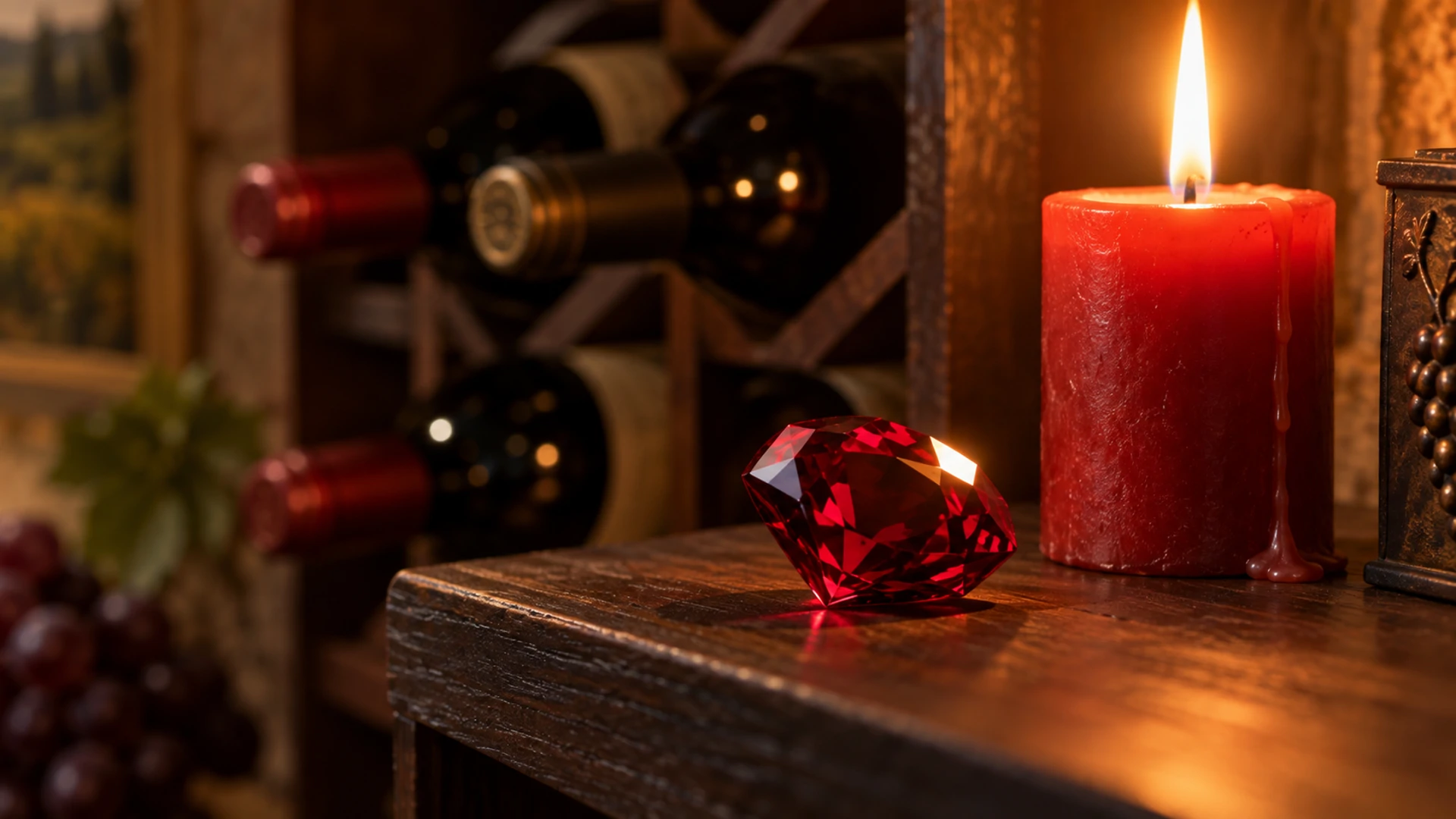
Ruby is the stone of love that feels like a pulse — heat, drive, and the physical aliveness of desire rather than tenderness or long-term devotion. It belongs to the Love & Relationships category not because it nurtures or commits, but because it ignites.
Love With Its Pulse Showing: Why Ruby Belongs in Love & Relationships
Ruby's mechanism in love magic is passionate, vital, embodied love: fire, sensuality, and courage in romance. That's a distinct and specific lane. It's worth naming what ruby is not, because the Love & Relationships category holds several stones that superficially look similar but operate on completely different registers. Pink tourmaline's work is the courage to be vulnerable in partnership — opening the heart specifically to let someone in, working along a root-to-heart pathway of emotional safety. Emerald is the Stone of Successful Love, and its emphasis is fidelity and loyalty in committed partnership — marriage, domestic harmony, the discipline of staying. Ruby is neither of those things. It isn't about the nerve to open up or the promise to remain. It's the fire underneath attraction itself: the physical pull, the heat of wanting, the energy that gets you into the room in the first place.
Mineralogically, ruby is corundum — aluminum oxide — colored red by trace chromium. That's the same mineral species as sapphire; the only difference is the impurity that produces the color. Red corundum is ruby. Every other color is sapphire. Ruby sits at Mohs 9 on the hardness scale, second only to diamond among natural gemstones. That hardness is part of its character in use: it's not a delicate or tentative stone. It holds its shape under pressure.
Ruby's primary ruling body is the Sun. The Sun in magical tradition governs vitality, life-force, and personal power — the energy that animates rather than the emotion that binds. Some traditions bring Mars in alongside it, adding a charge of drive, physical courage, and action, and that secondary correspondence feels honest to how ruby actually works in practice. The heart chakra is its home, but it doesn't sit there quietly. Ruby activates the heart the way the Sun activates a landscape: with heat, with urgency, with the kind of aliveness that makes everything feel more real.
Natural, Treated, or Grown: Choosing Ruby
The first distinction worth understanding before you buy is between natural and lab-created ruby. Lab-created ruby is chemically and physically identical to natural ruby — same corundum, same chromium, same hardness — but it's produced in a controlled environment rather than pulled from the earth. It's not fraudulent when it's disclosed, and good sellers will disclose it. But it is a different thing to be working with intentionally. If the geological age of a stone matters to your practice, or if you want something with a long history in the earth, natural ruby is what you're looking for. If you want the same mineral composition at a price that lets you own a larger or higher-quality piece, lab-created is a legitimate choice. The magic follows your intention either way, but know what you're holding.
Among natural rubies, treatment is the norm rather than the exception. The overwhelming majority of commercial ruby has been heat-treated to improve color and clarity — this is a widely accepted practice in the gem trade, stable over time, and rarely disclosed as exceptional because it's so standard. A smaller portion of natural ruby has been fracture-filled with glass, a treatment that improves apparent clarity by filling internal fractures with a foreign material. This must be disclosed by law in many markets, but isn't always. Fracture-filling affects more than price: it affects durability. A glass-filled stone is more vulnerable than a heat-treated one.
For care, Mohs 9 makes ruby one of the most durable stones you can work with. It's water-safe, stands up to daily wear, and doesn't require delicate handling. The exception is glass-filled material: harsh chemicals and ultrasonic cleaners can damage or remove the glass filling, which will change the stone's appearance. If you don't know whether your ruby is fracture-filled, treat it as though it might be and skip the ultrasonic. For all ruby, a soft cloth and mild soap in lukewarm water is more than enough. There's no need to protect it from sunlight, heat from candles, or normal wear.
Three Practices for Love in Full Color
The Kindled Spark
This practice is for reigniting passion and physical attraction in an existing relationship that has gone quiet — not broken, not hostile, but dimmed in the way long partnerships sometimes dim.
Hold your ruby in your dominant hand and let it warm in your palm for a full minute before you begin. Light a red candle on your altar or workspace. Red holds the same fire and urgency as ruby itself, and using them together concentrates that energy into a single point of intention. Bring your partner to mind — not a version of who they were at the beginning, but who they are right now. Hold both the stone and that specific image simultaneously. When the warmth from the ruby feels undeniable in your hand, speak aloud (or in your mind, if you need to) one thing you find genuinely attractive about your partner today. Not a memory. One thing that is true right now. Set the stone on the altar beside the candle and let the candle burn for at least one hour. Do this on a Sunday during a Sun hour for maximum alignment with ruby's primary ruling body. Carry the stone with you for the next three days.
The Bold Approach
This practice is for the courage it takes to pursue someone or make the first romantic move — when you know what you want but feel the fear of exposure more than the desire to act.
The morning before you intend to make your move, sit with your ruby in your non-dominant hand. Hold the stone at your chest, over the heart chakra. Close your eyes and breathe in slowly through the nose, out through the mouth, seven times. With each exhale, let the ruby's heat spread outward from your sternum. Ruby's connection to the Sun means it responds especially well to intention set in morning light — place yourself somewhere the sun can reach you if possible, or work near a window. After the seven breaths, say aloud: "I am the heat in this. I move toward what I want." Carry the ruby in your pocket for the rest of the day. If the moment comes and you hesitate, close your hand around the stone. The warmth is your reminder that the desire is already there — you're not waiting for courage to arrive, you're choosing to act on what you already feel.
The Full Presence
This practice is for being fully, sensually present with a partner — for the times when you're physically there but emotionally or mentally elsewhere, distracted by the noise of daily life.
Before spending intentional time with your partner, take five minutes alone with your ruby. Sit somewhere quiet and hold the stone flat in both palms, one hand beneath the other. Breathe slowly and bring your attention entirely into your body: the weight of the stone, the temperature of it, the sensation of breath moving through your chest. Ruby works in the register of embodied, physical love, which means it pulls attention into the body rather than the mind — that's exactly what presence requires. After five minutes, tuck the stone somewhere close to your skin (a pocket, a bra, waistband). You don't need to think about it again. The practice of arriving into your body before you arrive to your partner is the working itself. Some practitioners add a few drops of rose or sandalwood oil to their palms before holding the stone, linking it to the Venus current alongside Ruby's solar fire. That's optional, but it layers the intention well.
The Dearly Loved Stone
French jewelers of the nineteenth century called ruby "la pierre bien aimée" — the dearly loved stone. That's a specific, documented term of the Victorian-era gem trade, and it ties the stone explicitly to romantic devotion rather than general luxury or status. Ruby was the love stone, full stop, at a time when the language of gems was taken seriously as a language.
The Burmese warrior tradition that ruby could grant invincibility in battle — including the legend that warriors implanted rubies beneath their skin before combat — belongs to the register of folklore rather than verified historical practice. It tells you something true about how the stone was perceived: as protective, as courage-giving, as intensifying the life-force of the person carrying it. Whether any warrior ever acted on that belief literally is impossible to confirm. What the legend communicates is that ruby was understood as a stone of vital force, not beauty alone.
A remark sometimes attributed to Ivan the Terrible praises ruby's power over the heart and blood, describing it as the lord of gems. It should be noted as attributed rather than confirmed — the quotation circulates in gem lore without a reliable primary source to trace it to. But the sentiment reflects a real and long-standing place ruby has held in the hierarchy of precious stones: not as the most refined, but as the most alive. Sanskrit texts called it ratnaraj, king of precious stones. That's the register ruby has occupied across cultures and centuries — not quiet, not subtle, not soft. The most vital thing in the room.
Love That Runs Hot
Ruby's place in the Love & Relationships category is earned by what it specifically does: fire, physical vitality, and the embodied courage that romantic and sexual attraction actually requires. It doesn't overlap with the other stones in this cluster because it isn't trying to do what they do. It's not building toward something — it's the thing that makes you want to build toward it in the first place.
If you want to see how ruby sits alongside the full range of stones in this category — and alongside the six other categories that make up a complete crystal practice — The Crystal Compendium: Seven Paths to Stone Magic is the place to see the whole picture.