Pink Tourmaline: The Courage to Stay Open
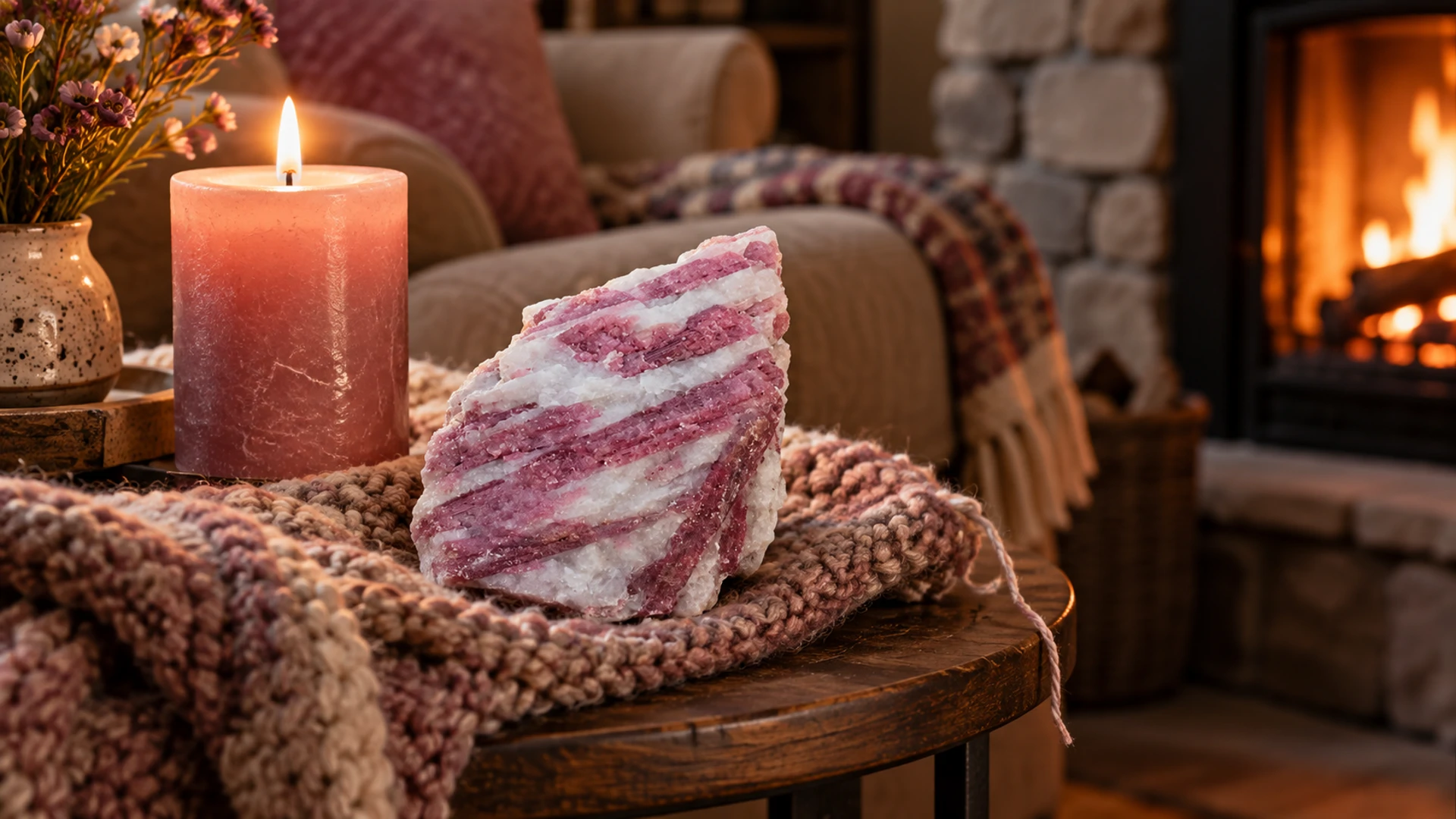
Pink tourmaline is the stone for the specific kind of bravery that romantic love demands: staying emotionally open with another person even when closing off would feel safer. It works not in the abstract register of self-love or forgiveness, but in the live, present-tense register of an active relationship.
The Courage to Stay Open: Why Pink Tourmaline Belongs in Love & Relationships
The Love & Relationships category is not one thing. Each stone in it addresses a different register of the experience, and understanding where pink tourmaline sits requires knowing where it doesn't. Rose quartz works with universal, unconditional love — it's the foundational stone for every form of love, from self-regard to family bonds to friendship, without targeting any single register. Rhodonite addresses healing and forgiveness after relational wounds — it repairs what's broken rather than initiating anything new. Pink tourmaline does neither of those things. Its specific mechanism is romantic, feminine heart-opening: the courage to be vulnerable within a partnership, to remain soft when the self-protective instinct would rather build a wall.
What makes this stone distinct is the pathway it works along. Most heart-centered stones operate within the emotional register and stay there. Pink tourmaline moves along a channel that runs from the root chakra upward to the heart, which means the openness it supports isn't purely emotional — it's grounded, embodied, and capable of holding its own weight. Vulnerability rooted in the body doesn't collapse when it meets friction. That's the specific quality this stone is associated with: the nerve to stay present, not the softness to feel.
In terms of composition, pink tourmaline belongs to the elaborate tourmaline mineral group, a family of complex aluminum borosilicate minerals. Its pink-to-red color comes specifically from manganese, and the presence of natural lithium in the crystal structure is one reason it's associated with calm within that openness — a steadiness rather than an excitability. At the most intensely saturated end of the color range, where the pink deepens into a vivid red-pink, the material is sometimes traded under the name rubellite. Rubellite is not a different stone; it's a trade name for the richest specimens within the same species.
Venus governs this stone, which fits: Venus rules not just love as feeling but love as relationship, as mutual investment between two people. Libra is the zodiac sign most commonly cited alongside pink tourmaline, and again the fit is apt — Libra is the sign of the partnership itself, not of passion or of solitude. The heart chakra is the primary activation point, but as noted above, the root chakra is also engaged, anchoring the heart's openness in something steadier than sentiment.
Mistaken for Ruby, for Centuries: Choosing Pink Tourmaline
Before tourmaline was recognized as its own distinct mineral species in the eighteenth century, pink and red tourmaline circulated in the lapidary trade under other names entirely. It was sold and worn as garnet, as ruby, and as spinel — all red and pink stones that shared its visual range, none of which shared its actual composition. This wasn't a failure of observation; it was a failure of available classification. The tools to distinguish these minerals structurally simply didn't exist yet, and color was the working standard. The reclassification of tourmaline as a distinct species finally gave a name to material that had been present in collections and jewelry for a very long time without a proper identity.
When you're choosing a specimen today, the first quality to look for is color saturation. Pink tourmaline ranges from a pale, almost translucent blush to a deep, warm pink that borders on red. Both ends of that range are genuine; neither is inferior. If you encounter the trade name rubellite, it refers specifically to the most vivid, deeply saturated specimens — the ones where the color is strong and stable under different light conditions. Rubellite commands a higher price because genuinely vivid color in this range is less common, and it should be clear under both daylight and incandescent light rather than shifting toward orange or brown in warmer light, which would indicate a lower-grade pink.
For everyday use, pink tourmaline is well suited to wear. Its Mohs hardness falls between 7 and 7.5, which is durable enough for rings, pendants, and bracelets used regularly. It's water-safe — brief rinsing presents no concern — and carries no toxicity risk for normal handling. Store it away from harder stones that could scratch the surface, and clean it with a soft, damp cloth when needed. It doesn't require special cleansing protocols or particular sensitivity beyond the ordinary care you'd give any gemstone in your collection.
Three Practices for Staying Open
The First Risk
Use this practice in the early stage of romantic interest, when the feeling is real but the other person's response is still unknown — the specific window where the risk of showing yourself hasn't been resolved yet.
Hold your pink tourmaline in your left hand and sit with it for a few minutes before any interaction where you intend to be more honest or expressive than feels comfortable. If you can, time this during a Venus hour — it doesn't need to be elaborate, just intentional. The work is simple: let the stone warm in your hand and articulate internally, as clearly as you can, exactly what you want to express. Not a performance of it, just the actual feeling. Carry the stone with you or keep it in a pocket during the conversation. The point is not to guarantee a particular outcome; it's to make the expression of genuine feeling feel less like a freefall.
The Grounded Opening
Use this practice when you're in an established relationship and a moment arises where the instinct is to protect yourself rather than stay present — a disagreement, a moment of feeling misunderstood, or a conversation that's harder than expected.
Before or after the difficult moment (not during it — the stone is a preparation, not a prop), sit with pink tourmaline placed at the center of your chest and breathe slowly. Light a pink candle if the setting allows. The intention is to feel the weight of the stone on your sternum and use that physical sensation as an anchor — something tangible to return to when the pull toward self-closure is strong. Spend five to ten minutes simply breathing and letting the stone's warmth settle. The practice trains the body to associate that weight with the choice to stay open, so when a similar moment arises without the stone present, the body has a reference for what the alternative feels like.
The Held Tenderness
Use this practice for the specific difficulty of receiving care, affection, or appreciation from a partner without deflecting it, minimizing it, or redirecting the attention away from yourself.
This one works best as a solo preparation before an occasion where you know affection will be offered — an anniversary, a moment of reunion, or any time when being fully received by another person feels exposing. Sit quietly with pink tourmaline in both palms, cupped between your hands. Bring to mind a specific instance of being cared for by this person, or a specific form of affection you tend to deflect. Let the memory sit without commenting on it internally. Some people find it useful to pair this with a few drops of rose oil on the wrists — the scent alone can soften the guardedness that shows up in the body before the mind has caught up. The goal of the practice is simply to rehearse receiving without shrinking.
A Favorite of the Last Empress of China
Empress Dowager Cixi, the last reigning Empress of China, developed a documented and well-corroborated fondness for pink tourmaline. The material she prized came specifically from mines in Maine and California — American deposits, reaching imperial China through the gem trade of the late nineteenth and early twentieth centuries. The conduit was George Kunz, the celebrated gemologist at Tiffany & Co., who built the trade relationship that brought California and Maine tourmaline east.
What makes this particular piece of history useful for understanding the stone is what it illustrates about pink tourmaline's appeal at the upper end of the market. Cixi was not working with an unfamiliar or exotic material — jade, pearl, ruby, and sapphire were all firmly established in Chinese court tradition. Her preference for pink tourmaline was a distinct taste, not a default. The vivid, gem-quality material being produced from American deposits at that time was genuinely competitive with the finest material available anywhere, and the imperial appetite for it created a demand that sustained those mines for decades. The American West's tourmaline industry and an imperial Chinese court's aesthetic preference were, briefly and specifically, directly connected.
It's also worth noting that tourmaline's formal classification as its own mineral species — separating it definitively from garnet, ruby, and spinel in the trade — was itself relatively recent by the time of Cixi's interest. The stone Cixi was collecting had only been properly named and categorized for roughly a century. She was, in that sense, an early adopter of a stone that had always existed but had only recently acquired its own identity.
Love That Requires Nerve
Pink tourmaline's position in the Love & Relationships category is earned by the specificity of what it addresses. Most of us can manage love in the abstract. The harder work is love in the present tense — staying emotionally available to a real person on an ordinary day, or an especially difficult one. That's the register this stone works in, and it's the one that tends to get the least attention in love magic, which gravitates toward attraction or healing rather than the sustained vulnerability of an active partnership.
If you want to see how pink tourmaline fits alongside the other stones in this cluster, and alongside all seven paths in stone magic, The Crystal Compendium: Seven Paths to Stone Magic is the place to start.