Sardonyx: Willpower Pressed Into Layers
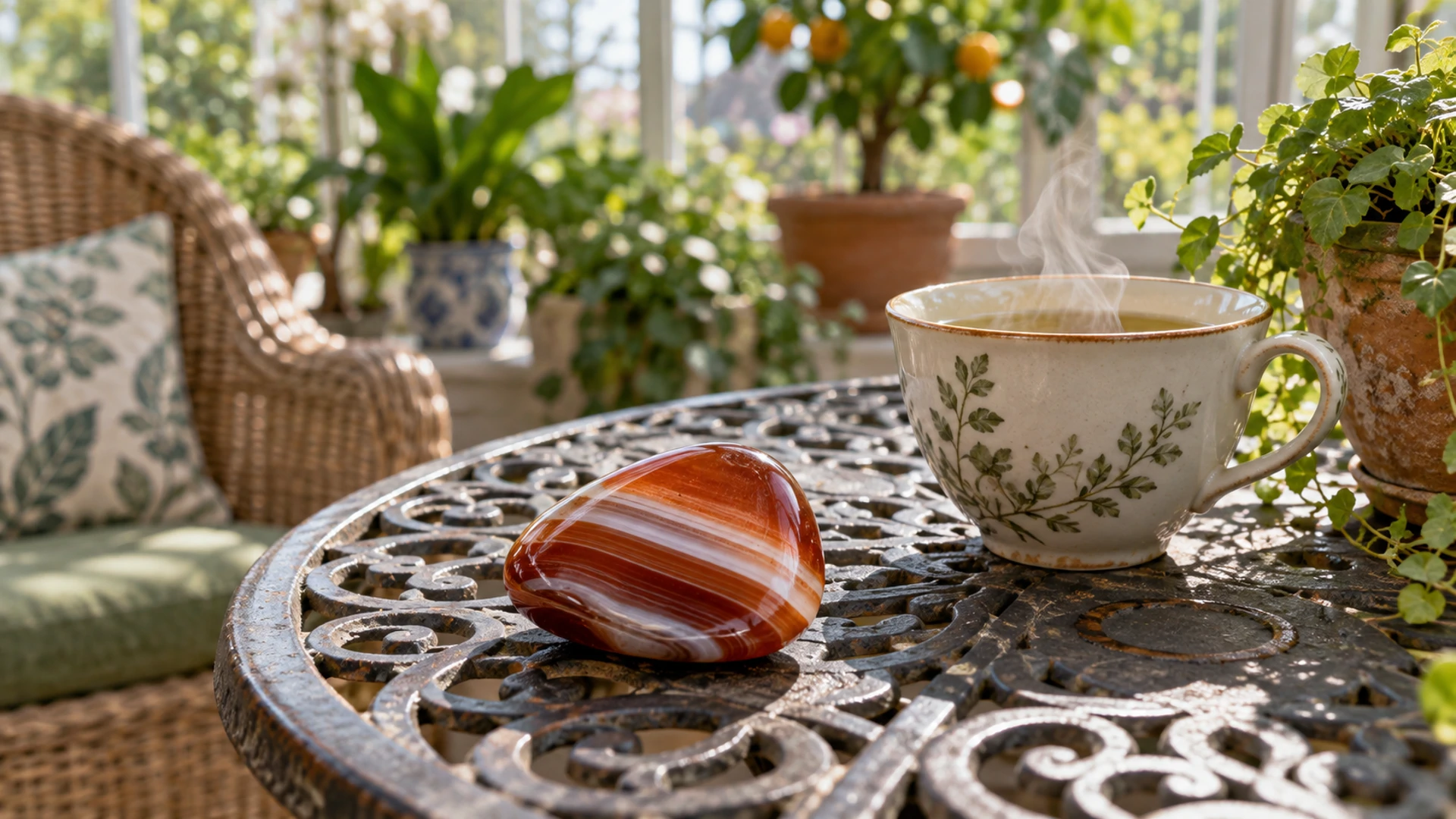
Sardonyx is a protection stone with a specific target: the moment you're already in a fight and need to hold your line. It doesn't ward off everything — it steadies you for what's directly in front of you.
Willpower Pressed Into Layers: Why Sardonyx Belongs in Protection
Sardonyx is a banded chalcedony, and its name tells you exactly what it is: a portmanteau of sard and onyx. Sard is a reddish-brown chalcedony closely related to carnelian. Onyx is a banded chalcedony in black and white. Sardonyx is what you get when both form together in parallel layers — the warm earth-red of sard alternating with crisp white or black bands of onyx, all within a single stone. It isn't a blend or a composite. It's two distinct chalcedony varieties deposited in the same chamber, which is part of why the banding is so visually decisive when the stone is high quality.
That layered structure is a useful way to understand what this stone actually does. The mechanism of Sardonyx in the Protection category is disciplined willpower in adversarial or competitive situations. Not a general shield, not a soft ground. Something more specific: the kind of inner steadiness that lets you stay controlled when someone is actively pushing against you — in a negotiation, a legal dispute, a competition, a prolonged professional conflict. This is protection as self-governance. The stone isn't keeping something away from you. It's keeping you coherent under pressure.
That distinction matters when you're deciding which protection stone fits your situation. Bloodstone's mechanism is active courage and vitality — it's a warrior's amulet for situations that require you to move, act, and push through. Sardonyx is for situations that require you to hold: to resist being destabilized, to stay articulate when you're being pressed, to see the contest through without cracking. Separately, Aegirine severs cords and attachments already placed on your energetic field — it works on influences that have already taken hold and need to be cut. Sardonyx doesn't target an external influence at all. Its whole function is inside you: the part of you that can be worn down, distracted, or bullied into compliance. That's what it shores up.
The correspondences are straightforward once the mechanism is clear. Sardonyx is ruled by Mars — which it shares with Bloodstone, despite the two stones operating through genuinely different means. This is worth sitting with for a moment. Mars governs will, force, and conflict, and both stones draw on that current, but Bloodstone channels it as physical vitality and courage in motion, while Sardonyx channels it as strategic endurance and mental discipline. The same planetary current expressing through two very different temperaments. Sardonyx works with the root chakra, grounding your sense of personal stability, and the sacral chakra, where your confidence, identity, and sense of personal authority live. Earth element. Saturday and Tuesday both carry relevance given its Saturn-adjacent qualities and Mars rulership — Tuesday being Mars's own day is the stronger fit for active use.
One more thing worth naming plainly: Sardonyx is one of the twelve stones in the biblical breastplate of Aaron described in Exodus, and it appears consistently throughout ancient Roman and Renaissance tradition in roles that have everything to do with standing firm in adversarial circumstances. This isn't a stone that arrived in contemporary metaphysical practice through a recent rebranding. Its protective reputation has a documented track record going back thousands of years, across distinct cultures, and it consistently shows up in the same role: the stone for those who need to hold their ground.
Sharp Bands, Not Blurred: Choosing Sardonyx
The most immediately readable quality marker in Sardonyx is the sharpness of its banding. In a high-quality specimen, the layers between reddish-brown sard and white or black onyx are clean, parallel, and clearly delineated — you can see exactly where one layer ends and the next begins. When the banding is blurred, hazy, or the color transition is gradual rather than distinct, the stone is lower quality. The visual clarity of those bands isn't just aesthetic. It reflects the geological precision of the layered deposition process, and a stone with crisp banding simply has more presence as a working tool. If you're buying in person, hold it in good light and look for those edges.
There are two common points of confusion when identifying Sardonyx. Plain onyx shows banding only in black and white — there's no reddish-brown sard layer present. If a stone is described as onyx but has warm reddish tones banded through it, it's more likely Sardonyx. Carnelian, on the other hand, is a solid, unbanded reddish-orange chalcedony — it doesn't have visible parallel layers at all. Sardonyx is identifiable specifically by the combination of that warm reddish-brown sard tone and distinct parallel banding. All three are in the chalcedony family, which is why the confusion happens, but they're visually and mineralogically distinct when you know what to look for.
On care, Sardonyx is about as low-maintenance as stones get. It comes in at Mohs 6.5 to 7, which puts it in durable everyday territory — it won't scratch easily and it doesn't require protective storage away from other stones unless those stones are significantly harder. It's water-safe for brief contact, so rinsing it clean is fine. There are no toxicity concerns from handling, and no special sensitivity to light. If you're carrying Sardonyx daily — in a pocket, worn as jewelry, kept in a bag — it will hold up without particular attention. The main thing to avoid is prolonged soaking, which applies to most chalcedony varieties as a general caution, though Sardonyx is considerably more durable than softer stones that share this warning.
Three Practices for Holding Your Ground
The Held Line
This practice is for sustained conflicts or competitions that unfold over days or weeks — a difficult negotiation, an ongoing rivalry, a legal or professional dispute you're navigating over time, not a single confrontation.
Hold the stone in your dominant hand at the start of each day for the duration of the situation. Before setting it down, state aloud, simply and specifically, what you are holding firm on: not a vague wish, but the actual position or commitment you need to maintain. During a Mars hour on a Tuesday, carry the stone in your left pocket — the receiving side — as a reminder that the discipline is something you're drawing in, not projecting outward. At the end of each day, set it on your altar or nightstand rather than leaving it loose. The consistency of this daily handling is the practice. Sardonyx's mechanism is endurance, and the ritual should reflect that: not a single dramatic moment, but a repeated, deliberate act of recommitment.
The Sealed Word
This practice is for moments when a decision needs to feel settled and binding — when you've made a choice and want to stop relitigating it internally.
Write the decision or commitment on a small piece of paper in clear, direct language. Fold it once and press the Sardonyx flat against it. Hold both in your hands for several minutes, applying gentle, steady pressure — the weight of your own hands doing the sealing. This draws directly on the stone's historical role as a wax-seal material: Sardonyx was valued in ancient Rome specifically because wax doesn't adhere to it, making it ideal for signet rings that pressed official seals into correspondence. The symbolic weight of that function translates here. The stone doesn't absorb the decision — it witnesses it and holds the pressure. Place the folded paper under the stone and leave it there until the decision no longer feels uncertain. A red candle burned nearby during the initial sealing amplifies the Mars correspondence, if you want a stronger working.
The Orator's Nerve
This practice is for the minutes before a high-stakes speech, presentation, pitch, or any moment when you need your words to carry authority and your composure to hold under scrutiny.
Keep the stone in your hand or a pocket throughout the preparation period. Renaissance orators wore Sardonyx believing it made speech more persuasive and commanding — this practice works with that same association, not as superstition but as focused symbolic priming. In the fifteen minutes before you speak, hold the stone against your solar plexus with both hands and breathe slowly. Let your attention move inward rather than outward. You're not rehearsing; you're anchoring. The stone's contact with the body is the practice: a physical reminder of the mechanism — discipline, not nerves; held ground, not scrambling. If time allows, brew a cup of bay laurel beforehand, a herb with a long history of association with earned authority and recognition. Set the stone beside the cup while you drink. Carry it into the room when you go to speak.
The Ring That Went Into Battle and Sealed the Letter
Roman soldiers wore Sardonyx signet rings carved with the image of Mars. The belief was direct: the stone granted courage in battle, and bearing the god of war's likeness on a material governed by his planetary influence concentrated that power into something wearable. This wasn't a passive talisman. It was part of how a soldier prepared — carried into the field as a material anchor for the qualities needed in a specific adversarial context, which is exactly how its mechanism still reads today.
The same rings served a genuinely practical second purpose that has nothing to do with magic and everything to do with Sardonyx's physical properties. Hot wax doesn't stick to Sardonyx. This made it a favored material for signet rings used to seal official documents — the ring could press a clear impression into the wax and lift cleanly away without tearing or distorting the seal. A Roman official or general might wear the same ring for both purposes: courage in the field, and the authority to seal a letter or decree. The stone that steadied the soldier's nerve was the same stone that pressed the mark of his word into correspondence. There's something coherent about that. The mechanism is the same in both uses: a material that holds firm under pressure and releases cleanly, without sticking to what it touches.
Renaissance orators adopted the stone later, believing it made speech more persuasive and commanding. That extension is consistent with the stone's earlier trajectory — from battlefield discipline to authoritative communication, both of which require the same core quality: the ability to hold your position while being observed and challenged. The Renaissance association doesn't contradict the Roman one. It continues it into a different arena.
Discipline That Doesn't Flinch
Protection stones work through many different mechanisms. Some ground first and then hold a boundary. Some absorb. Some reflect. Sardonyx does something more interior: it presses discipline into the moments where most people begin to give way. It's for the long contest, the one where you can't afford to flinch or soften or negotiate yourself out of your own position. That's a narrow function, and that's exactly what makes it useful. The more clearly you know what you need, the more clearly you can choose the right tool.
If you want to see how Sardonyx sits among the other protection stones — and how protection itself fits within the six other categories of crystal work — the full context is in The Crystal Compendium: Seven Paths to Stone Magic.