Bloodstone: Vitality Wound Into Green Stone
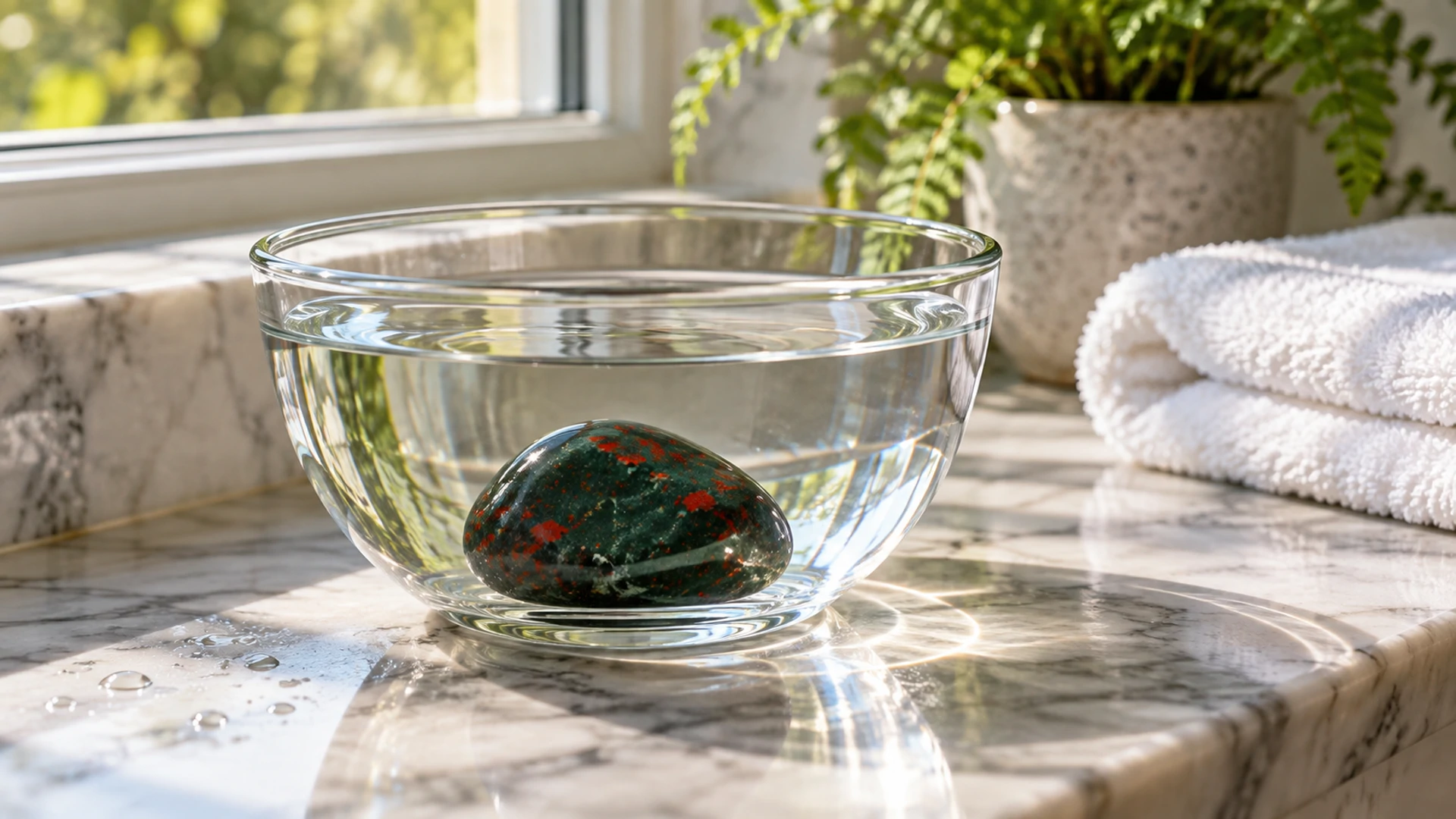
Bloodstone protects by building you up from the inside — courage, stamina, and physical resolve are its currencies, not shields or barriers. If you've ever needed to face something frightening not mentally but bodily, this is the stone for that.
Vitality Wound Into Green Stone: Why Bloodstone Belongs in Protection
Bloodstone's mechanism in protection work is straightforward once you name it: active courage and vitality. It is a warrior's amulet. It does not protect by standing between you and something threatening — it protects by making sure you are strong, grounded, and clear-headed enough to meet whatever is coming. That is a specific kind of protection, and it is worth distinguishing it from what other stones in this category actually do. Black Tourmaline grounds first, then holds a boundary — Saturn in operation, steady and firm. Black Andradite Garnet consolidates scattered energy into dense personal power — a drawing inward. Bloodstone moves in the opposite direction. It pushes outward. It activates.
Mineralogically, Bloodstone is a dark green variety of chalcedony — microcrystalline quartz — flecked with vivid red spots caused by iron oxide inclusions. It belongs to the jasper family, and it has been sold and documented under several names across history: Blood Jasper, Green Jasper, and most classically, Heliotrope, from the Greek words for sun and turn. It forms in basaltic lava, and significant sources today include India, Brazil, Australia, and the United States. This stone is technically a jasper, which is worth stating plainly — though it is a very different animal from the general jasper tradition, which occupies a gentler, everyday nurturing and grounding baseline in protection work. Bloodstone is not nurturing in that soft sense. It is active, embodied, and more demanding of the practitioner.
Its correspondences confirm this. Bloodstone is ruled by Mars — the planet of drive, physical force, and direct action — and it is rooted at the base of the body through the root chakra. That combination tells you everything: this is not a stone of reflection or calm. It is a stone of doing. Its elemental associations split between fire and earth, which makes sense for something that combines the heat of Mars with the dense physicality of a dark green stone shot through with iron. It is also associated with Aries and Pisces in various traditions, and with Scorpio — signs that share a capacity for intensity and endurance, each in their own way. The traditional birthstone designation for March is shared between Bloodstone and Aquamarine, a pairing that underscores how long this stone has been considered significant in Western gem tradition.
As a protection stone, Bloodstone asks something of you that purely shielding stones do not. It assumes you are going to move toward the thing you need to face. Its role is to make sure your body, your stamina, and your nerve are intact when you arrive. That framing is consistent across the historical record and across modern practice, and it is what separates it cleanly from the rest of the protection category.
Blood-Red on Green: Choosing Bloodstone
Genuine Bloodstone has a quality that makes it recognizable once you have seen it. The base color is deep forest green — not bright, not lime, but dark and almost opaque, the kind of green that feels solid. The red spots are vivid and distinct, and they appear embedded within the stone rather than sitting on its surface. When you tilt the stone in light, those spots shift slightly but hold their character. The effect is unmistakable. Dyed imitations do exist, and they tend to show a flatter, more uniform red that lacks the depth and irregularity of naturally occurring iron oxide inclusions. If the red looks applied — too even, too consistent, too surface-level — trust that instinct.
The spots do not have to be red to be genuine. Some specimens show yellow or orange spots alongside the red, and occasionally the matrix leans toward a blue-green rather than a pure forest green. These variations are natural. What you are looking for is the overall character of the stone: opaque, dense, green, with mineral inclusions that feel internal to the material rather than printed onto it. Tumbled specimens are widely available and work perfectly well for most practices. Raw chunks show the natural formation more clearly and can be worth sourcing if you want to see the mineral composition for yourself.
Care is uncomplicated. Bloodstone sits at Mohs 6.5 to 7, which makes it durable enough for daily wear without special handling. Brief water contact is fine — it is water-safe and carries no toxicity concerns for normal handling. Avoid extended soaking as a habit, since chalcedony can have minor internal fractures that prolonged submersion may affect over time, but a rinse or a brief wash presents no real risk. Keep it away from harder stones that could scratch it in storage — most standard gemstones above Mohs 7 qualify. Beyond that, Bloodstone is one of the more forgiving stones to own and work with consistently.
Three Practices for Embodied Courage
The Steadied Blood
Use this when something frightening is approaching — not a fear you can think your way out of, but one that lives in your chest and your gut, in the physical body rather than the rational mind.
Hold the Bloodstone in your dominant hand and sit somewhere you can feel the ground beneath you. Place your bare feet flat on the floor if possible. Close your eyes and bring your attention to the weight of the stone — its density, its coolness, the specific pressure of it in your palm. Breathe slowly and let your attention stay on physical sensation: the stone, the floor, the breath moving through your chest. Do not try to convince yourself of anything. Do not talk yourself through it. Just stay in the body with the stone until the physical fear begins to settle into something steadier. This practice works best during a Mars hour on a Tuesday, when the planet governing Bloodstone's courage is at its most accessible — but it is effective any time the need is real.
The Warrior's Rest
Use this after a period of sustained hard effort — when you have been giving everything for too long and the body, not just the mind, is genuinely depleted.
Place the Bloodstone at your solar plexus or hold it loosely against your lower belly as you lie down. Light a red candle nearby if you have one — red carries Mars's restorative fire as well as its activating force. Let yourself be still and breathe without directing anything. The intention here is not active work but reception: you are allowing the stone's correspondence with vitality and physical stamina to remind your body of its own reserves. Rest for as long as you need. You can pair this with red jasper — though red jasper belongs to the Empowerment category rather than Protection, its root-chakra and Mars correspondences make it a natural companion for rebuilding physical vitality from the ground up.
The Sun in Water
Use this as a contemplative focus practice drawn directly from Bloodstone's oldest documented use — Pliny the Elder described placing the stone in water and watching what it did to light, and that observation is still worth making for yourself.
Place your Bloodstone in a clear glass or bowl of water in a position where natural light can reach it. Watch the light move across the stone and through the water. Notice how the red spots read differently when the stone is submerged — how the green deepens and the iron inclusions seem to float. This is not a visualization exercise and it is not a spell in the traditional sense. It is an attention practice. You are training steady, unhurried focus on something physical and present, which is itself a form of preparation for courage. The ancient description of heliotrope turning sunlight blood-red in water is more poetic than literally accurate in most specimens, but the quality of attention the practice cultivates is real and worth building.
What Pliny Actually Said
The earliest named literary source for Bloodstone is Pliny the Elder, writing in the Naturalis Historia around 77 CE. In Book 37, he describes heliotrope as a leek-green stone marked with blood-red streaks that, when placed in water, appears to turn the sun's reflection blood-red. That is a specific, well-documented account, and it is striking for how closely it matches the physical description of the stone itself: the deep green base, the iron-red inclusions, the way the stone interacts with light and water. Pliny was working as a naturalist cataloguing materials, and his interest in heliotrope was observational and mineralogical rather than magical.
What Pliny does not say is equally important. He does not connect heliotrope to courage, to warriors, or to the stopping of blood in wounds. He does not frame it as a protective talisman or invoke any military or healing use. Those associations — and they are significant, and they are genuinely old — belong to a separate, later tradition that developed through medieval European herbal and lapidary writing. The warrior's amulet meaning, the belief that carrying the stone could staunch bleeding or grant fearlessness in battle, arrived centuries after Pliny and should be understood as medieval folk and magical tradition rather than classical natural history.
The Christian legend that Bloodstone's red spots were formed from drops of Christ's blood falling on green jasper at the crucifixion belongs to this same medieval layer. It is a beautiful and culturally significant story, and it explains why the stone was also called Christ's Stone in some European traditions. But it is not ancient in the classical sense, and it is not documented in Roman-era sources. The honest way to hold the history of Bloodstone is as two distinct eras: Pliny's mineralogical observation in the first century CE, and a rich separate tradition of magical and devotional meaning that built up during the medieval period and has informed how the stone is used ever since.
Both layers matter. The medieval tradition gave Bloodstone its reputation as a warrior's and healer's stone — carried by soldiers into battle, used in amulets to protect against physical harm and support physical recovery. That tradition is old enough and consistent enough to be taken seriously as part of the stone's documented history, even if it does not trace back to classical antiquity. It is also what makes Bloodstone one of the few protection stones in this category with a sustained, cross-cultural record of active, embodied use rather than primarily symbolic or energetic protection.
Protection That Lives in the Body
Most protection stones in this category work from the outside in — they establish a boundary, absorb what crosses it, or reflect it back. Bloodstone works from the inside out. The protection it offers is the protection of being fully present in your own body, with your nerve intact and your stamina available. That is a different kind of safety, and for many situations it is the more useful kind.
If you want to see how Bloodstone fits alongside the other stones across all seven categories — protection, cleansing, healing, empowerment, abundance, love, and intuition — The Crystal Compendium: Seven Paths to Stone Magic is the place to start.