Zircon: The Oldest Stone Standing Watch
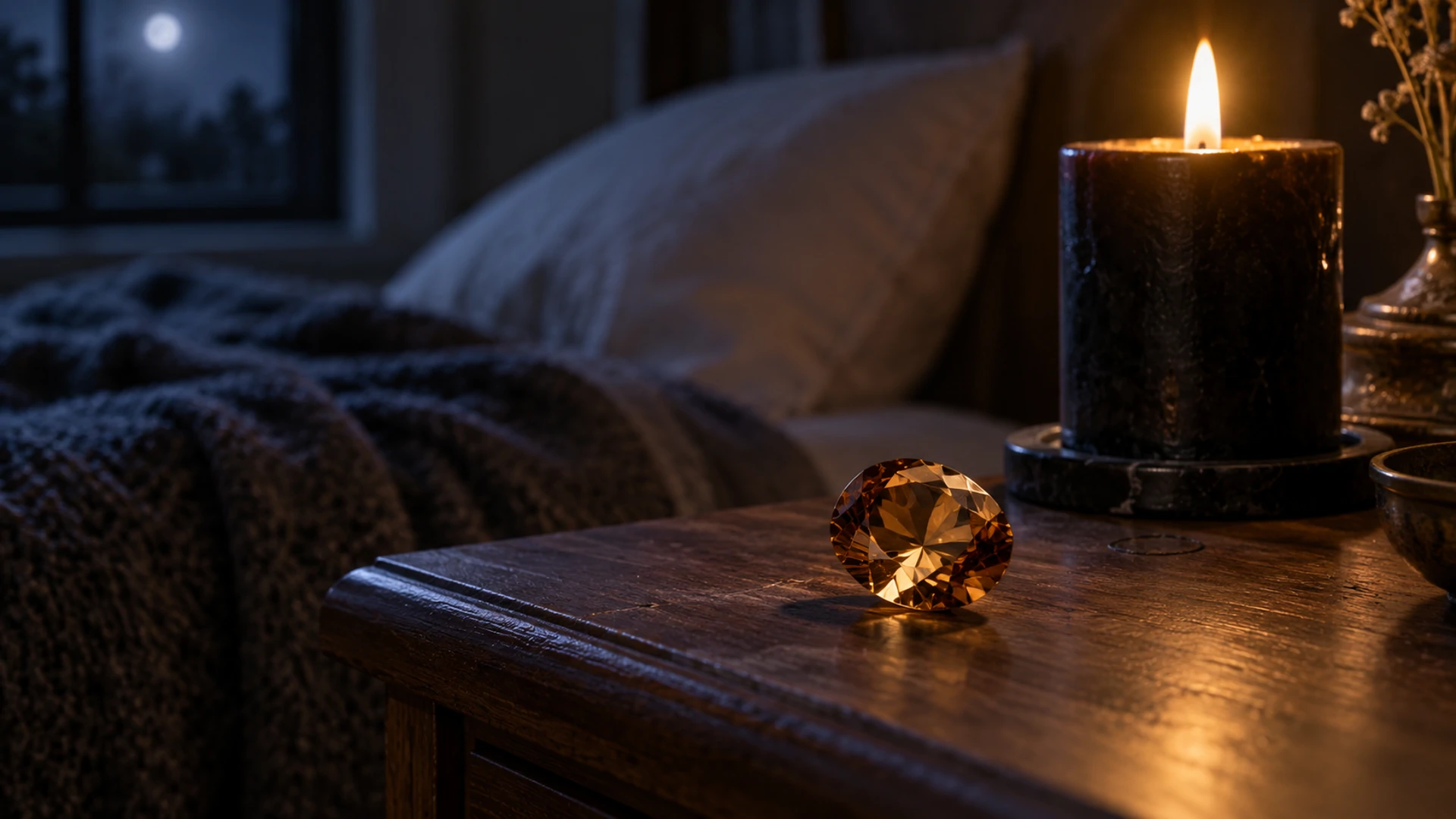
Zircon is a protection stone with a specific territory: the night. Historically carried and placed near the bed to ward off nightmares and shield the sleeping self, it holds its office during the hours when a person is least guarded, with a quieter secondary thread reaching toward prosperity.
The Oldest Stone Standing Watch: Why Zircon Belongs in Protection
Most protection stones occupy the waking world. They are set at thresholds, carried in pockets, worn at the collar. Zircon's traditional function is narrower and more specific than that: it is a guardian of the sleeping state, a watcher during the hours when the conscious mind goes quiet and the psyche becomes its most undefended. Medieval European tradition held that Zircon promoted restful sleep, dispelled evil during the night, and drove away nightmares — not as a side benefit, but as its primary office. That specificity is what places it in the protection category, and what distinguishes it clearly from the other stones holding that same category.
Consider where the neighboring stones stand by comparison. Jet's protective function is specific to grief, ancestor work, and liminal states — the in-between places of loss, ceremony, and transition. Black Kyanite grounds and shields, and uniquely self-clears, able to clear other stones too. Neither of those stones is primarily a nighttime tool. Zircon's territory is the sleeping and dreaming state itself — the specific vulnerability that comes not from crossing a threshold or sitting with grief, but from lying down and losing waking consciousness entirely.
There is one clarification that needs to happen before anything else: natural Zircon and cubic zirconia are not the same material, and they are not even close relatives. Natural Zircon is a genuine mineral — zirconium silicate, ZrSiO4 — with its own geological history, its own crystal structure, and a documented presence in human adornment and tradition going back centuries. Cubic zirconia is a lab-grown simulant, synthesized in the 1970s as a diamond substitute. It does not occur in nature. The similarity in name is coincidence, not kinship. Any stone sold as "zircon" in a spiritual or crystal context should be the natural mineral, not the lab-made imitation, and knowing the difference protects you from buying the wrong thing entirely.
Zircon's correspondences reflect its night-specific function. It is most commonly assigned to the root chakra, anchoring the self during sleep — when the energetic body is actively processing and the dreaming mind moves through territory the waking self cannot monitor. Some traditions tie it secondarily to Venus and Mercury rather than a single planetary ruler, and its elemental association with fire is the least immediately obvious, given how nocturnal its use is, but fire here points to the same force that keeps a coal burning through the night unseen: low, steady, protective heat. The abundance thread — prosperity, honor, wealth — runs quietly through Zircon's historical reputation as well, but it's genuinely secondary. If you're drawn to this stone primarily for manifestation work, citrine, pyrite, or green jade are all going to be more straightforward choices. Zircon's real gift is what it does while you sleep.
Not Cubic Zirconia: Choosing Zircon
The most useful test when buying a stone labeled "zircon" is to look at it honestly. Natural Zircon sits at Mohs 6 to 7.5 — durable but not extraordinary — and genuinely natural specimens often show minor cloudiness, surface inclusions, or color variation. That imperfection is not a flaw; it is geological evidence. The stone formed in real conditions, under real pressure, over real time. Cubic zirconia, by contrast, is lab-grown and nearly always flawless, with a brilliance and optical perfection that natural minerals simply do not produce. It also sits at Mohs 8, making it harder than natural Zircon. If a stone is being sold cheaply, is perfectly transparent, has no inclusions whatsoever, and is marketed as "zircon," it is very likely cubic zirconia. Knowing this isn't about gem snobbery — it's about making sure you're working with what you intend to work with.
Natural Zircon occurs in a wide range of colors: colorless, yellow, brown, red, blue, and green. Most blue Zircon on the commercial market has been heat-treated from brown material to produce its color, which is a stable and widely accepted process in the trade. For magical work focused on protection and sleep, color matters less than the stone's geological authenticity — a natural brown or golden Zircon carries the same protective history as a blue one.
There is one honest safety note worth naming directly rather than sliding past it: natural Zircon contains trace amounts of uranium and thorium as impurities within its crystal structure. This is, in fact, exactly what makes Zircon so valuable to geological science — those radioactive elements decay at known rates, and measuring their decay products is how scientists establish the 4.4-billion-year age of the Jack Hills specimens. For a piece of finished gem-quality Zircon worn as jewelry or held during practice, the radiation exposure from those trace impurities is not a meaningful concern. You are not handling enough material, at close enough range, for long enough periods, for it to register as anything other than background-level exposure. If you were cutting raw Zircon ore and inhaling dust, that calculation would change — but a tumbled or faceted piece worn at the throat or placed on a nightstand poses no measurable risk.
On care: brief water contact is fine. Zircon is not water-soluble, does not react to humidity the way halite does, and won't pit or craze from a quick rinse. Avoid ultrasonic cleaners on lower-quality or included material, since vibration can stress existing fractures. Store it away from harder stones — anything at Mohs 8 and above (topaz, sapphire, diamond) can scratch it. Sunlight is generally tolerated, though heat-treated blue Zircon can occasionally revert toward its original brown with extended strong light exposure over time, so a drawer or a covered dish is a better home than a south-facing windowsill.
Three Practices for the Unguarded Hours
The Watched Sleep
Use this when a period of disturbed or fearful sleep has set in — recurring nightmares, anxiety that spikes at bedtime, or a sense that the night itself feels unsafe.
In the hour before bed, hold your Zircon in both hands and state what you want it to stand watch against — not abstractly, but specifically. Name the fear, the image, the pattern that keeps returning. Then place the stone on your nightstand, directly beside where your head will rest. If you want to support the practice with a candle, a black candle for protection is appropriate — let it burn for a short, deliberate period before extinguishing it safely before sleep. The stone stays. Let it work through the night while you rest.
The Cleared Night
Use this when grief or loss is sitting heaviest at the end of the day — not for ancestral ceremony or threshold-crossing work, which belongs to other stones, but for the ordinary weight of personal loss that makes the night feel especially long.
Before sleep, sit quietly with the Zircon in your non-dominant hand. In your other hand, hold something small that represents what you're carrying — a written word, a folded paper, nothing elaborate. Breathe out slowly three times. Ask the stone to hold the weight of it during the night so you don't have to. Set the object and the stone together on your nightstand. This is not a working for the stone to resolve the grief — it doesn't promise that — but to take the acute edge of it off your sleeping mind so the night can give you some actual rest. Chamomile, either as a tea drunk beforehand or as a small bundle placed nearby, pairs well here; chamomile carries a genuinely calming energy that complements rather than competes with what the stone is doing.
The Waking Ember
Use this in the morning — specifically in the first few minutes after waking, when the day's energy is still forming and the night's quality (good or poor) can be turned into fuel rather than inertia.
Keep the Zircon on your nightstand overnight, and pick it up immediately upon waking before doing anything else. Hold it at your solar plexus and let yourself recall, without forcing it, whatever sense of rest or momentum you woke with. Zircon's secondary abundance thread is quieter than its protective one, but it is there — and this is when it becomes active. Set an intention for the day's work out loud, even one sentence. The stone has already been doing its job through the night; this is you picking up that continuity and carrying it forward into the waking hours. If you work with a Jupiter hour for prosperity and expansion, orienting this practice to fall within that window sharpens the abundance thread noticeably.
Older Than Almost Anything Else on Earth
The scientific case for Zircon's age is not an approximation. Crystals recovered from the Jack Hills region of Western Australia have been dated to approximately 4.4 billion years old, making them the oldest minerals ever identified on Earth. To put that number in context: the planet itself is estimated to be around 4.5 billion years old. These Zircon crystals formed within roughly 100 million years of Earth's formation — when the planet was still in its earliest, most violent state. They survived everything that came after: volcanic upheaval, erosion, the entire history of complex life on Earth. The fact that any of them still exist in recoverable form is itself remarkable.
What makes this relevant beyond geology is that the dating method depends entirely on something unique to Zircon's chemistry. The trace uranium and thorium locked inside each crystal decay at known, fixed rates into lead isotopes. Measuring the ratio of parent to daughter elements tells scientists exactly how long the crystal has been sitting there. Zircon's own internal chemistry is its clock. No other common mineral keeps geological time with the same reliability, which is why it appears so often in scientific literature about the deep history of the planet.
Medieval European tradition took a different but complementary view of the stone's relationship with time and darkness. The historical record holds that Zircon was carried to promote restful sleep, protect the sleeper through the night, and ward off evil spirits — a role it has carried in folk tradition for centuries, without a single originating event or named authority attached to that belief. The stone was simply known for this. The fact that it also happens to be one of the most temporally enduring materials on the planet is a piece of context that the medieval tradition didn't have, but that does nothing to soften the coherence between the stone's geological nature and its historical use. Something this old keeping watch through the dark hours feels entirely earned.
Standing Watch Through the Night
What makes Zircon useful in a protection practice is its specificity. It is not trying to do everything. It holds its post during sleep — during the hours when the waking will is offline and the psyche is processing without a guard — and it does that work with the quiet authority of something that has outlasted nearly every other material on the planet. That narrowness is a strength, not a limitation. Knowing exactly when and why to reach for a stone is the difference between a collection and a practice.
If you want to see how Zircon sits alongside the other protection stones — and how the protection category itself sits within the broader landscape of crystal magic — The Crystal Compendium covers all seven paths in one place. It's a good reference for understanding which stone's mechanism actually fits the working you have in mind.