Jasper: The Nurturer Beneath a Thousand Faces
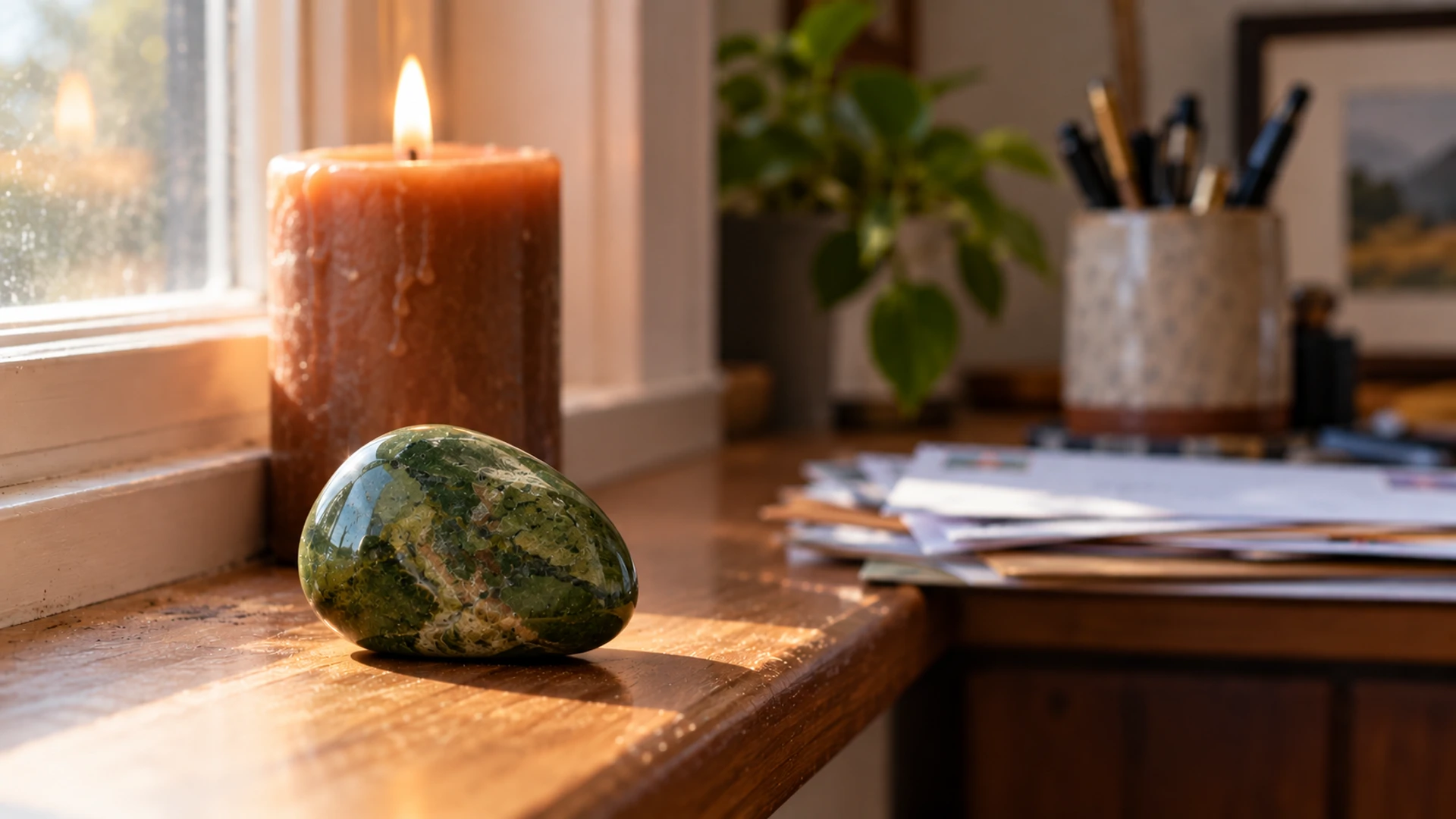
Jasper is a steady, nurturing stone. Its role in protection isn't to block, deflect, or reflect — it's to keep the whole of you grounded and supported, day after day, without requiring a specific crisis to justify it.
The Nurturer Beneath a Thousand Faces: Why Jasper Belongs in Protection
Before anything else, two distinctions are worth stating clearly, because jasper appears in two separate places on this site. This article covers the general Jasper family — a broad mineral group with thousands of named varieties. The site also has a dedicated Red Jasper article, which covers that specific variety as an Empowerment-category stone with a fire-based mechanism focused on stamina and vitality — quite different work from what this article describes. If red, iron-rich vitality is what you're looking for, that's the right page. This article is about the wider family.
The second distinction is Bloodstone. Historically, it was called Blood Jasper or Green Jasper, and mineralogically it does belong to the jasper family. But Bloodstone's mechanism is entirely its own: active courage and vitality, a warrior's amulet. It earns a separate article in this Protection category because it behaves like a separate stone in practice. Jasper in general does not share that active-combat quality. That distinction is the whole point of this section.
Jasper's protective mechanism is a gentle, everyday nurturing and grounding baseline. Steady and constant rather than sharp or situational. It supports the whole being rather than targeting one specific threat. Think of it less as a ward and more as a foundation — the ground beneath your feet that keeps everything else stable. Where Black Tourmaline grounds first, then holds a boundary, and Smoky Quartz transmutes rather than blocks, Jasper doesn't assert itself at all. It simply persists.
Mineralogically, Jasper is an opaque, microcrystalline variety of chalcedony — the same broad mineral family as agate, onyx, and carnelian. What sets jasper apart is its opacity, which comes from the density of its microcrystalline structure and the presence of mineral inclusions throughout. Iron oxides produce the reds, yellows, and browns. Clay minerals, ash, and other impurities create the greens, creams, and grays, as well as the patterns — spots, swirls, orbicular rings, dendritic branching, picture-like scenic formations. The resulting variety is genuine: there are thousands of named jasper varieties across the globe, making it one of the most varied single stones in the mineral kingdom. No two localities produce quite the same material.
The correspondences follow naturally from the mechanism. The root chakra is Jasper's primary anchor, grounding the physical body and the base sense of safety. But jasper is one of those stones more accurately described as supporting the whole energy system rather than locking onto one center. It doesn't specialize. Mars governs it in most traditional sources — fitting for a stone of endurance and steady strength, even if that strength lacks the spark of carnelian or red jasper's fire. The element is earth, which tells you everything about the pace of this stone. Saturn is a secondary planetary association in some systems, reinforcing the themes of endurance, structure, and staying power. Across Aries, Scorpio, Leo, and Virgo, jasper's zodiac associations shift with the variety — another indicator of how broadly this stone moves rather than narrowing to a single sign or quality.
Opaque, Not Glassy: Choosing Jasper
The single most useful thing to know when selecting jasper is this: genuine jasper is always opaque. If a stone described as jasper shows any translucency when you hold it up to a light source, it isn't jasper — it's likely agate or a related chalcedony variety, which is a different stone with different behavior. Jasper's opacity isn't a flaw. It's the defining characteristic of what the stone is, geologically and energetically.
For common varieties — red jasper, brown jasper, yellow jasper, basic brecciated material — buying from any reputable crystal seller is straightforward. The stone is abundant and inexpensive, and there's little incentive to fake it. The caution applies more specifically to the decorative and patterned varieties sold under evocative names: Ocean Jasper, Kambaba Jasper, Elephant Skin Jasper, Imperial Jasper, Rainforest Jasper. Some of these names are trademarked locality designations for genuinely distinct and beautiful material. Others have become marketing terms applied loosely, and in some cases, dyed howlite, magnesite, or unrelated stone is sold under similar-sounding names to attract buyers drawn to unusual patterning. With these varieties, sourcing from a dealer who knows their provenance and can tell you what's actually in the stone matters more than it does for a simple piece of red jasper.
Care is uncomplicated. Jasper sits at Mohs 6.5 to 7, which makes it durable enough for daily wear and confident handling. It is water-safe, so brief rinsing for physical cleaning is fine. There are no toxicity concerns with normal handling. Sunlight is generally safe for most jasper, though some of the more vividly dyed or unusual-coloring varieties may fade with very prolonged exposure — if you're unsure, keep decorative pieces out of direct afternoon sun. For energetic cleansing, the usual methods all work: moonlight, sound, smoke, or a brief rest on a selenite slab. Jasper doesn't need anything elaborate.
Three Practices for Steady Ground
The Steady Ground
Use this when life is moving fast and you haven't been doing anything intentional to stay grounded — not a crisis, just an accumulated drift away from yourself.
Hold a piece of jasper in your non-dominant hand and sit with both feet flat on the floor. Close your eyes. Don't try to fix or release anything — just notice where you are in your body. Spend three to five minutes breathing slowly, letting the weight of the stone remind you that the ground is still there. If you want to add a candle, a brown candle is the closest match for what jasper is doing in this practice. No additional tools are required. Return to this as often as you like — it works precisely because it isn't a special occasion.
The Whole-Body Anchor
Use this during a stretch of time when your attention and energy are pulled in several different directions at once — not one big problem, but many smaller ones draining the same reserve.
Collect three to five pieces of jasper — ideally different varieties if you have them, but the same kind works too. Place one at the top of your head, one at each hand, one at each foot, and lie down on your back for ten to fifteen minutes. If you'd like an herb in the space, rosemary supports this kind of work well: it sharpens the connection between the mind and the body, which is often where the scatter originates. You don't need to visualize anything specific. The point is the layout itself — a simple perimeter that tells your whole system it's being held, not just one part of it.
The Quiet Watch
Use this during any sustained period — a season, a move, a long project — when you want a stone working in the background rather than performing a discrete ritual.
Choose one piece of jasper and place it somewhere you'll see it daily: a windowsill, a desk corner, a kitchen shelf. Don't charge it with a specific intention. Don't return to it for regular workings. Just let it sit there. Jasper's frequency is slow and steady by nature, and this practice takes that seriously — it's asking the stone to do what it already does, over time, in a space you inhabit. If you want to mark the beginning of this practice with something brief, a Saturn hour is an appropriate moment to set it in place, since Saturn governs long, patient workings. After that, leave it alone.
Named for Its Spots, Set Into Sacred Ground
The name jasper traces to the Greek iaspis and through to Hebrew and Akkadian roots meaning "spotted stone." The name has always described what you see: a patterned, opaque stone in the earth's most basic colors. What's notable is how consistently those basic colors earned this stone a place in sacred and ceremonial contexts across the ancient world. Jasper appears among the twelve stones listed in the breastplate of Aaron in the Book of Exodus, and it is named again — significantly — as one of the twelve foundation stones of the New Jerusalem in the Book of Revelation. That's a specific, verifiable textual reference, not a vague legend, and it speaks to how fully this stone was embedded in the sacred geography of the biblical world: not an ornament, but a foundation material.
Across ancient Near Eastern cultures more broadly, jasper was carved into seals and worn as protective amulets. The stone's abundance and workability made it practical, but its use in sacred contexts wasn't simply a matter of availability. Opaque, patterned, and earthen in color, jasper carries something visually grounded that other stones don't — it looks like the earth it came from in a way that transparent gems don't. That quality seems to have made it persistently legible as a material for grounding, protection, and sacred marking across many different traditions and thousands of years of human practice.
Protection That Doesn't Need a Reason
Most protection stones require a context. Zircon guards against nightmares. Sardonyx supports disciplined willpower in adversarial or competitive situations. Jet is specific to grief, ancestor work, and liminal states. Jasper doesn't need one. It's for ordinary days when there's nothing specific to ward against but you still want to feel steady. That's the mechanism — not sharp, not targeted, just constant.
This article is specifically about the general Jasper family and its grounding, nurturing baseline. If you're looking for Red Jasper's fire-based vitality and stamina, that stone has its own dedicated page. And if you want to see how jasper fits alongside the other stones in this Protection category — and across the six other categories on this site — the Crystal Compendium: Seven Paths to Stone Magic is the place to start.