Turquoise, the December Birthstone: The Bridge Between Vision and Reality
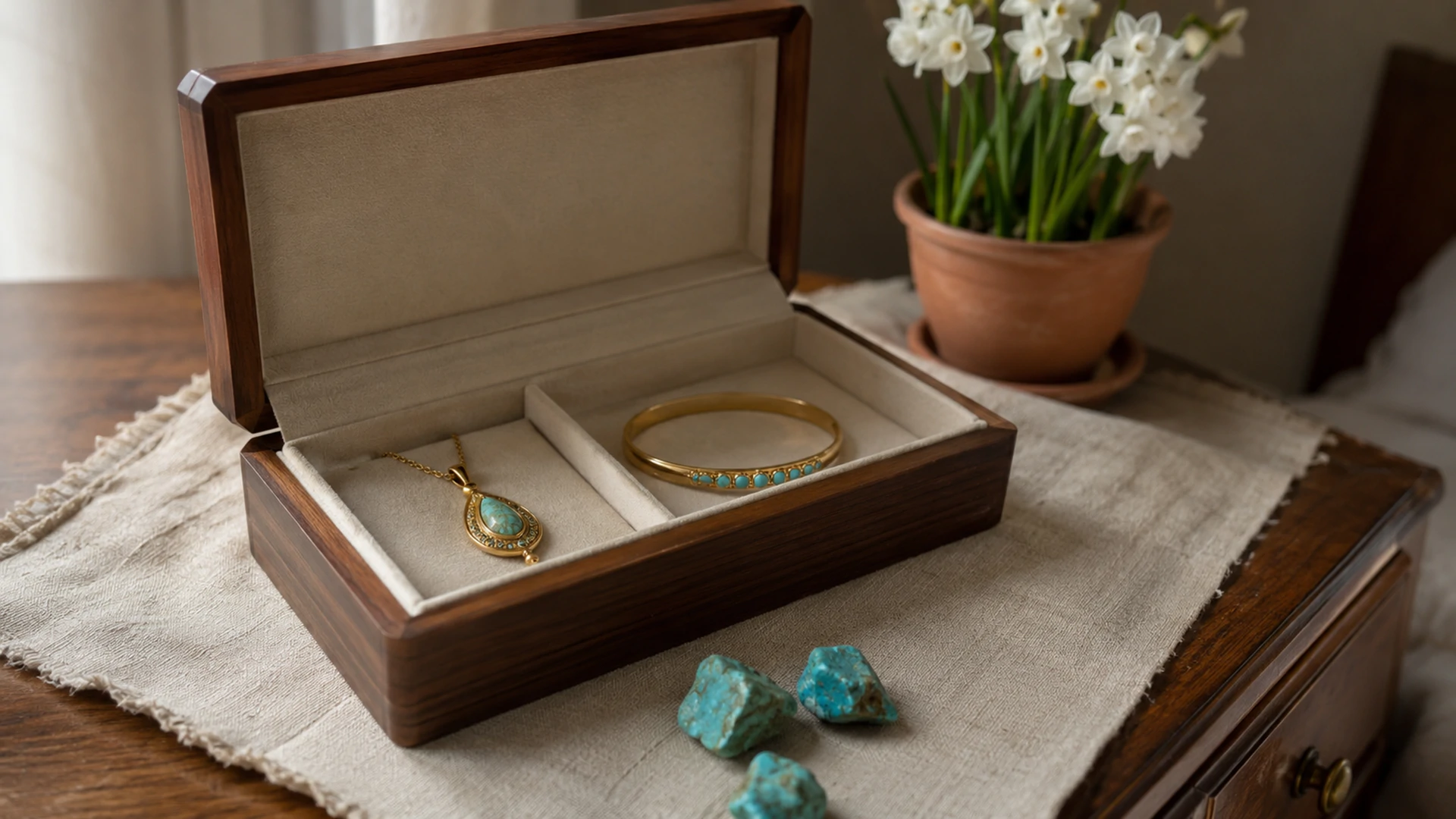
Turquoise has been worn as a protective amulet and truth stone for thousands of years across cultures that had no contact with one another, and all of them reached the same conclusion: this stone carries something real. As the traditional December birthstone, turquoise isn't just historically assigned to the month. Its energy fits December with a precision that makes sense the moment you understand what the stone actually does and what the month actually demands. If you were born in December, turquoise isn't just a pretty blue stone you're supposed to like. It's a stone already tuned to the frequency you arrived in this world carrying.
What Turquoise Means as the December Birthstone
December sits at the end of the calendar year and at a significant seasonal threshold in the northern hemisphere. The days are at their shortest. The year is closing. There's real psychological pressure in December — the weight of what you did and didn't accomplish, the pull toward celebration while also feeling the darkness of the season more acutely than any other month. Turquoise speaks directly to that tension. Its core virtues are protection, honest communication, and the bridging of heaven and earth, or in more practical terms, the bridging of vision and reality.
December spans two zodiac signs: Sagittarius (through December 21) and Capricorn (from December 22 onward). These two signs couldn't be more differently wired. Sagittarius is expansive, idealistic, and hungry for truth and meaning at any cost. Capricorn is disciplined, grounded, and focused on long-term structure. The internal tension of being born in December is often this exact friction — you either have a Sagittarian restlessness that struggles to commit to anything concrete, or a Capricorn drive so focused on achievement that it cuts off your access to genuine vision. Turquoise addresses both sides of this. It's been called a bridging stone in magical traditions for centuries, and that bridging quality works here in a very specific way: it helps Sagittarius land, and it helps Capricorn breathe.
The historical record of turquoise as a December stone is ancient. Persian traders were among the first to bring turquoise westward, calling it pērōzeh, meaning victory stone, and it traveled through Turkey into Europe, which is where the French name turquoise (literally, Turkish stone) originates. Ancient Egyptians mined it on the Sinai Peninsula as early as 3200 BCE and set it into the burial masks and pectorals of pharaohs specifically for protection in transition. The Aztec used it to face the masks of gods. Tibetan and Mongolian shamans wore it as a talisman of spiritual protection and safe passage. In 1912, when the American National Retail Jewelers Association published the first standardized modern birthstone list, turquoise and lapis lazuli were the original pairing for December — a recognition of what thousands of years of use had already established. December also claims three other birthstones worth knowing: blue topaz, with its sharp mental clarity and amplifying quality; tanzanite, a stone of spiritual vision and psychic depth; and zircon, one of the oldest minerals on earth, carrying grounding and protective fire. Turquoise is the eldest of the four in terms of historical use, and its assignment to the month runs deeper than any modern list.
Working with turquoise as your birthstone pulls on something the stone already does well: it bridges. It closes the distance between what you know to be true and what you're willing to say out loud, between the vision you carry and the reality you're building. For a December-born practitioner, that quality isn't something you have to coax out of the stone. The same seasonal force that shaped turquoise's oldest uses — transition, protection through darkness, honest passage from one state to another — is the same force present at your birth. When you pick up your birthstone, you're not introducing a new current into your practice. You're switching one on that was already wired in.
Turquoise Hardness, Care & Origins
Turquoise sits at 5 to 6 on the Mohs hardness scale, which makes it notably soft compared to most gemstones you'd wear regularly. Among December's four birthstones, it's the most fragile by a significant margin. That's worth knowing upfront because it affects both how you care for it and how you use it — a stone this soft requires more deliberate handling than the harder stones in your collection.
Its porosity is the other factor to keep in mind. Turquoise is an open-structured stone, which means it readily absorbs whatever it comes into contact with: skin oils, perfume, sunscreen, cleaning products. Over time, that absorption changes the stone's color, often darkening it or shifting it toward green in ways that are permanent. Clean it with a soft dry cloth only. Skip ultrasonic cleaners and steam entirely. If you're wearing it daily as jewelry, take it off before applying lotions or fragrances, and avoid prolonged contact with heavy sweat.
It's worth knowing that a significant amount of commercial turquoise has been stabilized with resin to improve its durability and deepen its color. This is a standard, widely disclosed treatment in the gem trade — not a deception, just something to ask about when you're buying. Stabilized turquoise is more durable than raw natural stone, but it's still porous underneath the treatment, so the same care rules apply.
In terms of sourcing, the historical benchmark for fine turquoise has long been Nishapur in northeastern Iran, where mines have been active for over a thousand years and where the stone's deep sky-blue color set the standard for quality across ancient trade routes. Egypt's Sinai Peninsula, already noted as one of the earliest documented mining sites, was the primary source for pharaonic-era turquoise. Today, the American Southwest is a major modern source — Arizona's Sleeping Beauty and Kingman mines have both produced significant quantities, with Sleeping Beauty known specifically for its even, untreated sky-blue coloring that commands strong attention from collectors.
How to Use Turquoise as Your Birthstone in Magic Rituals
Charging and Carrying Your Birthstone
The simplest and most foundational practice is also the most consistent one: charge your turquoise intentionally and keep it on your body. Hold the stone in your dominant hand and breathe slowly until you feel settled. With each exhale, push a specific intention into the stone — not a vague wish, but a concrete statement about what you're calling in or protecting. Protection from deception works especially well with turquoise, as does the intention to speak and hear only what is true. Once the stone feels warm in your hand and you sense the intention is seated, keep it in your pocket, bra, or a small pouch worn close to the skin. December-born practitioners often find it most powerful to re-charge the stone on their birthday or at each new moon, using the same words each time to build a cumulative charge.
Blue Candle and Turquoise Truth-Speaking Ritual
Turquoise's strongest magical association is honest communication, and blue candle magic shares this same current of clarity, truth, and the spoken word. Pair them in a simple but effective working. Place your turquoise at the base of a blue candle — a chime candle works well here because it burns in a single focused session. Before lighting the candle, hold the stone and speak aloud whatever feels true but unsaid. This doesn't have to be addressed to anyone. It might be something you've been avoiding acknowledging about a situation, a feeling you keep explaining away, or a decision you already know you've made but haven't committed to out loud. Light the candle. Place the turquoise beside the flame and let the candle burn completely. The ritual works on the principle that turquoise draws truth upward and the candle's flame carries it outward, clearing the blockage between what you know and what you're willing to act on.
Winter Solstice Threshold Ritual
December 21 or 22 marks the winter solstice, the darkest point in the year and one of the most potent thresholds in the seasonal calendar for magical work. For December-born practitioners, it's especially significant because many of you were born near this threshold, which means the solstice carries a personal resonance beyond its seasonal weight. This ritual works with turquoise's function as a bridge between worlds. On the solstice evening, sit in darkness or by a single candle and hold your turquoise in both hands. Spend a few minutes reviewing the year honestly — not cataloguing your failures or tallying your wins, but genuinely looking at what the year taught you. When you feel ready, make one clear statement about what you're releasing from the past year and one about what you are choosing to carry forward. Then set the stone down and let it sit through the night. By morning, the stone has absorbed the work of the threshold, and carrying it through the following weeks grounds the intention in your daily life.
Throat Chakra Activation with Turquoise
Turquoise has a genuine and historically supported correspondence with the throat chakra, the energy center located at the base of the throat that governs communication, self-expression, and the alignment between what you think and what you say. When this center is blocked or underactive, you might notice a pattern of speaking dishonestly not out of malice but out of fear, swallowing what's true because you're worried about the consequences of saying it. Lie down and place your turquoise directly on your throat. Breathe slowly and with intention. On each inhale, imagine blue light gathering at the stone. On each exhale, let it expand outward through your chest and jaw. Hold this for ten to fifteen minutes. This practice is especially useful before a difficult conversation, before any situation where you'll need to advocate for yourself, or when you feel that gap between what you know and what you're willing to say has been growing too wide.
Dream Incubation and Turquoise
Turquoise has a long tradition of use in sleep and dream work, particularly in Tibetan and Native American traditions, where it was placed near the sleeping body to encourage protective and revelatory dreams. The logic is consistent with the stone's core virtue: turquoise is a truth-teller, and dreams are one channel through which truth surfaces when the waking mind won't let it. Place your turquoise under your pillow or on your nightstand with a clear question in mind. The question doesn't have to be dramatic. It might be something you've been avoiding deciding, a situation where you feel uncertain about your own motives, or a relationship dynamic you can't quite read clearly. Spend a few minutes before sleep holding the stone and silently repeating the question. Keep a notebook nearby. What emerges in dreams over the following nights won't always be literal, but turquoise tends to push toward clarity in symbolic language that your waking mind can work with.
Altar Placement for Protection and Clear Speech
If you maintain an altar or dedicated working space, turquoise earns a permanent place there as a December-born practitioner. Position it in the eastern quadrant of your altar, which governs communication and new beginnings in many Western magical traditions, or near any tools you use specifically for divination or truth-seeking, such as tarot cards, a pendulum, or a scrying mirror. Turquoise on the altar functions as an anchor, holding the intention of honest communication and protective clarity in the space as a constant rather than something you invoke only during formal ritual. You can also place it on top of written petitions or letters of intent before you burn or bury them, letting the stone's energy press the working toward truthful outcomes rather than wishful ones.
Wearing & Carrying Turquoise for Daily Protection
Jewelry
Turquoise is one of the few stones with a genuinely ancient history as wearable protection, which means it was designed by its earliest users to be in contact with the body as much as possible. Rings, bracelets, and necklaces that rest near the throat are the most direct choices, given turquoise's correspondence with communication and self-expression. A turquoise pendant worn at collarbone height keeps the stone close to both the heart and throat all day without requiring any conscious effort on your part. That proximity matters, because the stone works by proximity, not by formal invocation. One practical note: given its softness and porosity, turquoise jewelry worn in situations involving heavy sweat, sunscreen, or humid conditions will absorb those substances over time — so rings during a beach trip or a gym session aren't ideal. Save it for the contexts where you actually want it doing its protective work.
In the Home
Turquoise placed near the front door acts on its protective correspondence, standing as a ward against deception entering the household. This is rooted in the same function that made ancient cultures place turquoise on thresholds and entryways: the stone's virtue of calling out what is hidden or false extends to the people and energies that cross your threshold. If you carry a piece in your pocket rather than wearing it as jewelry, keep it in your left pocket. The left side of the body is traditionally associated with receiving energy in many magical traditions, so carrying it there keeps you open to the stone's protective influence. Touching it briefly during stressful moments — before a hard conversation, when you're about to make a big decision, or when you feel like someone isn't being straight with you — reinforces the contact and reminds your nervous system of the intention already in the stone.
In the Workspace
A piece of turquoise near your phone or computer directly targets the communication channel of that space, supporting honest exchanges and clear thinking during the hours you spend there. This is one of the most practical placements for the stone's truth-telling quality — the workspace is where you're most likely to navigate ambiguous language, half-stated expectations, and the gap between what's said and what's meant. Turquoise on a desk doesn't need to be charged daily to do this work. Set the intention clearly once, place it deliberately, and let it hold the space.
Travel
Turquoise is one of the oldest travel protection stones in the historical record, worn by Persian horsemen who believed it would prevent accidents and ensure safe passage, and carried by traders crossing dangerous routes. If you travel frequently, keeping a piece in your carry-on or glove compartment keeps that protective correspondence active without requiring any ritual framework. Its protective virtue doesn't require re-activation for daily carry — that's what charging it intentionally at the start is for. That said, be honest about the conditions: turquoise traveling through humid climates, beach bags with sunscreen, or gym packs is going to take on more than just your intentions. A tumbled piece dedicated specifically to travel is worth keeping separate from a piece you've put significant charging work into.
December's Other Birthstones: How They Compare
December is one of only two months with four recognized birthstones, and each of the other three occupies a genuinely different lane from turquoise. Understanding where they differ helps you choose the right stone for what you're actually working on — or layer them intentionally when a situation calls for more than one.
Zircon is turquoise's direct historical companion on the modern birthstone list — when lapis lazuli was dropped from the 1912 pairing, zircon took the adjacent position. It's one of the oldest minerals on earth geologically, and its magical character reflects that: grounding, stabilizing, and quietly protective in a way that's more concerned with what's beneath the surface than what's being spoken aloud. Where turquoise bridges vision and reality, zircon anchors you in the present one. It's also significantly harder at Mohs 6 to 7.5, making it more resilient for daily wear than turquoise, though certain varieties can be brittle along their cleavage planes.
Blue topaz comes in at Mohs 8, which makes it the most durable of December's four for everyday rings and high-contact jewelry. Its magical correspondence is less about protection and more about amplification — it sharpens mental clarity, accelerates communication, and pushes intention forward with a precision that turquoise doesn't prioritize. If you're working on something that requires rapid, clear thinking rather than slow honest reckoning, blue topaz is the better fit. The two actually pair well: turquoise draws out what's true, blue topaz helps you articulate it with precision.
Tanzanite is the newest of the four, only discovered in Tanzania in 1967 and added to the official birthstone list in 2002. It's also the rarest: the entire global supply comes from a small mining area near Mount Kilimanjaro, and that deposit is estimated to be significantly depleted within decades. Its magical character is distinctly inward and visionary — tanzanite corresponds to psychic depth, spiritual sight, and the kind of perception that operates below the threshold of ordinary awareness. Where turquoise is the stone of what you know and need to say, tanzanite is the stone of what you haven't yet recognized. For December practitioners drawn to deep inner work rather than outward communication, tanzanite is the more compelling choice.
Turquoise Crystal Combinations: What Pairs Well
Turquoise and Black Tourmaline — Both are protective stones, but they work on different layers. Black tourmaline creates a hard energetic boundary against external negative influence. Turquoise works from the inside out, aligning you with truth so that deception finds no purchase. Together, they cover both the exterior shield and the internal clarity you need to recognize when something is wrong before it reaches you.
Turquoise and Lapis Lazuli — These two stones share a planetary correspondence with Venus and a strong connection to truth, wisdom, and the spoken word. Lapis is older and more solar in its wisdom-seeking quality — it pushes toward deep knowledge and spiritual insight. Turquoise is more immediate, focused on honest communication in everyday life. Paired, lapis provides the depth of understanding while turquoise provides the ability to actually speak what you've understood. This is a strong combination for any work that requires both clarity of thought and the courage to say it aloud.
Turquoise and Labradorite — Labradorite is a stone of transformation, specifically of revealing what is hidden beneath the surface. Turquoise brings that material into clear communication. Where labradorite helps you see, turquoise helps you say. This pairing works especially well during periods of personal change when you're in the process of becoming something different and need both the sight to know what's shifting and the voice to claim it.
Turquoise and Chrysocolla — Chrysocolla is the stone most closely linked to empowered feminine communication and the confident use of voice, particularly in situations where someone has been silenced or dismissed. Turquoise and chrysocolla share a color range and a correspondence with truth-telling that makes them natural partners. The difference is that chrysocolla adds emotional courage and warmth to what turquoise clarifies. Together, they're particularly effective for anyone who knows what's true but struggles with the emotional weight of saying it.
Turquoise and Smoky Quartz — Turquoise bridges vision and reality, and smoky quartz is one of the most effective grounding stones available, pulling scattered energy down into the body and into practical action. When turquoise's expansive, bridge-building quality needs an anchor, smoky quartz provides it. This pairing is ideal for December-born practitioners who resonate more with the Sagittarian end of the month, where big vision and restlessness can make it hard to actually follow through on anything. Smoky quartz gives the turquoise's clarity somewhere to land.
You Were Born in December for a Reason — Wear the Stone That Knows It
Turquoise became December's traditional birthstone because the qualities it has carried across five thousand years of human use map directly onto what December demands: honest reckoning at the year's edge, protection through a season of darkness, and the ability to bridge the gap between vision and what you actually commit to. It didn't earn that assignment through an arbitrary list. It earned it through consistent use by ancient Egyptians, Persian traders, Tibetan shamans, Aztec priests, and countless ordinary people who found that this blue-green stone did something specific and reliable when they needed protection and truth most.
For you, as someone born in December, the stone isn't just historically significant. It's personally calibrated. Your energetic signature and turquoise's virtue were shaped by the same seasonal force. Working with it, wearing it, and charging it with intention isn't adding a foreign element to your practice — it's amplifying something that was always already yours. The rituals in this article give you six different points of entry, from the simplest daily carry to the most intentional solstice threshold work, because birthstone practice doesn't need to be complicated to be powerful. It needs to be consistent and genuine.
If you want to see how turquoise fits into the full picture of birthstone magic across all twelve months, the complete birthstone guide covers every stone and every month in one place.