Turquoise: Calm Enough to Travel By
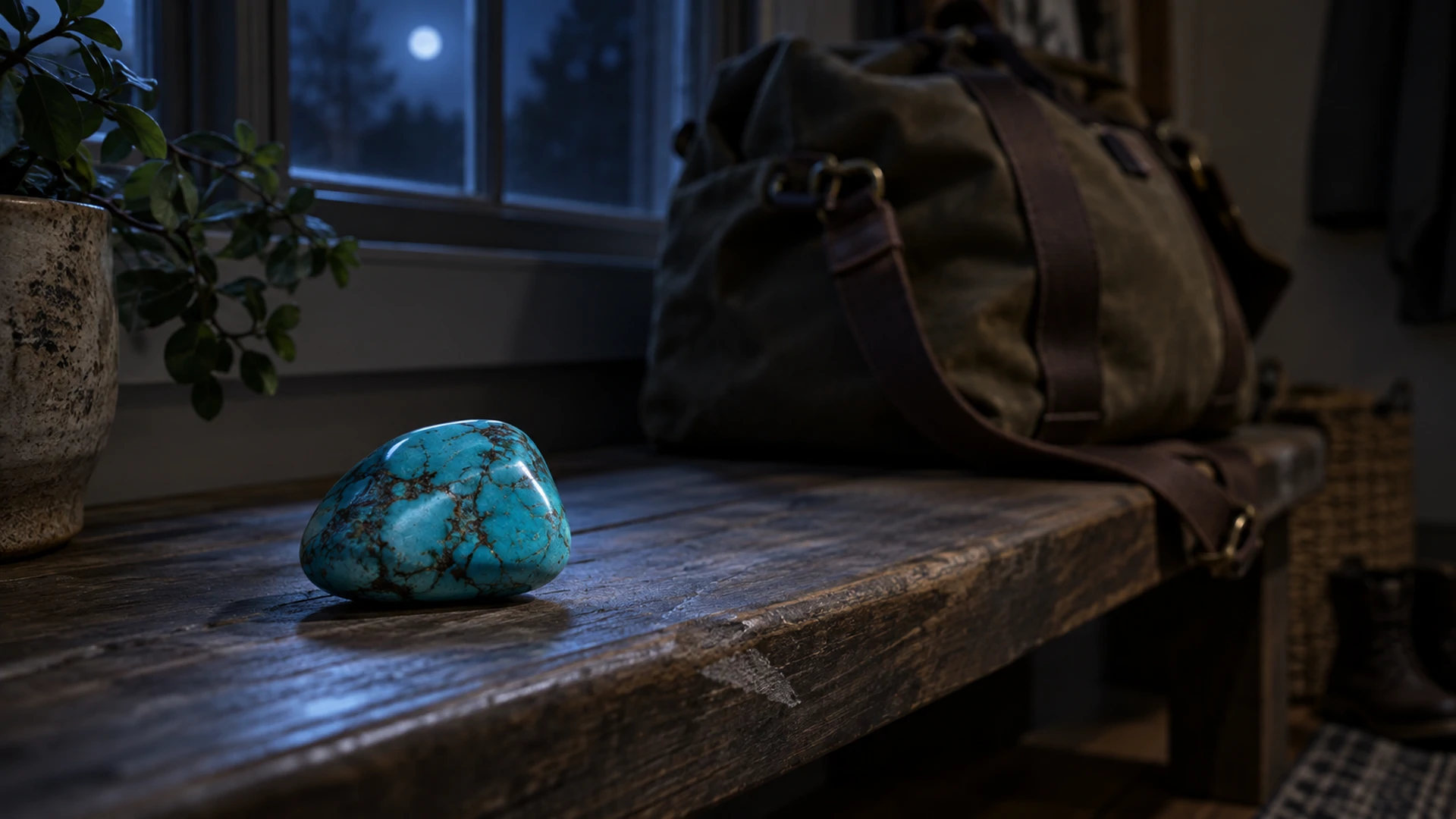
Turquoise's protection isn't stationary. It was made for people moving through unfamiliar terrain, and that's exactly what it does best.
Calm Enough to Travel By: Why Turquoise Belongs in Protection
The defining feature of Turquoise as a protection stone is that it moves with you. Most stones in this category hold a boundary by staying put — Black Tourmaline grounds first, then holds a boundary, rooted to a specific location or body point. Black Onyx builds sustained endurance over time, a long, slow shield built for standing your ground through prolonged pressure. Turquoise works differently. Its mechanism is travel-specific: it calms as it shields, easing the particular vulnerability of being away from home or in motion rather than establishing a fixed perimeter. The stone doesn't hold a wall. It steadies the nervous system and keeps you grounded enough to navigate whatever comes.
That calming quality is tied to its geology. Turquoise is a hydrated phosphate of copper and aluminum, formed when copper-rich groundwater moves slowly through aluminum-bearing rock in dry, arid regions. The copper content is what gives it that distinctive blue-to-blue-green color — more copper pulls it toward vivid sky blue, while iron in the deposit shifts it toward green. It forms slowly, in thin veins and masses through the host rock, which explains its porous structure. Mohs hardness sits between 5 and 6, moderate compared to other protection stones, and its porosity is part of why it requires more care than most stones in this category.
For correspondences, Turquoise works primarily with the throat chakra. That might seem unexpected for a stone in the Protection category, but it makes sense once you consider the specific situation it addresses. When you're traveling — away from the people, routines, and environments that normally anchor you — honest communication becomes a particular pressure point. You're negotiating unfamiliar situations, sometimes in unfamiliar languages, often without your usual support system nearby. Turquoise's throat-chakra alignment fits: it supports clear, honest expression in exactly the kind of moments where being away from home makes you most likely to misread or be misread.
Elementally, Turquoise is associated with both water and earth, which mirrors its formation — water moving through stone, depositing something durable over time. Planet-wise, Venus governs it in most Western traditions, though Jupiter and Neptune also appear across sources. Venus's connection to harmony and goodwill makes sense for a stone whose protection comes partly from calming, from softening the friction of being in motion. In terms of zodiac, Sagittarius and Pisces are the most commonly cited signs. Sagittarius is particularly fitting — it's the sign most directly associated with travel, philosophy, and the expanded perspective that comes from moving through the world. Saturday lends itself to Turquoise's more Saturn-adjacent protective qualities, though its Venus association means Friday workings are just as traditional.
Stabilized, Not Fake: Choosing Turquoise
The single most important thing to know before buying Turquoise is that most commercial material has been stabilized. Because the stone is naturally porous, it's standard industry practice to treat it with a clear resin under pressure, which fills the pores, hardens the surface, deepens the color, and makes the finished piece far more durable for everyday wear. This is not deception — stabilization is a widely disclosed, accepted practice in the gem trade — but it does mean that stones advertised as natural, untreated, or high-grade should be exactly that, and a price point that seems too accessible for a vivid, saturated blue should prompt a second look.
Genuinely untreated, high-grade Turquoise — the kind sourced from Iran's historic mines or from specific American Southwest deposits (Nevada, Arizona, New Mexico) — commands a real premium because that natural surface integrity is genuinely uncommon. Persian Turquoise, mined in the region for thousands of years, is still considered some of the finest material available. American Southwest Turquoise has its own distinguished lineage, deeply tied to Navajo and Pueblo jewelry traditions. If you're buying for a meaningful working or a piece intended to last decades, asking specifically about treatment status and source is worth the conversation.
Then there's the outright substitute issue: a significant portion of inexpensive "turquoise" on the market is dyed howlite or dyed magnesite, neither of which is turquoise at all. Howlite is white with gray veining and takes blue dye readily, producing something that looks convincing to the untrained eye. If the price is very low and the color is very uniform — no natural matrix, no variation in tone — treat it with skepticism and ask the seller directly.
Care for Turquoise follows from its structure. Because it's porous, it absorbs what it contacts — perfumes, body oils, and chemical cleaners can all discolor it permanently over time. Remove it before applying lotion or spray, and wipe it with a soft dry cloth after wear rather than rinsing it regularly. Prolonged water exposure isn't recommended, especially for untreated material, which is more vulnerable than stabilized pieces. Keep it out of strong, direct sunlight over long periods; the color can shift or fade. Store it away from harder stones — anything above Mohs 6 can scratch it, which includes most other stones in your collection.
Three Practices for the Road
The Traveler's Charm
Use this before a specific journey — any travel where you'll be away from your usual environment, whether that's across the country or across the world.
Hold your Turquoise in both hands the night before you leave. Bring your attention to the specific journey ahead: where you're going, what conditions you'll move through, what you want to arrive at intact. State your intention clearly, either aloud or internally — something direct and specific, like naming the destination and what you need to remain steady through. Set the stone somewhere it will sit undisturbed overnight, ideally near a window where it can take in moonlight. In the morning, tuck it somewhere on your body or in your carry bag rather than checked luggage. The practice is in the contact, the stone traveling with you rather than waiting at home.
The Homeward Calm
Use this during extended time away from home, when the accumulated weight of unfamiliar environments starts to feel like low-grade anxiety that won't quit.
Find a quiet moment — a hotel room in the evening, a park bench, anywhere you can be still for a few minutes. Hold the stone at your throat or press it to your sternum if the throat feels too exposed. Breathe slowly and let your attention drop out of the logistics of travel and into what you actually feel. You're not trying to suppress the discomfort of being away — you're giving it a container. Turquoise's calming quality isn't about suppression; it steadies the nervous system enough to let you be present with what's difficult rather than bracing against it. Five minutes of this, done consistently each evening of a long trip, is more useful than a single long ritual before you leave.
The Warned Road
Use this when you're moving into conditions that feel uncertain — a route you don't know well, a situation with variables you can't fully predict, any moment where staying alert to early warning signs matters.
Before you set out, hold the stone and name specifically what you want to remain alert to: not a vague sense of danger, but the actual category of thing you're watching for. Changed road conditions, shifting weather, the mood of a negotiation, a situation that could go wrong in a particular way. State it plainly. Carry the stone somewhere you can touch it easily — a jacket pocket or the palm of your hand if you're on foot. The practice draws on the stone's old reputation (covered in the history section below) for responding to its environment. You're not waiting for the stone to change color; you're using the practice of naming specific concerns to sharpen your own attention to the signals already present.
A Stone Said to Change Color With the Danger
Persian tradition held that Turquoise could shift color to warn its wearer of approaching danger. The stone was understood not merely as a passive shield but as a responsive one — something that would show, visibly, when conditions were turning against the traveler who carried it. This is worth stating plainly as tradition rather than verified phenomenon. Turquoise does genuinely change color over time in response to its environment — light exposure, body chemistry, oil absorption, humidity — and it's easy to see how that real, observable quality gave rise to the legend. A stone that visibly responded to what it contacted would, in a world before materials science, look like warning.
As a single supporting detail rather than a full parallel history: Turquoise was mined in Egypt's Sinai Peninsula in antiquity and appears in Tutankhamun's burial mask, one of the most widely recognized artifacts in the world. The two traditions — Persian traveler's talisman and Egyptian sacred adornment — share the stone's protective reputation across very different ceremonial contexts. What the Persian tradition adds that the Egyptian use doesn't is the specific quality of responsiveness: a stone that doesn't just protect but notices. That's consistent with how Turquoise works in practice, a stone that stays in relationship with its wearer rather than simply standing between them and harm.
Protection That Moves With You
Not every protection stone was built for the same situation. Turquoise was built for being in motion — for the specific exposure that comes from leaving your familiar ground and moving through the world without your usual anchors. Its mechanism, calming as it shields, addresses exactly the kind of vulnerability that travel creates: a nervous system slightly off-balance, communication slightly higher-stakes, surroundings slightly less predictable. That's a specific kind of protection, and it belongs in a specific kind of work.
If you want to see how Turquoise sits alongside the other stones in the Protection category and the six other categories of stone magic, The Crystal Compendium: Seven Paths to Stone Magic is the place to go.