Citrine, the November Birthstone: Generating Your Own Warmth From Within
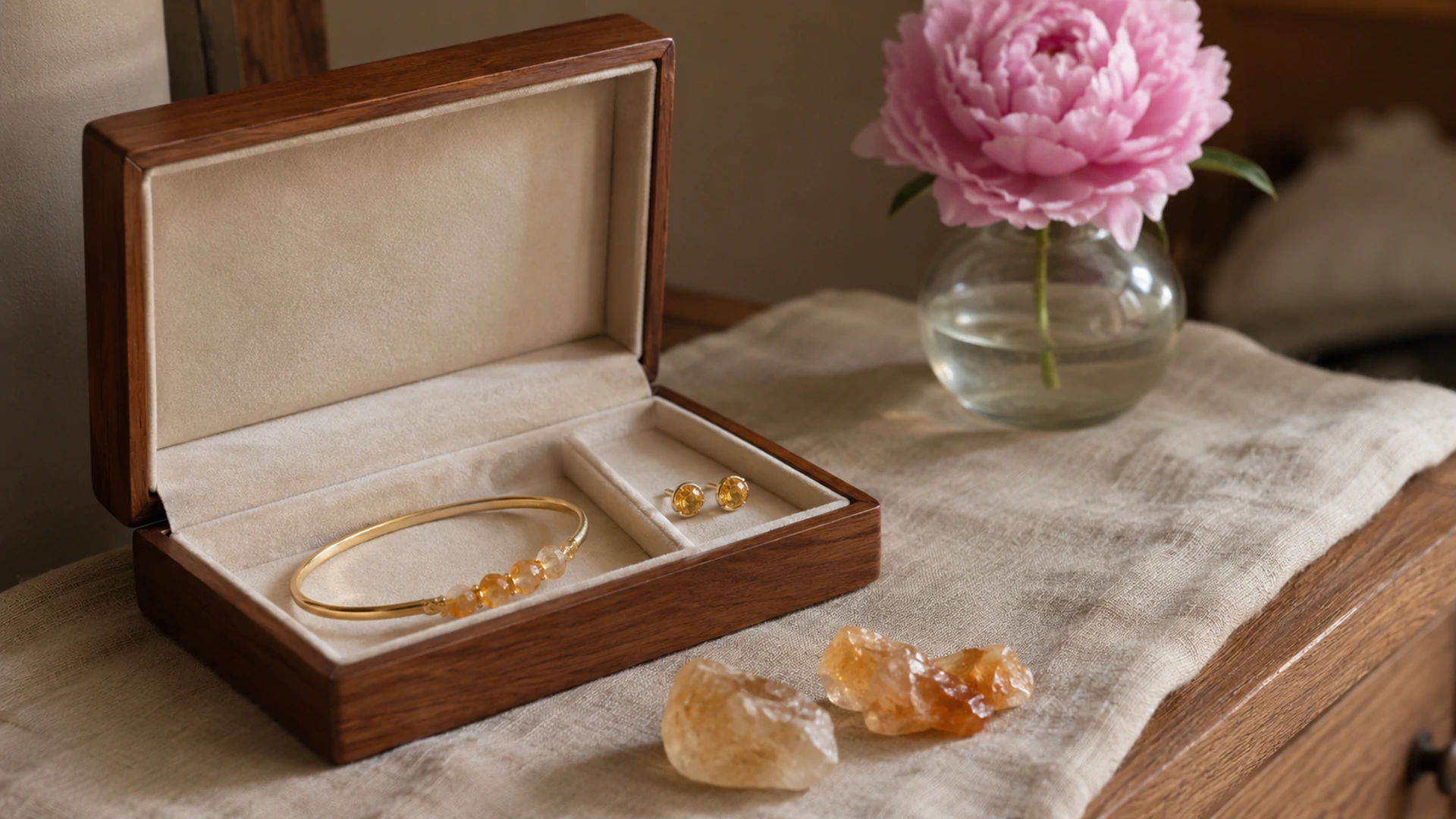
Citrine is November's alternative birthstone, sitting alongside Imperial Topaz as the month's recognized stone pair. If you were born in November or you're drawn to working with November's energy, Citrine brings something distinct to the table: raw solar warmth in the middle of autumn's descent. The Citrine birthstone meaning isn't just about prosperity or optimism in the abstract — it's about what those qualities mean when the world is getting colder and darker, and your own light becomes the most important resource you have. This article covers what Citrine means specifically in its role as a November birthstone, how to work with it in ritual, how to carry that energy into your everyday life, and which stones pair best with it when you want to go deeper.
What Citrine Means as the November Birthstone
November sits at a particular crossroads in the year. In the Northern Hemisphere, it's deep autumn: the harvest is over, the days are short, and the natural world is pulling inward. This is the month that holds both Scorpio (through the 21st) and Sagittarius (from the 22nd onward), and those two signs have almost nothing in common on the surface. Scorpio digs down into secrets, into grief, into transformation. Sagittarius fires upward toward meaning, toward expansion, toward the horizon. November's energy is that exact tension: a month that asks you to sit with what's ending while simultaneously pointing you toward what's possible. Citrine sits right at the center of that.
As a November alternative birthstone, Citrine is governed by the Sun and carries solar virtue even in a sunless season. Historically, yellow and golden gemstones were grouped together across lapidary traditions, and Citrine — a yellow variety of quartz — was long confused with or substituted for Topaz in medieval gem lore. The modern birthstone lists were formalized in 1912 by the American National Retail Jewelers Association, and Citrine was officially added as November's secondary stone in 1952, giving people an accessible alternative to the more expensive Topaz. But the solar correspondences that make Citrine appropriate for November predate that formalization by centuries. Sun-colored stones were associated with vitality, clarity, and the preservation of inner warmth — exactly what November demands.
For Scorpio, Citrine addresses something very specific. Scorpio's gift is depth, but its shadow is stagnation — the tendency to stay submerged in intensity and lose sight of forward movement. Citrine's solar current cuts through that. It doesn't ask Scorpio to be less deep; it asks Scorpio to let some light in. For Sagittarius, Citrine is more of an amplifier. Sagittarius already wants to expand, and Citrine feeds that fire, sharpening the optimism and giving the archer's enthusiasm a grounded, golden quality rather than a scattered one. The stone doesn't just suit November's calendar — it speaks directly to the psychological work both signs are doing.
Working with Citrine as your November birthstone is different from working with it as a general abundance stone. Most commercial citrine began its life as amethyst — heat-treated until the purple burned away and gold took its place. That's not a footnote about authenticity; it's the stone's actual story. Citrine became itself through fire. When you bring it into birthstone work, you're not borrowing a quality that belongs to some other month. You're working with a stone whose defining transformation is literally solar — one that reached its current nature through intense heat rather than gradual crystal growth. That fire-to-light quality mirrors exactly what November asks of you: to generate warmth from within, not to wait for it from outside. For the full framework behind how birthstone resonance works, the history and magical context behind birthstones goes deeper. And for Citrine's broader magical profile beyond the birthstone context, the complete Citrine correspondences guide covers its full range of uses.
Citrine's Hardness, Care & Origins
Citrine sits at Mohs 7 on the hardness scale — durable enough for daily wear, with no cleavage planes that make it vulnerable to splitting. This is worth noting if you're deciding between the two November stones: Imperial Topaz rates harder at Mohs 8 but has a distinct cleavage direction, meaning a hard impact at the right angle can split it cleanly. Citrine doesn't carry that risk, which makes it the more practical everyday choice even if it's the softer stone.
Care is straightforward. Wash Citrine with cool water and a soft cloth. Avoid steam cleaning and prolonged exposure to strong sunlight or intense heat — both can fade the color over time, which matters especially for heat-treated material. Store it away from harder stones that could scratch the surface.
On the subject of heat treatment: over 90% of the citrine sold commercially is actually amethyst that has been baked at high temperatures — typically between 470°C and 560°C — until the purple color shifts to yellow, gold, or orange-brown. Natural citrine is genuinely rare. It forms when iron impurities within quartz are oxidized under the right geological conditions, rather than reduced into the violet tone amethyst produces. The main sources for natural material are Brazil (particularly Rio Grande do Sul and Minas Gerais), Bolivia's Anahi mine — which also happens to be the world's only commercial source of ametrine, the stone that's half amethyst, half citrine in a single crystal — and smaller deposits in Madagascar and the Congo. When you're buying, natural citrine tends toward pale yellow to light gold; deeply saturated orange and reddish-brown tones are almost always the product of heat treatment. Neither is more or less magically useful, but knowing which you have matters if the stone's transformation story is part of how you're working with it.
How to Use Citrine as Your Birthstone in Magic Rituals
The six rituals below cover different approaches so you're not just doing the same working in six different containers. Some are active, some are quiet. Some are timed to specific moments, others are ongoing. Work with what fits your practice right now.
The Solar Charging and Carrying Practice
This is the foundational birthstone working, and the one to return to whenever your relationship with the stone feels flat or disconnected. Hold your Citrine in both hands and spend a few minutes in the early morning light, either outdoors or near a sun-facing window. You don't need direct sunlight, just the awareness that the sun is up and active. As you hold the stone, breathe slowly and bring your attention to the solar plexus — the area just above your navel. Feel the warmth there, even if it's faint. State your intention out loud: what you want this stone to support you in carrying through November, through winter, through this season of your life. Then place the stone against your skin — in a pocket close to your body, in a bra, clipped to a waistband — and keep it there through the day. Repeat the morning hold and statement whenever you want to re-anchor the intention, especially at new moons or when life has pulled you away from your purpose.
Citrine and Gold Candle Abundance Working
Citrine and gold candle energy share the same solar correspondence — both carry the virtue of the Sun, which governs material abundance, confidence, and sustained success. This pairing makes for one of the most direct abundance workings you can do with a birthstone. Take a gold or deep yellow candle and dress it with a solar oil — orange, frankincense, or cinnamon work well. Place your Citrine at the base of the candle so the stone sits in the candlelight as it burns. Before lighting the candle, hold the stone against your chest and name — specifically, not vaguely — what you want to call in. Not just "abundance" but what abundance looks like for you right now: a specific project, a financial goal, a creative output, a relationship dynamic. Light the candle, set the stone down, and sit quietly for at least ten minutes watching the flame. Let your mind stay with the image of what you named. When the candle burns down, keep the Citrine on your altar or carry it until what you named has moved.
Samhain Threshold Intention Ritual
November opens just after Samhain, the threshold between the old year and the new in many magical traditions. This makes early November an unusually potent time for intention work — the veil between endings and beginnings is still thin. On or around November 1st through the first week of the month, sit quietly with your Citrine in a darkened room. Light a single candle. Write out what you are consciously releasing from the year that just closed — not in a vague "I release negativity" way, but specifically: a habit, a story you've been telling yourself, a relationship pattern, an old goal that no longer fits. Read it aloud. Then turn the paper over and write what you're planting in the new cycle. Read that aloud too. Fold the paper around your Citrine and hold them together for a moment, feeling the warmth of the stone against the paper. Burn the releasing side of the paper safely in the candle flame (or tear it away and compost it), and keep the intention side somewhere visible through November. Your Citrine carries both the release and the new seed forward.
Solar Plexus Activation Practice
Citrine's primary chakra correspondence is the solar plexus — the energy center associated with personal will, self-worth, and the confidence to act on your own authority. For November-born people, this correspondence is especially relevant because the solar plexus is often what gets depleted when the season turns dark. Lie down comfortably and place your Citrine directly on your solar plexus, the soft area above your navel. Breathe deeply and, on each inhale, imagine warm golden light expanding from the stone outward through your torso. On each exhale, release tension, self-doubt, or any sense that you need to shrink to be acceptable. Spend at least ten minutes here. This isn't a passive rest — it's active work. Let the stone's warmth remind your body that your will is intact even when the world outside feels heavy. Finish by pressing your palms flat to the floor and taking three full breaths before sitting up slowly.
Dream Seeding with Citrine
November's Scorpio season is one of the most vivid periods for dream activity — Scorpio rules the subconscious, and the longer nights give the dreaming mind more room to work. Citrine isn't a traditional dream stone, but in this context it serves a specific purpose: seeding the dream space with positive, solar intention rather than leaving it to whatever the subconscious dredges up on its own. Before bed, hold your Citrine at your sternum and think clearly about a situation in your waking life you want insight or forward movement on. Don't ask a question — plant an image of the resolution. See it as done. Then place the stone on your nightstand, close enough that it's in your field as you fall asleep. Keep a journal nearby and write down whatever you remember in the first few minutes of waking, before the dream logic fades. Over several nights you may find that your dreaming mind starts contributing to the working rather than running old patterns. Mugwort placed near the nightstand alongside your Citrine can deepen dream recall even further, if that's something you want to layer in.
Abundance Altar Placement for November
If you keep an altar, Citrine belongs in the southeast corner during November — the direction traditionally associated with wealth and incoming energy in many Western folk traditions. But placement alone isn't the working. Once you've positioned the stone, feed the altar regularly throughout the month: add a bay leaf with a wish written on it, a small piece of cinnamon, a coin that carries meaning for you. Every time you add something, touch the Citrine first and speak the altar's purpose aloud — even just one sentence. This keeps the altar active rather than decorative. Citrine on an altar that you engage with consistently amplifies the accumulated intention; Citrine on an altar you set and forget is just a pretty rock.
Wearing & Carrying Citrine for Daily Support
Jewelry. Because Citrine is a solar stone, skin contact is genuinely useful in a practical sense. The warmth of your body keeps that solar current moving, and wearing it close to the solar plexus — a pendant at mid-chest length, or a crystal tucked into a shirt pocket — maintains the connection throughout the day without any active ritual effort. A ring on the dominant hand is another strong option, particularly if your work involves communication, creativity, or negotiation, since the hand that reaches outward carries the stone's abundance current into what you're doing. Citrine is durable enough at Mohs 7 that rings and bracelets hold up well to daily use — just keep it away from harder stones in storage that could scratch the surface.
In the Home. Citrine placed on a windowsill that catches morning light does double work: it absorbs solar energy through the day and radiates it into the space. For November specifically, when natural light is in short supply, a sun-facing windowsill placement acts as a solar anchor for the room. Kitchens and home offices are traditional spots — anywhere that activity, sustenance, or productive energy flows. Bedrooms are less traditional for Citrine because its solar, activating quality can be too stimulating for sleep; if you find it keeps you up, move it to a common space instead. One thing to watch: prolonged direct sun exposure can fade color over time, especially in heat-treated material, so rotate it away from the window on very bright days if you're working with a stone whose warm gold color matters to you.
When you're traveling or commuting, a tumbled Citrine in your coat pocket or bag keeps the stone close without requiring any attention. November travel tends to carry its own particular weight — the month is dense with obligations, deadlines, and the social pressure of the holiday season building. Citrine in your pocket functions as a physical reminder that you generate your own warmth, which is worth something on days when external circumstances are doing their best to drain it. It also makes a genuinely fitting travel companion given its own history: a stone that literally transformed from one thing into another through heat is a useful ally for anyone moving through change. And if you're shopping for Citrine in person or online, the historical confusion between Citrine and Topaz in medieval gem lore still echoes in how the two November stones are marketed today — knowing the difference (color saturation, origin, treatment history) helps you buy with clarity rather than guessing.
Citrine Crystal Combinations: What Pairs Well
Citrine and Pyrite — Both stones carry solar and abundance correspondences, but they work on different registers. Citrine amplifies the internal state — confidence, clarity of intention, the feeling of worthiness that makes abundance possible. Pyrite works on the external layer — it's a stone of material manifestation, action, and the practical groundwork of financial magic. Together they cover both sides of the abundance current: the inner belief and the outer structure. This is one of the strongest pairings for November abundance work.
Citrine and Black Tourmaline — Citrine generates and amplifies solar energy; Black Tourmaline creates a boundary around that energy so it isn't drained or disrupted. In November, when the season's heaviness and collective anxiety can pull at your personal field, this pairing keeps your solar current protected. Wear Citrine at the chest and Black Tourmaline at the base — wrist, ankle, or lower pocket — for a clean separation between what you're generating and what the environment is doing.
Citrine and Carnelian — Carnelian is a fire stone ruled by Mars, carrying the correspondence of action, courage, and creative drive. Citrine is a solar stone carrying confidence and abundance. Where Citrine supplies the vision and the energetic warmth, Carnelian supplies the momentum to actually move. For Scorpios who tend to over-plan and under-execute, or for anyone in November who needs to stop holding back and start doing, this pairing addresses that specific friction directly.
Citrine and Amethyst — On the surface this looks like an odd pairing: Citrine is solar and active, Amethyst is lunar and receptive. But November's dual nature — Scorpio introspection meeting Sagittarius expansion — actually makes this combination appropriate for the month specifically. Amethyst deepens the intuitive and reflective work that Scorpio season invites, while Citrine keeps the energy from collapsing into stagnation. They balance each other without canceling each other out. This is a particularly good combination for the dream seeding practice described above. And if you happen to be working with ametrine — the single-crystal combination of amethyst and citrine found at Bolivia's Anahi mine — you have both energies in one stone, which makes it an unusually apt choice for November's split nature.
Citrine and Tiger's Eye — Tiger's Eye shares Citrine's solar correspondence and adds a specific virtue of its own: discernment. It's traditionally used for seeing through illusion, making clear decisions under pressure, and maintaining focus when multiple demands compete for attention. November — with its holiday noise, year-end pressure, and the emotional weight of Scorpio season — is exactly when that discernment matters. Citrine keeps the solar abundance current active; Tiger's Eye keeps you from scattering it in too many directions.
Citrine and Smoky Quartz — Smoky Quartz is one of the primary grounding stones in crystal magic, with a particular gift for transmuting heavy energy rather than just blocking it. Paired with Citrine, it provides the earth anchor that pure solar energy sometimes lacks. When Citrine's optimism and upward pull needs a root — when you want to manifest rather than just envision — Smoky Quartz brings the working down into the body and into practical reality. This is the pairing to reach for when abundance intentions feel ungrounded or when enthusiasm keeps failing to translate into actual results.
November's Two Birthstones: Citrine and Imperial Topaz
November is one of a handful of months with two officially recognized birthstones, and the two stones genuinely aren't interchangeable. Imperial Topaz is the traditional stone — older in the birthstone record, historically more prestigious, and naturally harder at Mohs 8. Unlike Citrine, Imperial Topaz is almost always found in its warm gold and amber tones without heat treatment, which gives it a different kind of integrity for practitioners who care about working with unaltered material. It's also considerably rarer and more expensive, which is exactly why Citrine was added as an alternative in 1952.
The two stones have been confused with each other for centuries — in medieval lapidary tradition, any yellow-gold stone could be called "topaz" regardless of its actual mineral composition, and Citrine was frequently sold as Topaz well into the modern era. That confusion still echoes in how both stones are marketed today. If you're sourcing either stone and the price seems off relative to what you'd expect, that historical conflation is usually why. Knowing which you actually have matters, especially if the stone's natural or treated status is part of how you're working with it magically.
In terms of magical character, Imperial Topaz carries the virtue of sustained solar authority — it's associated with confidence, leadership, and long-term abundance in a way that reads as more established and declarative. Citrine, particularly given that most of it began as something else and was transformed by heat, tends to suit workings around becoming, transition, and generating warmth where none existed before. Neither is more powerful. They just address different moments in the solar current. If you're drawn to both, working with them together is entirely legitimate — just give each stone its own clear purpose rather than using them interchangeably.
Your Light in the Dark Season: Why Citrine Was Made for November
Citrine is November's secondary birthstone because its solar virtue directly addresses what the month asks of you. November compresses a year's worth of endings and beginnings into thirty days, running you from Scorpio's depth to Sagittarius's fire while the natural world dims around you. Citrine doesn't fight that seasonal pressure — it gives you a source of warmth that doesn't depend on the sun being out. The stone was assigned to this month not just by modern convention but by centuries of association between yellow-gold gemstones and the preservation of solar energy in dark seasons.
When Citrine is your birthstone, the relationship runs deeper than correspondence. Most of the citrine in the world became what it is through fire — amethyst heated until it crossed into gold. That transformation is baked into the stone's physical reality, not just its symbolism. Working with it in November, when you're being asked to generate your own light in a season that offers less and less of it, means working with a stone that has already done exactly that. It knows what it means to become something brighter through pressure and heat. That's worth more than a generic abundance stone you're borrowing for the month.
If you're building a broader birthstone practice, the full framework for every month is in Birthstones: The Complete Guide to Every Month's Stone. Your stone is already yours. The work is just learning to use it.