Banishment Candle Magic: The Decisive Work of Removal
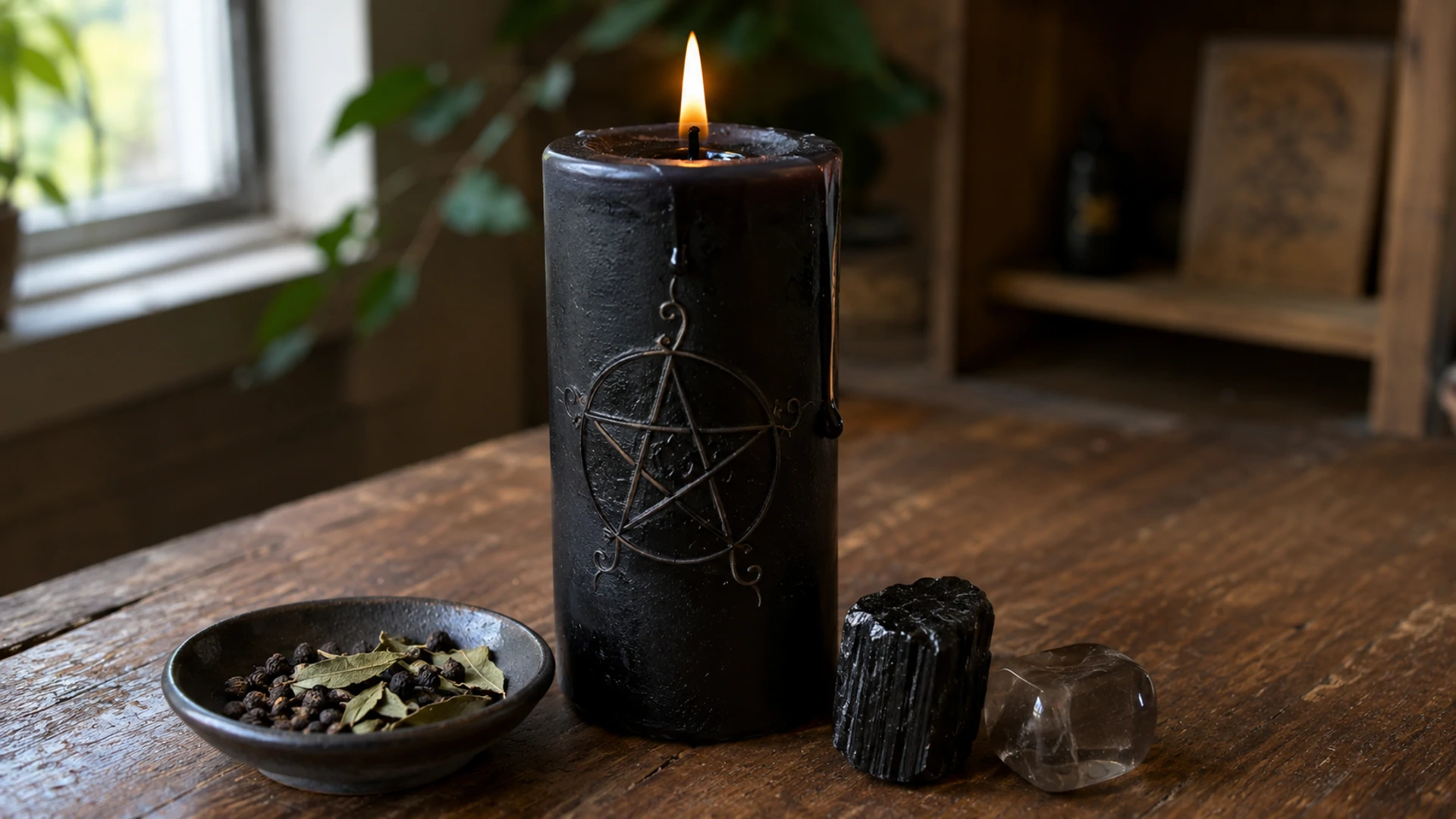
Banishment magic is one of the most direct, decisive workings you can do. It is not about attracting or building — it is about removing. You are using your focused will to push something out of your life, your space, or your energy field. That something might be a toxic relationship, a destructive habit, a persistent negative energy, an unwanted spiritual presence, or even a version of yourself you are ready to leave behind. Whatever the target, the goal is the same: gone.
Candles are one of the oldest and most effective tools for this kind of work. Fire transforms and consumes. As a candle burns, it enacts your intention in real time — the wax melting and the flame destroying what you have written, dressed, and charged into it. Every element of preparation deepens the signal your will is sending. The more deliberately you prepare your candle, the more precisely your intention is focused, and the stronger your working becomes.
This guide walks you through every stage of preparing a candle specifically for banishment. You will learn which colors, shapes, and sizes to choose, how to dress and inscribe your candle for maximum effect, how to charge it with real intent, and what common mistakes to avoid so your working lands clean and clear.
Choosing Your Candle: Colors, Shapes, and Sizes for Banishment Magic
The candle you choose is your first act of intention. Before you ever touch an oil or pick up a carving tool, you are already making a statement about what this working is for. Selecting the right candle is not superstition — it is symbolic alignment. You are choosing a physical object that resonates with the energy you want to direct.
Color
For banishment, black is the primary color of choice. Black absorbs, contains, and neutralizes. It corresponds to the void — to endings, to the removal of what no longer belongs, and to the banishing of harmful forces. In a banishment working, black tells your subconscious and your will exactly what mode you are operating in. There is no ambiguity.
White is a strong secondary option when your goal leans more toward purification than expulsion. If you are clearing residual energy from a space or cleansing an attachment that is more passive than active, white can carry that intention cleanly. Grey works well for workings that sit in a middle zone — dissolving confusion, neutralizing an ambiguous influence, or banishing something that is neither clearly harmful nor clearly benign. Some practitioners combine colors: a black candle for expulsion paired with a white candle for purification of the space left behind.
Shape
Shape matters more than most beginners realize. A standard taper candle is a good all-purpose choice — it is easy to inscribe along its length, takes dressing well, and burns at a steady pace that gives your working time to build. Chime candles, the small four-inch tapers used in candle magic, are ideal for focused, single-session workings where you want the candle to burn completely in one sitting. Figure candles shaped like a human form are used when the banishment targets a specific person — you would choose a figure that matches the target and work it accordingly, though this requires a clear and grounded intention.
Pillar candles work for longer, multi-day banishment workings where you return to the candle over several sessions. Jar candles are generally less suited to banishment because the enclosed wax traps rather than releases — and for banishment, you want the energy moving outward, not contained. Stick with open-form candles for this work.
Size
Size should match the scale and duration of your working. A chime candle is right for a quick, decisive banishment — something you want to clear in a single focused session. A full-length taper carries more working time and is better when the thing you are banishing has been persistent or has deep roots. A pillar candle is for something you have been working to remove over a long period, or when you want to commit to a working that builds across several nights. Do not default to bigger automatically. Sometimes the most powerful banishment is a small, razor-sharp working done with complete focus in one sitting.
Dressing Your Banishment Candle: Oils and Herbs
Dressing a candle means anointing it with oil and, optionally, rolling it in or pressing herbs into its surface. This step is where the symbolic and energetic layers of your working really start to build. The substances you choose carry their own magical correspondences, and the technique you use determines the direction the energy moves. For banishment, both matter enormously.
Oils
Oils for banishment should carry cleansing, expelling, or banishing properties. Some of the strongest choices include:
- Banishing oil — A traditional blend formulated specifically for this purpose, typically containing black pepper, clove, and rue. You can buy it or make your own.
- Clove oil — Sharp, penetrating, and assertive. Clove drives things out and breaks unwanted connections.
- Black pepper oil — One of the most direct banishing agents in the herbal tradition. It disperses, repels, and removes.
- Rue oil — Deeply protective and cleansing, with a long history of use in banishment and warding across multiple traditions. Rue is one of the stronger oils on this list — always use it heavily diluted, avoid sun exposure on treated skin, and skip it if you're pregnant.
- Lemon oil — Excellent for purification. Works particularly well when the banishment involves clearing stagnant or contaminated energy rather than expelling an active force.
- Frankincense oil — Elevates the working and clears the space around it. Good combined with a stronger banishing oil.
You can use a single oil or blend two or three that complement each other. Keep the blend intentional. More is not always stronger — a focused oil chosen for a specific reason carries more power than a handful of ingredients thrown together without clear purpose.
Dressing Technique and Direction
The dressing technique for banishment is the reverse of attraction work. When you dress a candle to draw something in, you anoint from the base to the wick — moving energy toward yourself. For banishment, you reverse this: anoint from the wick downward to the base — moving away from yourself. Apply the oil using your fingers, working it into the wax as you hold your intention clearly in mind. This is not a mechanical step — the physical act of anointing is your will making contact with the tool.
Herbs
Herbs for banishment can be pressed into the oiled surface of the candle or sprinkled around the candle's base. Strong choices include:
- Black Pepper — Direct and forceful. One of the classic banishing herbs across traditions.
- Rue — Traditional banishing and purification herb. Particularly effective against curses, attachments, and unwanted spiritual presences.
- Rosemary — Cleansing and clarifying. Rosemary clears the energetic field and reinforces protective boundaries after banishment.
- Nettle — Assertive and sharp-edged. Good for banishing hostile or aggressive energies.
- Wormwood — Powerful banishing herb with a long history in baneful and protective workings. Use with clear intent. Wormwood can cause skin irritation or an allergic reaction in some people, so handle it with gloves or clean hands, keep it away from children and pets, and avoid it if you're pregnant.
- Agrimony — Traditionally used to send negative energy back to its source and break unwanted ties.
If you press herbs into the candle's surface, use finely ground material so it adheres cleanly and does not create fire hazards when the candle burns. If you are new to candle dressing, keep the herb layer thin — a light coating is all you need to establish the correspondence. You are working with symbolism and focused will, not measuring potency by volume.
Inscribing Your Banishment Candle: What to Write and How
Inscription is the act of writing directly into the wax of your candle — carving words, symbols, sigils, or names that define exactly what your working is targeting and what it is commanding. This is where your intention becomes specific. A dressed but uninscribed candle is a general statement. An inscribed candle is a precise directive.
You inscribe with a pointed tool — a burin, a stylus, a toothpick, a sharp pencil, a ritual blade, or even a simple nail. The tool does not need to be fancy. What matters is that you are carving with intention, not just scratching marks into wax. Some practitioners dedicate a single tool to inscription work only, which is a reasonable practice if you want to keep your tools specialized. Work before dressing if you want clean lines, or after dressing if you prefer the oil to be in the wax while you inscribe. Either order works — what matters is that both steps are done before you light the candle.
Common Inscriptions
For candle inscription in banishment magic, common approaches include:
- The target's name — If you are banishing a specific person, carve their name into the candle. You can write it upside down or backward to reinforce the idea of reversal and removal.
- The thing being banished — If you are banishing a habit, a pattern, or an energy rather than a person, name it directly. Write "ANXIETY," "SELF-DOUBT," "STAGNATION" — whatever it is, name it. Naming gives your will something precise to act on.
- Commanding words — Words like "BEGONE," "AWAY," "LEAVE," "OUT," or "BANISHED" carved into the wax anchor the directive energy of the working. These are not requests. They are commands.
- Banishing symbols — The pentagram (five-pointed star) is one of the oldest banishing symbols in Western ceremonial magic. The banishing pentagram is drawn starting from the lower-left point. You can also use the symbol of Saturn, which governs endings and limitations, or any symbol from your own tradition that carries banishment meaning for you.
Personalizing Your Inscription
The most powerful inscriptions are personal ones. A generic label carries generic energy. When you carve a phrase that is specific, emotionally resonant, and drawn from your own understanding of the situation, your subconscious engages at a deeper level, and your intention sharpens. Take time before your working to think about exactly what you want gone and why. Write it in your own words. Let it feel true. That truthfulness is what gives the inscription weight.
You can also inscribe a statement of outcome rather than naming the target — for example, "FREE AND CLEAR" or "THIS IS DONE" — particularly if naming the thing being banished feels like giving it too much focus. Some practitioners prefer to inscribe the desired result on one side and the target on the other. Experiment and find what resonates with your approach to magical work.
Charging Your Banishment Candle: Building the Will That Powers the Work
Charging is the step where you move from preparation into activation. Everything you have done so far — the color choice, the dressing, the inscription — has been building a focused physical symbol of your intention. Charging is where you push your will into that symbol and make it live. A candle that has not been charged is a prepared tool sitting idle. Charging is what turns it into a working.
The Charging Process
Begin by grounding yourself. Sit quietly, take a few slow breaths, and let your mind settle. You want to enter the charging process in a state of clarity and presence, not scattered half-attention. If you have a grounding practice — visualizing roots into the earth, a short meditation, or a simple centering breath sequence — use it here. The quality of your charge depends on the quality of your focus, and your focus depends on your state of mind.
Hold the candle in both hands. Close your eyes. Bring the target of your banishment clearly into your mind. Do not be vague here — see it, feel it, name it internally with precision. Then shift your focus to the outcome: what your life, your space, or your energy looks like without this thing in it. Feel that outcome as real. Feel the clarity, the relief, the strength of a field that is finally free of what you are removing. This emotional charge — this felt sense of completion — is the energetic core of the working. You are not wishing or hoping. You are knowing.
As you hold that state, breathe your intention into the candle. Some practitioners speak their charge aloud — a clear, present-tense statement of what this candle is doing. Something like: "This candle carries my will. As it burns, [name/thing] is removed from my life completely. It is done." Speak it with authority, not supplication. You are not asking for permission. You are directing your will through a focused tool.
Timing Your Charge
You can also charge the candle by visualizing energy flowing from your hands into the wax — a dark, consuming light for banishment, the color of the void, pulling in and dissolving what is being expelled. Some practitioners prefer to charge under a waning or dark moon, which carries the energy of decrease and removal and aligns beautifully with banishment intent. Timing your working with lunar phases is not mandatory, but it adds an additional layer of symbolic alignment that can deepen your focus.
When the charge feels complete — when you feel the energy settled firmly in the candle — open your eyes. Your candle is ready to burn. When you light it, do so with the same presence and intention you brought to the charging. The lighting is part of the working, not an afterthought. State your intention again as you strike the match or touch the flame to the wick. Then let the candle burn, and trust your will to carry the work through.
What Not to Do: Mistakes That Weaken Banishment Workings
Knowing what to avoid is just as important as knowing what to do — maybe more so, because mistakes in banishment work can leave your working muddy, incomplete, or misdirected. None of these errors are catastrophic, but they do dilute the power of your work. Understanding why they matter will make you a sharper practitioner.
The most common mistake is a vague or conflicted intention. Banishment magic requires precision. If you are unclear about what you are banishing, or if part of you is ambivalent about removing it, that ambivalence goes straight into the working and divides its power. You cannot effectively banish something you are half-hoping will stay. Before you prepare your candle, spend real time with the question of what you want gone and whether you are actually ready to release it. Journaling, shadow work, or simply sitting in honest reflection can help you get clear. A working built on clarity cuts clean. A working built on ambivalence wanders.
Another frequent error is reversing the dressing direction without realizing it. This sounds small, but the direction you apply oil is a meaningful act of symbolic direction. Dressing toward yourself draws energy inward — which is exactly wrong for banishment. If you accidentally dress your candle in the attraction direction for a banishment working, you are symbolically pulling the thing you want gone closer to you. Always dress outward for banishment: wick to base, or center to ends. If you are unsure, go slowly, stay conscious of what each movement means, and set your intention clearly as you anoint.
Using the wrong color candle because it is all you have is a more common compromise than it should be. Intention is the engine of magic, but the tools you choose are the architecture of that intention. Grabbing a pink or red candle because you ran out of black does not align your symbolic environment with your goal, and misaligned symbols create friction in your focus. Keep basic banishment supplies on hand — a few black chime candles take up almost no space and cost almost nothing. If you genuinely have no black candle, white is an acceptable substitute with strong purification intention, but make that substitution consciously, not by default.
Rushing the charging step is perhaps the most damaging error of all. Practitioners who are comfortable with dressing and inscription sometimes treat charging as a formality — a quick visualization before lighting the candle and moving on. But charging is where the actual energy transfer happens. It is where your will enters the tool. If you rush through it with a distracted mind, you produce a candle that is physically prepared but energetically hollow. Take your time here. If you cannot settle your focus on a given night, it is better to wait than to push through a half-charged working.
Finally, do not neglect what comes after the candle burns. Banishment creates a vacuum — you have expelled something, and the space it occupied does not automatically fill with something better. After a banishment working, follow up with a protective or purifying practice: smoke cleansing your space, placing black tourmaline at your thresholds, or doing a simple energetic boundary-setting ritual. Banishment opens a door outward — protection closes it behind what left and keeps it from returning. Treating these two practices as a unit makes your banishment work far more durable and complete.
Putting It All Together
You now have a complete framework for preparing a banishment candle from the ground up. You know which colors, shapes, and sizes align with expulsion and removal. You know how to select and apply oils and herbs that carry banishing power, and how to dress your candle in the direction that moves energy away. You know how to inscribe with precision — naming your target, commanding the outcome, and building an inscription that is specific enough to give your will real traction. And you know how to charge your candle with genuine focused intent, bringing your whole self to the working rather than going through the motions.
Each one of these steps reinforces the others. A well-chosen color sharpens your mental state before you even begin. A deliberately dressed candle deepens your focus during inscription. A precisely inscribed candle makes the charge feel real and grounded. By the time you light the flame, every layer of preparation is working together, and the working that follows is the product of your full, undivided will.
Banishment magic is one of the most empowering things you can do in your practice. The ability to remove what is not serving you — clearly, deliberately, and on your own terms — is a skill that builds real personal sovereignty over time. Every working you complete teaches you something about your own will, your own clarity, and your own capacity to shape the conditions of your life.
If you want to go deeper into the broader principles behind all of this — the general framework for preparing any candle for magical work, from dressing and inscription to charging and beyond — the full foundation is laid out in the complete guide to dressing, inscribing, and charging candles for magic. It is the natural companion to everything you have learned here.