Blue Kyanite: The Stone That Clears Itself
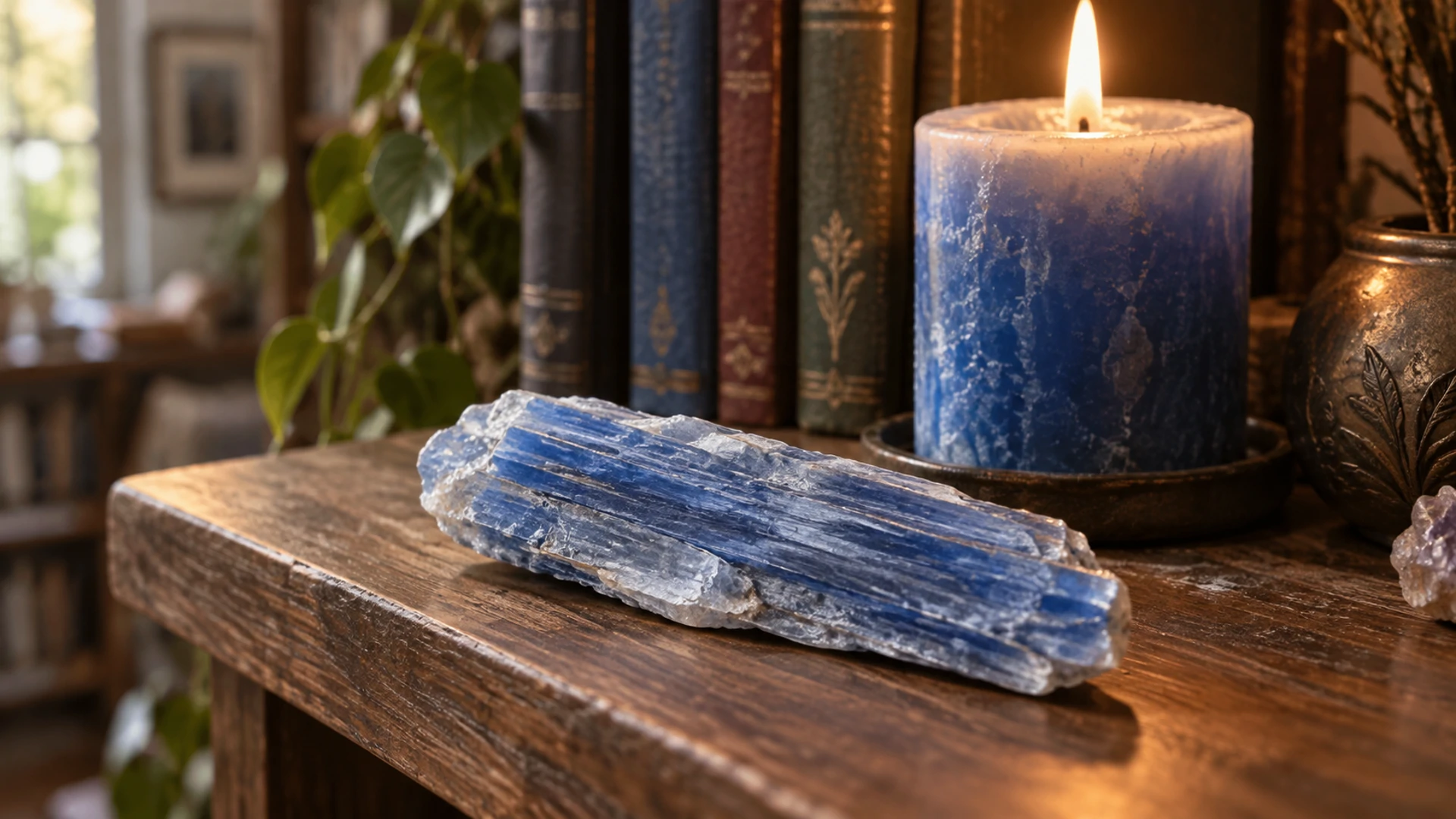
Blue kyanite is one of the few stones in crystal practice widely held to never accumulate negative energy — it doesn't need cleansing, and it doesn't hold on to what it moves through. That self-maintaining quality is the core of its use in intuition and psychic development work.
The Stone That Clears Itself: Why Blue Kyanite Belongs in Intuition & Psychic Development
Blue kyanite's mechanism in this category is specific: instant, self-maintaining chakra alignment. The blade-like shape isn't incidental — within crystal practice, it's read as structural. The crystal cuts through confusion the same way its physical form suggests it would, which is why its primary application is opening honest communication rather than deepening trance or enhancing vision. The throat chakra is its main point of entry, and work there isn't metaphorical with kyanite. It's said to remove the obstruction — the held breath, the swallowed sentence, the thing you knew was true but didn't say — so that what follows can be genuine.
What makes kyanite genuinely unusual is the second part of that claim: that it aligns all chakras simultaneously, not just the throat. Most stones in this category work on one or two energy centers. Kyanite doesn't pick one. Within crystal healing tradition, this is described as a sweeping property rather than a targeted one — run a blade of it through the aura or hold it along the body's central line and it's said to bring everything into coherence at once, without requiring you to address each center separately. That's a different approach than what most practitioners are used to, and it's part of why kyanite gets used both as a standalone tool and as a preparatory step before working with stones that go deeper in a specific direction.
The "never needs cleansing" property is worth being precise about. Within crystal practice, the belief is that kyanite neither accumulates nor retains negative energy the way most other stones are said to. It doesn't absorb what it moves through — it disperses it. This is widely held as a given in modern crystal-healing writing, but it's a belief within a practice, not a documented physical property of the mineral. That distinction matters, because it affects how you work with it: if you trust the tradition, you don't need to put kyanite in moonlight or on a selenite slab between uses. You just pick it up again.
Compare kyanite's approach to truth-speech with Lapis Lazuli's ancient wisdom turned into honest speech — that stone pairs third-eye insight with the throat chakra, for speaking the true thing rather than only perceiving it, and its authority comes from thousands of years of documented use across Egyptian, Persian, and Renaissance tradition. Kyanite's throat-chakra work doesn't carry that inherited weight. It's structural and mechanical. The blade is the metaphor for cutting through — there's no lineage behind it, no ceremonial history that passes the property forward. It just does what its shape implies it should. That's a different kind of power, and it suits different moments.
Contrast it also with Celestite's gentle, receptive contact with angelic and higher realms — Celestite reaches up and waits for what comes down. Kyanite doesn't wait. It sweeps through, clears the line, and opens the channel. Where Celestite is the softest and most passive stone in this category, kyanite is active by nature. You're not settling into something with kyanite. You're cutting through to it.
Correspondences sit naturally alongside these descriptions. Blue kyanite is associated with the throat chakra as its primary seat, with its all-chakra alignment claim sitting beside that. It's linked to the air element, to Mercury as its governing planet, and to no single zodiac sign with any real consensus across sources. Saturn governs its close cousin black kyanite, and Mercury appears consistently with the blue variety — fitting for a stone whose primary gift is communication. Its Mohs hardness ranges from 4.5 to 7 depending on direction, for reasons the next section covers in full.
Harder One Way Than the Other: Choosing Blue Kyanite
Kyanite is anisotropic, which means its hardness actually changes depending on the direction you're testing it. Across the blade — perpendicular to its length — it's roughly Mohs 4 to 4.5. Along the blade's length, it climbs to 6 to 7. This isn't a flaw or an inconsistency in the mineral. It's the direct result of how kyanite's crystal lattice is structured: the bonds running lengthwise along the blade are significantly stronger than the bonds crossing it. This anisotropy is also why kyanite always forms in long, flat blade-like shapes rather than in blocky, equidimensional crystals. The shape is the mineral being honest about its own internal geometry.
Practically, this means a piece of kyanite can be scratched much more easily across its width than along its length. Something as hard as a steel file can leave a mark if drawn across the blade's face. When you're handling it, hold it lengthwise rather than gripping across the middle, and avoid pressing it against rough surfaces. Raw specimens are especially vulnerable at the tips of the blades, which can split or chip if knocked against a harder surface from the wrong angle. Polished kyanite slabs are sturdier at the edges, but the same directional fragility applies.
When choosing a specimen, look for blades with a clean, consistent blue color — the best material runs from a medium sky blue to a slightly deeper peacock blue, often with white or silver streaks running along the grain. Those streaks are part of the mineral's character, not impurities to avoid. Inclusions of other minerals do appear in some specimens, which is fine. What you want to avoid is surface crazing (networks of small cracks across the face), which suggests the piece may have been handled roughly or exposed to repeated temperature changes.
For care: mild soap and lukewarm water with a soft cloth is safe for cleaning. Avoid abrasive cleaning tools — anything that moves across the face of the blade rather than along it can leave scratches in the softer direction. Keep kyanite away from harder stones in storage. Storing it loose with quartz points or sapphire, for example, is asking for chips. A fabric-lined pouch or a separate tray keeps the blades intact. Prolonged direct sunlight and sustained heat should also be avoided — kyanite's color can dull with extended exposure, and heat stresses the already-susceptible cleavage planes.
Three Practices for Cutting Through to the Truth
The Standing Current
Use this when you want kyanite's alignment work happening in the background of daily life rather than as a formal seated practice — particularly useful during periods when you're mentally scattered or emotionally reactive without a clear cause.
Place one blade of blue kyanite flat on a surface you spend time near — a desk, a nightstand, the edge of a bathroom shelf. Orientation matters slightly here: lay it so its long axis runs toward you rather than across your path, in the same direction the stone's own alignment is said to move. You don't activate it, charge it, or set it with a spoken intention. The tradition holds that kyanite is already working. What you're doing is putting yourself within range. Check in with it at the end of each day — not to work with it, just to notice. Over time, most practitioners report that the check-in itself becomes a signal to the nervous system that something is being maintained even when you're not consciously tending to it. That's the practice. Passive, continuous, low-maintenance — like the stone itself.
The Cut Through
Use this immediately before a conversation that requires honesty from you — not just clarity about what you think, but the actual willingness to say it out loud to someone else.
Hold a blade of blue kyanite in your dominant hand and sweep it slowly from the base of your throat down toward your sternum, then back up to just above the collar. Do this three to five times, slowly. You're not pressing it into your skin — hold it an inch or two away from the body. As you sweep, breathe out on each downward pass and breathe in on each upward pass. The breath is doing as much work as the stone here: the out-breath carries what you've been holding, and the in-breath is the commitment to speak. When you feel the physical tension across your chest and throat begin to soften — not disappear, just shift — the practice is complete. You can work within a Mercury hour for additional resonance, since Mercury governs both the stone and the act of honest communication. Set the kyanite down where you'll see it during the conversation if possible.
The Spoken Truth
Use this when something true has been waiting — something you know, something that belongs in the open air, but that you've been carrying internally for longer than it should have stayed there.
Sit quietly and hold a blue kyanite blade flat against your throat — not pressing hard, just resting there, lengthwise along the front of the neck. Light a blue candle within sight. Breathe normally for a minute or two, letting the weight of the stone register against your skin. Then speak what you've been holding — out loud, even if no one is there to hear it. Say it plainly, without softening, without the qualifications you'd normally add to make it easier for someone else to receive. The stone at your throat is the reminder that you have the capacity to say the true thing; the blue candle is the acknowledgment that this is an act of will, not just expression. When you've said it, set the stone down and let the candle burn a little longer before extinguishing it. You've done the harder part.
Named in 1789, Not in Antiquity
Kyanite was formally named in 1789 by the German mineralogist Abraham Werner, who derived the name from the Greek word kyanos, meaning dark blue. That's a specific, well-documented point of origin — and it's a comparatively recent one in the long history of stones that have been named, used, and passed down through civilizations. Werner was working within the early systematic tradition of mineralogy, and his naming of kyanite was part of a broader effort to bring precise vocabulary to a discipline that had previously relied on highly inconsistent folk terminology.
What that 1789 date also tells you, honestly, is that kyanite doesn't carry a well-documented ancient spiritual tradition the way some other stones in this category do. Lapis lazuli's history runs to 6,000 years and Egyptian burial chambers. Kyanite's metaphysical reputation — including the "never needs cleansing" property that defines so much of its use — developed within twentieth-century crystal healing practice rather than being passed down from antiquity. Some lower-quality sources assert a vague ancient heritage for it without support, and that claim doesn't hold up. The stone is powerful within contemporary practice, and it doesn't need invented history to justify that. Its mechanism stands on its own terms.
Kyanite does appear historically in industrial contexts — its extreme heat resistance made it useful in high-temperature applications like spark plugs, porcelain, and refractory materials long before it became a staple of metaphysical work. That industrial legacy is worth noting not because it adds mystique, but because it explains why kyanite remained largely overlooked as a spiritual tool until comparatively recently. Stones that go into industrial manufacturing pipelines rarely become popular in crystal shops first. Blue kyanite's arrival in mainstream crystal healing is a twentieth-century story, and being honest about that is more useful than reaching backward for a history that isn't there.
Aligned Before You Even Ask
What sets blue kyanite apart in the Intuition & Psychic Development category is that it doesn't require much from you before it starts working. It doesn't need to be activated, cleansed, or slowly introduced to your energy field the way some stones do. It's self-maintaining, structurally communicative, and already aligned. You put it in the room, you hold it at your throat, you sweep it through your field — and whatever conversation you've been avoiding gets a little harder to keep postponing.
If you want to see how blue kyanite sits alongside the other stones in this category — alongside stones like labradorite, which awakens dormant psychic ability while shielding the aura during that opening, or moonstone's cyclical, lunar-tied intuition — and how all seven crystal categories fit together as a whole, the Crystal Compendium is where the map lives.