Snow Quartz: The Gentle Cousin of Clear Quartz
Snow quartz belongs to the Cleansing category, and its defining quality isn't softness in a vague, aesthetic sense — it's that its cleansing action is genuinely less intense than clear quartz, which makes it more appropriate, not less useful, in specific situations.
Gentler Than Clear Quartz: Why Snow Quartz Belongs in Cleansing
Snow quartz's cloudiness isn't caused by a trace element or mineral impurity the way colored quartz varieties get their color — amethyst turns violet from iron, citrine turns yellow from heat affecting iron, smoky quartz gets its color from natural irradiation. Snow quartz is chemically the same silicon dioxide as clear quartz. What makes it opaque is something different entirely: microscopic inclusions of trapped water and gas bubbles distributed throughout the crystal as it grew. The stone's interior is genuinely full of these tiny voids, and that's not a flaw. It's the formation story, and it maps directly onto function.
Where clear quartz cleanses by amplifying and resetting to a neutral state — a universal tool that clarifies and charges whatever it's paired with, not limited to one type of energy — snow quartz works differently. It cleanses gently rather than powerfully, suited to emotional cleansing during recovery, grief, or transition, where clear quartz's intensity would be too much. That's not a ranking. There are workings where you want power and there are workings where power is the wrong tool. Snow quartz is for the second kind.
Its correspondences are consistent with this function. Snow quartz is associated with the crown chakra — the energy center concerned with clarity, openness, and connection beyond the immediate — with some sources also citing the third eye, which makes sense given both chakras deal with perception and inner seeing rather than outward action. The elemental correspondence is water, which fits both the literal water inclusions inside the stone and the emotional register of its use. The planetary correspondence is Venus, which situates snow quartz in the territory of softness, receptivity, and care rather than the more assertive planetary currents.
Its zodiac association is worth addressing honestly: you'll find it listed under Capricorn in some sources, Cancer in others, occasionally attributed to multiple signs. There isn't a single consistently agreed-upon assignment, and pretending otherwise wouldn't be accurate. If you work with zodiac correspondences in your practice, treat this as an open correspondence and let your own intuition or experience make the call rather than deferring to a source that may simply have picked one arbitrarily.
Cloudy Inside, Not Just Outside: Choosing Snow Quartz
The physical check for genuine snow quartz is straightforward. Real snow quartz's cloudiness comes from inclusions distributed through the whole stone, so the milky quality should look consistent whether you're looking at the surface or at the interior of the piece. Hold it up to a light source and look through a thin edge or a translucent section if the stone allows it. The milkiness should be distributed throughout, not sitting on the surface like a coating.
Cheaper substitutes show up in this market. Frosted or sandblasted clear quartz is sometimes sold as snow quartz — it will look milky or frosted on the outer surface, but if you look closely at an edge, chip, or thin cross-section, the interior will be noticeably clearer or glassier than real snow quartz. Plain white glass is another occasional substitute, and it often has a more even, almost plastic-looking white to it, without the subtle internal variation that natural stone shows. If the price is very low and the piece looks uniformly perfect, those are signals worth paying attention to.
On the care side, snow quartz is one of the lowest-maintenance stones you'll encounter. At Mohs 7, it's hard enough to resist scratching from most everyday contact — harder than most minerals but softer than steel, so a metal file will scratch it, but your fingernail won't. It's water-safe, so brief rinsing or cleansing washes are fine without concern. It's not photosensitive, so sunlight won't fade it the way it would amethyst or rose quartz. There are no toxicity concerns with normal handling. You don't need to keep it away from other stones, from moisture, from direct light, or from anything else in particular.
One genuine difference from clear quartz in terms of care: clear quartz amplifies and charges whatever it's paired with, which means practitioners often pay careful attention to resetting it between uses so it isn't carrying the residue of one working into the next. Snow quartz doesn't carry that same intensity of charge, so it requires less deliberate intention-clearing between uses. You can cleanse it regularly as a matter of practice, but you're not dealing with the same accumulation concern.
Three Practices for Cleansing Without Intensity
The Recovery Hold
This practice is for someone moving through grief, burnout, or the slow, early stages of coming back from a difficult period — a time when a stronger stone would feel like too much, because it would push rather than allow.
Sit somewhere you won't be interrupted. Hold a piece of snow quartz in whichever hand feels natural, and do nothing with it for the first few minutes — just let it sit in your hand while you breathe. When you feel ready, set a quiet intention: not a goal or an outcome, just a direction. Something like returning to yourself, or clearing what's been sitting too long. You can pair this with a white candle if you want a physical anchor for the working. Sit with the stone for ten to twenty minutes. When you're done, set it down rather than putting it away immediately — let the working close at its own pace rather than punctuating it.
The Soft Reset
Use this when things feel slightly off or energetically cluttered but a full clearing isn't what's needed — just a quiet return to baseline, the same way you might open a window rather than scrub an entire room.
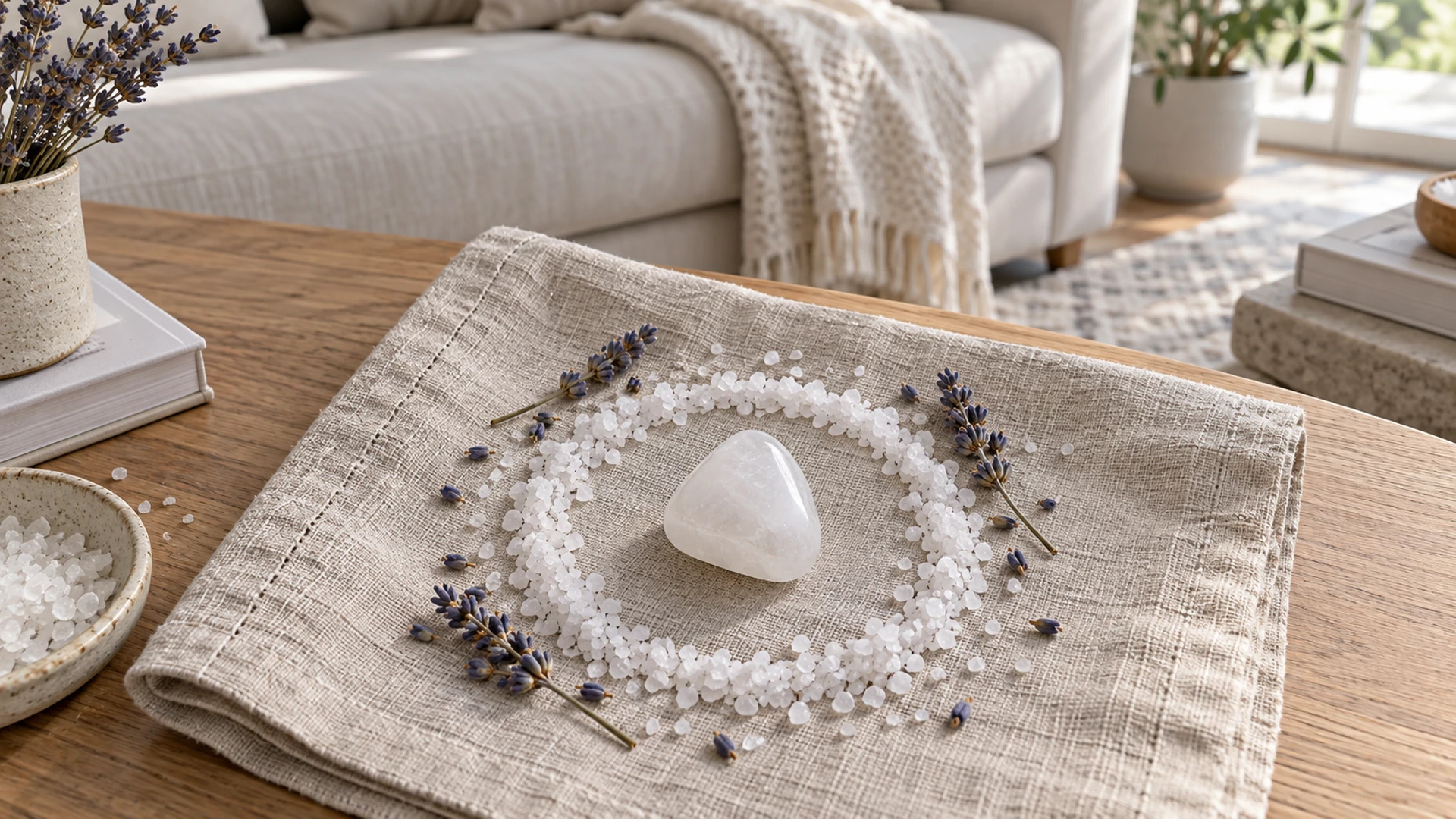
This works well during a Moon hour, when the lunar current supports emotional clearing without pushing change. Place your snow quartz on a clean surface — a cloth, a dish, or simply a cleared section of table. Surround it with a small ring of salt or a loose scatter of dried lavender if you have it. Rest your hands near it without touching it for a few minutes, and let your breath slow. The practice isn't active — you're not directing energy toward a goal. You're simply creating the conditions for a gentle reset and giving yourself enough stillness that it can happen. Five to ten minutes is enough.
The Quiet Room
This is a placement practice for a space that holds ongoing emotional weight — a room used for rest, recovery, or sitting with grief — rather than a space that needs a sharp, one-time energetic clearing.
Place one or more pieces of snow quartz in the corners or edges of the room — on a windowsill, a shelf, a bedside surface — so the stone's presence is passive rather than central. You're not setting up a ritual here, you're creating a low, continuous cleansing field that supports the room's purpose without pushing. If the space is used for sleep or recovery, pairing snow quartz with a piece of selenite — which cleanses continuously through its own high vibration and can cleanse other stones by proximity — will maintain the room's clarity between any active workings you do there. Keep the arrangement simple and replace or refresh the stones if the room goes through a particularly difficult period.
A Quartz Without Much History — And Why That's Worth Saying
Snow quartz — also called milky quartz, which is technically the same material under a different name used more often in mineralogy than in crystal practice — doesn't carry a deeply documented ancient tradition the way its more famous relatives do. Clear quartz appears across millennia of recorded magical and ritual history. Amethyst has an entire cultural narrative stretching back to ancient Greece. Snow quartz doesn't have that kind of documented lineage, and it's worth saying so plainly rather than papering over it with vague references to ancient wisdom.
In modern crystal-shop sources, you'll frequently see snow quartz linked to a Native American "Snow Moon" tradition — the full moon of January or February — presented as a grounding for the stone's meaning. This association is widely repeated, but it doesn't trace to a specific, well-documented source. The Snow Moon as a name for the winter full moon is real and has been used across various traditions, but the specific claim that snow quartz carries a particular role within Indigenous ceremonial or spiritual practice around this moon isn't backed by the kind of sourced documentation that would make it accurate to state as historical fact. Repeat it if you've seen it and find it resonant for your practice, but hold it as a modern association rather than settled history.
What's more interesting, arguably, is what this honesty points to: snow quartz is a stone whose reputation is still being built. It doesn't come to modern practice carrying centuries of accumulated symbolic weight, which means practitioners working with it now are part of writing what it means — building through direct experience rather than inheriting a fixed tradition. For some people that's a limitation. For others it's an invitation.
The Cleanse That Doesn't Push
Snow quartz's specific value in the Cleansing category is that it works without force. Most cleansing stones perform their function actively — drawing out, dissolving, amplifying, resetting. Snow quartz holds space instead. It creates conditions for clearing without demanding that clearing happen on a particular schedule or at a particular intensity. For workings tied to recovery, transition, or grief, that's not a compromise — it's what makes the stone actually useful rather than technically appropriate.
If you want to see how snow quartz sits alongside the other Cleansing stones and the six other categories of stone magic — protection, healing, empowerment, abundance, love, intuition — the full breakdown is in The Crystal Compendium: Seven Paths to Stone Magic. That's where the full landscape becomes clear.