Halite: The Stone Behind Your Salary
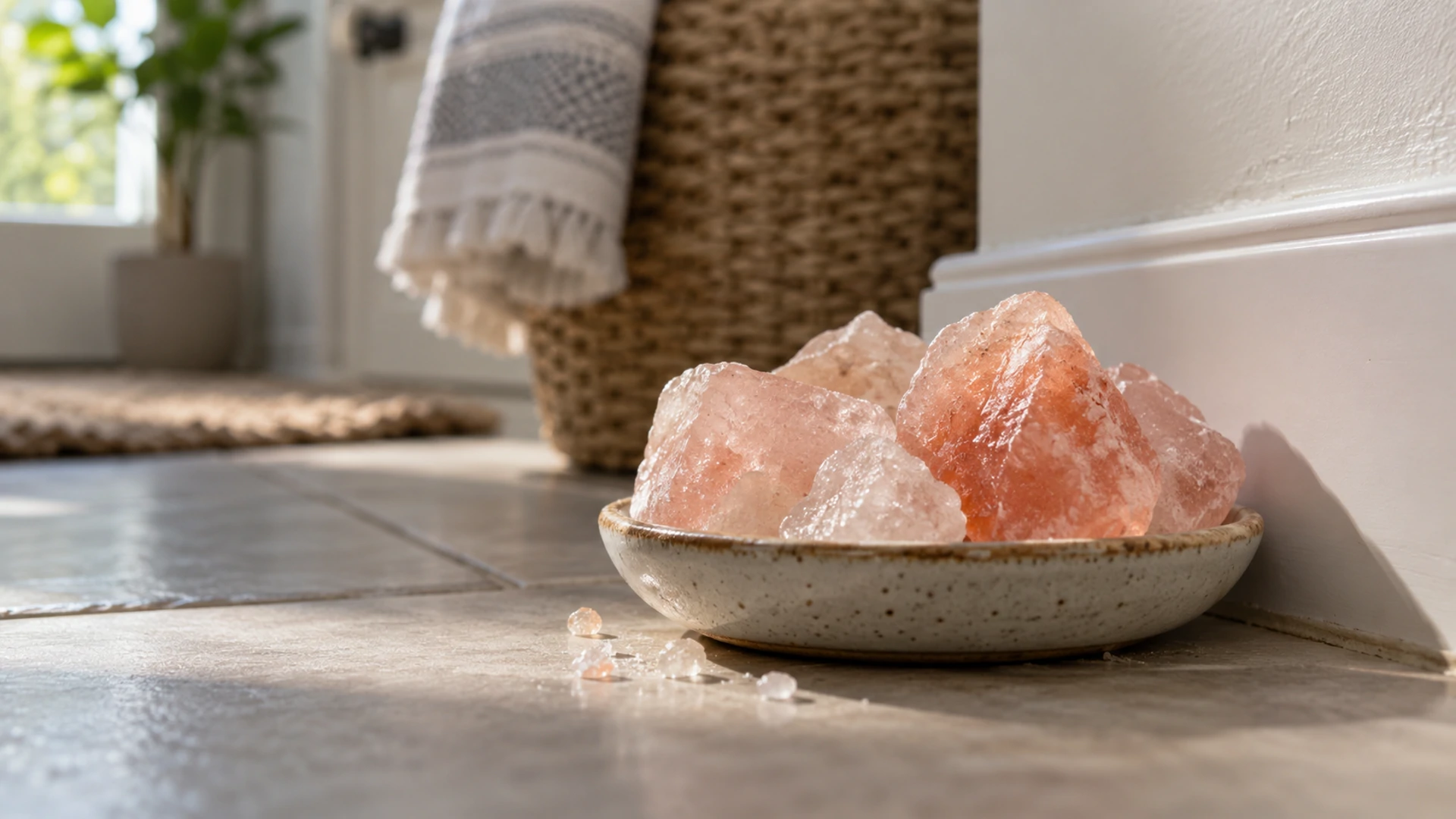
Halite is raw rock salt in mineral form — a cleansing stone whose power comes from the same place salt's power has always come from: its ability to draw out what doesn't belong and hold a boundary against what tries to return.
The Word Behind Your Salary: Why Halite Belongs in Cleansing
Most cleansing stones work by one of two broad approaches: they absorb dense energy into themselves, or they reset the field to a neutral state. Halite does neither. It draws out and dissolves stagnant energy the way salt draws out moisture from a wound or a brine — pulling it free from the tissue it has settled into and breaking it down rather than storing it. This is a meaningful distinction. A stone that absorbs needs to be cleared regularly before it becomes saturated. Clear quartz, by contrast, cleanses by amplifying and resetting to a neutral state — it's a universal clarifier, not a draw. Halite occupies its own category: it pulls the stagnant energy outward and disperses it.
This drawing-out quality also explains why halite carries a genuine secondary function in Protection. Salt has been used at thresholds, doorways, and boundaries across nearly every documented culture — not as decoration, but as a barrier. The understanding behind that practice is the same one that runs through halite's cleansing function: salt disrupts what has settled in and prevents it from re-entering. Cleansing and protection aren't two separate meanings loosely attributed to the same mineral. They're two expressions of the same mechanism, one pointed inward at what's already present, the other pointed outward at what approaches.
Halite's correspondences reflect this dual nature. It sits with the root chakra — the seat of safety, physical grounding, and the body's basic sense of security — which maps cleanly onto both the boundary-marking and the energetic clearing it performs. Colorless or very pale halite is sometimes cited with the crown chakra as well, given the clarity and almost meditative quality of translucent salt crystals, though the root chakra association is the more consistent one across sources. Its elements are water and earth, which sounds contradictory until you remember that salt exists precisely at the intersection of those two forces — it forms in evaporated seas and ancient ocean beds, shaped by water and solidified into mineral earth. Its planetary ruler is the Moon, linking it to cycles, purification, and the body's own fluid rhythms. Its signs are Cancer and Pisces, both water signs with a particular sensitivity to what accumulates emotionally and energetically — the kinds of build-up that halite's dissolving quality is well suited to address.
Table Salt or Ritual Stone? Choosing and Keeping Halite
The first thing worth clarifying is what halite actually is in a ritual context, because it's easy to assume that any salt will do. Raw halite — the material you want for altar work and crystal practice — is unrefined rock salt, formed millions of years ago when ancient seas evaporated and left their mineral content behind as thick crystalline deposits. What you find as specimens ranges from clear and glassy to pale pink, orange, red, or amber, depending on trace iron oxides and other minerals present in the deposit. Himalayan pink salt in large chunk form is a common and widely available variety of halite. The pale orange and red tones aren't impurities to avoid — they're part of what makes raw halite visually distinct from the processed product, and the mineral content that produces them doesn't affect its ritual function.
What you want to avoid is the heavily processed, iodized table salt from a kitchen shaker. That product has had its natural mineral companions stripped out, then had iodine and anti-caking agents added back in. It's also ground to a fine powder rather than existing in its natural crystalline form. For cleansing and altar work, you want raw halite chunks or a genuine salt lamp cut from a mined deposit — something sourced as a mineral specimen, not as a food product. Salt lamps are large enough to function as room presence pieces as well as light sources, and they do emit a mild hygroscopic effect, drawing ambient moisture from the air, which makes them feel particularly active in a space.
Care for halite is about as direct as it gets, and the single rule matters more here than with almost any other stone: never introduce water. Halite is literally rock salt, and it dissolves. This applies to running water, bowl-soaking, misting, and any other water-based cleansing method. Humid environments are also a slow problem — halite will degrade over time just from ambient moisture in the air, which is why salt lamps often appear to "sweat" in humid climates. Keep raw halite specimens in a dry indoor environment, away from kitchens and bathrooms if possible, and away from open windows in humid weather. For cleansing the stone itself, dry methods work well: smoke from incense or a herb bundle, sound cleansing with a bell or singing bowl, or brief exposure to indirect sunlight. None of these introduce moisture, and all of them work with halite's own energetic quality rather than against its physical structure.
Three Practices for a Stone That Draws Out What Doesn't Belong
The Threshold Line
Use this when a space feels energetically porous — when unwanted energy seems to drift in regularly, or when a room or home has been through a difficult period and needs its boundary reestablished.
Place raw halite chunks at doorways, windowsills, and corners of the room or home you want to protect and clear. You don't need a large amount — a chunk the size of your fist at each threshold point is enough. Before setting each piece, hold it briefly and state your intention plainly: this marks the edge of your space and draws out what has already accumulated while holding the boundary against what approaches. Leave the pieces in place rather than moving them daily. Replace or refresh them seasonally, or whenever they begin to visibly degrade from ambient humidity. If you want to reinforce the working, time it to a waning Moon hour — waning phases support the drawing-out and releasing quality that makes this practice work.
The Ritual Bath
Use this after a period of prolonged stress, emotional difficulty, or exposure to environments that felt draining — when you need to clear what has built up on you personally rather than in a space.
Draw a warm bath and dissolve a generous handful of raw halite chunks or large-grain rock salt into the water before you enter. The halite dissolves fully into solution, which means you're working with the cleansing virtue of salt diffused through the water rather than placing the raw crystal in contact with moisture and degrading it. Add a few drops of lavender if you want to soften the energetic tone — lavender works alongside the dissolving quality of the salt rather than pulling in a different direction. Before entering the bath, take a moment to state clearly what you're releasing. Soak for as long as feels right, then let the water drain away carrying everything you named. This is intentional use of the dissolved solution, not the raw crystal submerged — the mineral's work here is in the salt's chemistry and the ritual's direction together.
The Corner Draw
Use this for a room that feels persistently heavy, stagnant, or low — the kind of atmosphere that builds up slowly over time from argument, grief, long illness, or simply months of accumulated tension without release.
Place a raw halite chunk in each corner of the room, positioned on the floor or as low as practically possible, since heavier, denser energy tends to settle downward. You can set each piece on a small dish if you want to protect the floor from any moisture the salt might draw. Leave them in place and let them work passively — halite's mechanism is gradual and continuous rather than immediate, drawing out accumulated density the way it draws moisture, over days and weeks rather than a single session. After several weeks, remove and discard the chunks rather than recycling them into other workings. If the room has a black candle working already running, the halite complements it well — the candle addresses banishment and removal at the active level, while the halite draws at the passive level in between sessions.
Salt, Soldiers, and a Myth Worth Correcting
The English word "salary" genuinely traces back to the Latin salarium, which is built from sal — the Latin word for salt. The connection isn't disputed. Salt was one of the most economically significant commodities in the ancient world, essential for food preservation long before refrigeration existed, and the Romans built infrastructure around it. The Via Salaria — the Salt Road — was a major route carrying salt from coastal salt-works into Rome and the interior of the empire. The word salarium entered Roman usage in this context, and its descendants moved into French and then into English as "salary."
What's less well supported is the popular version of the story: that Roman soldiers were literally paid in salt, receiving actual quantities of the mineral as their wage. Roman sources record that soldiers were paid in coin — the stipendium — rather than in bulk commodities. The salarium was more likely a salt allowance, a supplement for purchasing salt, or simply a word for pay that carried salt's name because of how deeply salt's value was embedded in Roman economic life. The specific image of a soldier receiving bags of salt instead of coins is a compelling story, but it's a popular interpretation that Roman records don't clearly confirm. The etymology is real. The literal payment-in-salt version has been repeated so often it feels like history, but it overreaches what the sources actually show. Halite's genuine cultural significance doesn't need that embellishment — the Via Salaria alone tells you how central salt was.
The Oldest Purifier
What makes halite work is also what makes it one of the most intuitive cleansing tools available. Its mechanism — drawing out and dissolving stagnant energy rather than absorbing it or resetting it — matches the logic behind every salt-based purification practice that has persisted across centuries and cultures. It doesn't need a complex ritual framework to function. It needs placement, intention, and the basic understanding that it's pulling something out rather than blocking something off, though its secondary role in marking and holding boundaries means it can do both at once.
If you want to see how halite sits alongside the other cleansing stones and the six other categories of stone magic, The Crystal Compendium: Seven Paths to Stone Magic is the place to start. Cleansing is one path. Halite is one of its clearest examples.