Green Jade: The Fortune That Takes Its Time
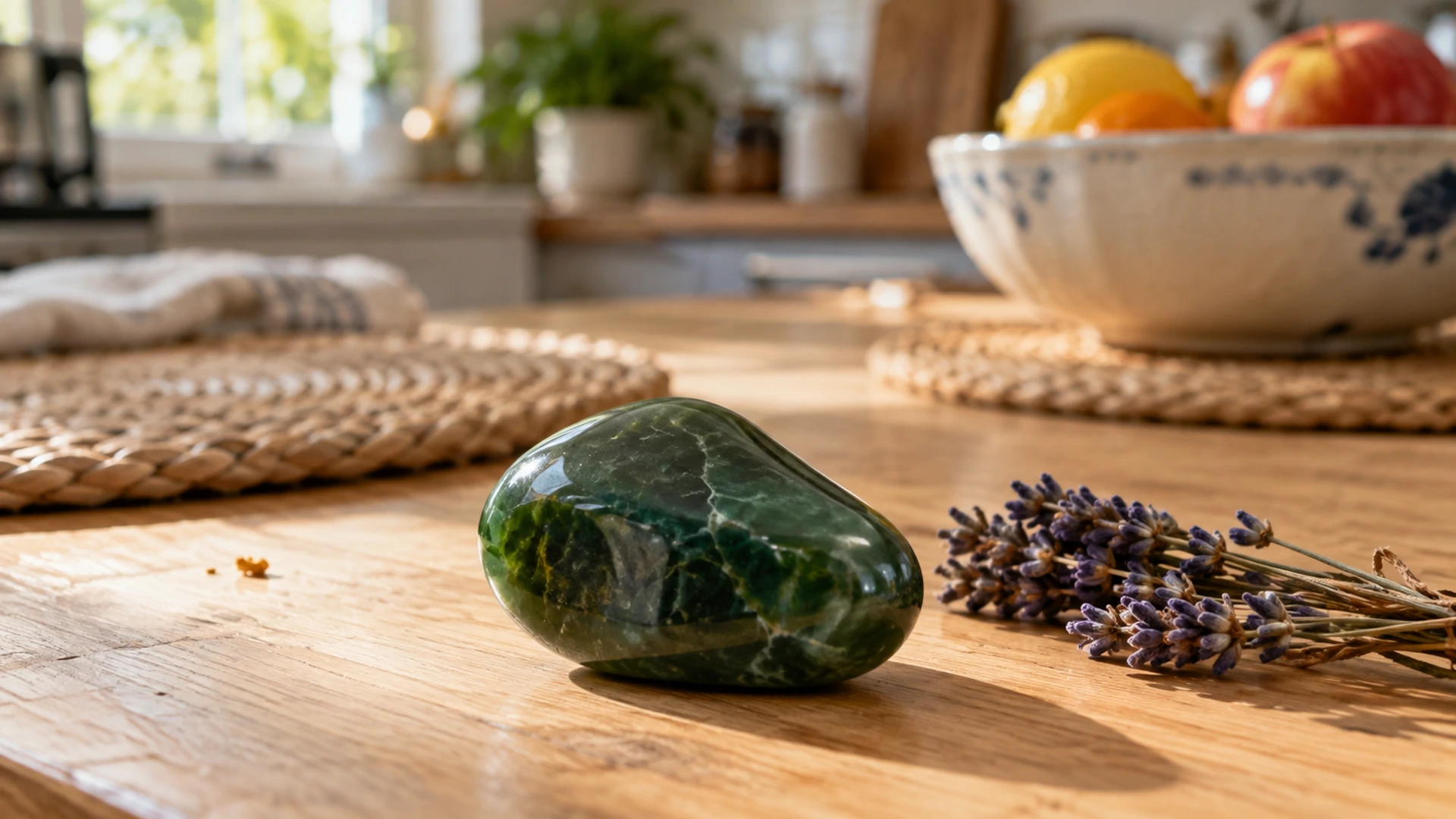
Green jade is an abundance stone whose power works through patience and alignment, not acceleration. It accumulates prosperity the way a long-tended relationship builds trust: gradually, steadily, and grounded in how you conduct yourself along the way.
The Fortune That Takes Its Time: Why Green Jade Belongs in Abundance
Most abundance stones root their work in the solar plexus, the seat of personal will, confidence, and drive. Green jade is the exception. Its work runs through the heart chakra, and that placement is not incidental. Jade's wealth mechanism is steady accumulated prosperity — wealth that builds over time through harmony and right conduct, not a sudden arrival. The heart, not the gut, governs how you treat people, what principles you hold, and whether your daily conduct aligns with what you say you value. According to jade's long tradition, that alignment is the engine of material fortune.
Contrast that with two of the other stones in this category. Citrine works through spontaneous manifestation — active, radiant generation of new wealth and opportunity through confidence and joy, not a slow accumulation. Pyrite works through protective, disciplined wealth-building — abundance through willpower, resolve, and safeguarding what's already been built, not spontaneous luck. Jade does neither of those things. It doesn't generate a spark, and it doesn't guard a fortress. It tends something more like a slow-growing orchard: you plant in right relationship with the land and the harvest comes in its own time, not yours.
The Confucian tradition made this explicit in a way few other cultural frameworks have for any stone. Confucius wrote about jade as the embodiment of virtue itself, mapping the stone's physical qualities onto moral ideals: its warmth to benevolence, its translucent clarity to wisdom, its unyielding hardness to courage, its sharp corners that cut without injuring to justice, and its unblemished surface to purity. These five virtues — benevolence, wisdom, courage, justice, and purity — were the pillars of Confucian ethics, and jade was considered their living material expression. Wearing jade wasn't purely ornamental. It was a daily reminder of the kind of person you were trying to become.
In terms of correspondences, jade is firmly associated with Venus as its planetary ruler, which fits the heart-centered, harmony-forward mechanism well. Venus governs relationship, beauty, and the kind of fortune that flows through goodwill rather than conquest. The element is earth, appropriate for a stone whose abundance is slow-building and grounded rather than fiery or sudden. On zodiac assignments: different traditions cite Taurus and Libra in some Western frameworks, with Virgo appearing in others. No single assignment dominates across sources, so treat these as lenses worth trying rather than fixed rules — try the one that resonates with your own chart or practice and see what holds.
One Name, Two Minerals: Choosing Green Jade
The single most important thing to know before buying jade is this: jade is one of the most heavily treated and counterfeited gemstones in the world, and the trade has a formal grading system for a reason. Type A jade has been treated only with a light wax coating to enhance its natural surface, leaving the stone's internal structure fully intact. Type B jade has been bleached and polymer-impregnated to improve its clarity and color — it looks better in the short term but its structural integrity is compromised, and the polymer filling degrades over time. Type C jade has been dyed to produce or deepen its color. Type D material is a composite or an entirely different mineral sold as jade — dyed quartzite and serpentine are among the most common substitutes. Only Type A is considered genuine untreated jade in the trade. The price difference reflects that directly.
What the world calls "jade" is actually two chemically distinct minerals that were lumped together under one name for millennia. Nephrite is a calcium magnesium silicate from the amphibole mineral family, dense and somewhat softer at Mohs 6 to 6.5, with a waxy luster and a color range from pale celadon to deep forest green. Jadeite is a sodium aluminum silicate from the pyroxene family, harder at Mohs 6.5 to 7, capable of a more vivid and saturated green, and rarer by a significant margin — fine jadeite from Myanmar is among the most valuable gemstone material on earth. The chemical distinction between them wasn't formally proven until 1863, when the French mineralogist Alexis Damour analyzed both minerals and found they were compositionally separate. Before that, craftspeople, royalty, and scholars across multiple civilizations had worked with, prized, and written about "jade" without knowing they were working with two different stones.
When sourcing jade in person, a few physical properties can help. Genuine jade, both nephrite and jadeite, feels noticeably cool to the touch at first contact and warms slowly against the skin — more slowly than glass or plastic imitations, which warm almost immediately. The surface of a polished piece should resist light scratching from a fingernail, and its density gives it a satisfying, solid weight for its size. A piece that feels unusually light, or warms too fast, or shows an artificially uniform color with no tonal variation whatsoever, warrants closer scrutiny. Buying from reputable dealers who disclose treatment type and, ideally, include a gemological certificate for higher-value pieces is the most reliable approach if you can't inspect in person.
Care is straightforward. Brief water rinses are fine for either nephrite or jadeite — the stone's density and hardness make it more durable than many others in this category. Avoid harsh chemical cleaners, which can interact with any surface coating on Type A material or accelerate degradation in treated pieces. High heat and ultrasonic cleaners should both be avoided, as they can cause existing cracks or fracture-fills to worsen. Wipe with a soft cloth after wear. Store it away from harder stones that could scratch its surface, and keep it out of prolonged direct sunlight if the color saturation matters to you.
Three Practices for Fortune Built Slowly
The Long Harvest
Use this practice when you're beginning a financial endeavor that will take months or years to mature — a business, an investment, a creative project with long-term commercial stakes.
On a Thursday, during a Venus hour, hold your green jade piece in both hands. Set a single, concrete intention for this stone — not a wish list, but one specific outcome you're moving toward. Speak it aloud, once, clearly, in your own words. Then place the jade on your altar or in a dedicated space near your workspace, and leave it there for the duration of the working. Every week, on the same day, hold the stone briefly and revisit the intention — not to add pressure, but to stay in conscious relationship with it. Dress a green candle with a prosperity oil and burn it for a portion of each weekly check-in. Let the practice match the pace of what you're building: slow, sustained, and unhurried.
The Household Balance
Use this practice when financial tension in a household is being driven by misalignment between partners or family members, rather than by a lack of resources.
Place green jade at the center of a shared space — a kitchen table, a dining room surface, somewhere both people pass through regularly. Burn a small amount of lavender nearby, not as a formal ritual but as an environmental shift, something that signals without announcing. Both people who share the space should agree, even informally, that the stone is there as a shared anchor — a reminder that the financial decisions being made are supposed to serve the household as a whole, not any single person's anxious short-term reaction. Once a month, sit together near it and go over one financial reality plainly: a bill, a savings goal, a shared concern. The jade's presence is a quiet prompt toward the kind of honest, non-combative conversation that jade's heart-chakra foundation supports. Move the stone only when the issue it was placed for has genuinely resolved.
The Virtuous Ledger
Use this practice before making any significant financial decision you feel uncertain about — particularly when the uncertainty is ethical rather than logistical.
Hold your green jade in your dominant hand and read the decision back to yourself aloud as if you were explaining it to someone you deeply respect. Notice where your voice flattens or where you instinctively soften the description. Those are the points worth examining. Then ask five questions, one for each of the Confucian virtues jade embodies: Does this harm anyone I'm in relationship with? Does this reflect what I actually know, or what I want to believe? Would I stand behind this if it became public? Does this treat the other parties fairly? Would I be comfortable with it written down permanently? You don't need every answer to be a clean yes. But if more than one answer feels genuinely uncomfortable, that's the jade doing its work — reflecting your own values back at you before you act, not after. Carry the stone with you for the full day of the decision, and set it down only once you've made your choice.
Five Thousand Years of the Stone of Heaven
China's relationship with jade spans more than five thousand years of continuous, documented use — longer than almost any other culture's documented relationship with any single material. That is not an exaggeration or a spiritual claim. Archaeological evidence places jade carving in China's Neolithic period, and its use persisted without interruption through dynasty after dynasty, across philosophical and political upheaval, and into the present day. No other stone in the world has that kind of unbroken cultural record in a single civilization.
In Chinese tradition, jade was called the "Stone of Heaven" and treated as the material bridge between the human and divine. It was placed in tombs to preserve the body and honor the spirit. It was carved into ritual objects — discs, blades, pendants — that held specific ceremonial significance. It was given as a diplomatic gift between rulers. And it was worn by scholars and officials as a daily signal of moral seriousness, in direct connection with the Confucian virtue framework described earlier. The green color associated with growth, life, and renewal made it the dominant choice for abundance and good fortune work, though white and lavender jade carry their own distinct symbolic registers in Chinese tradition.
Other cultures developed their own independent jade traditions — notably the Maori of New Zealand, who worked with nephrite in forms they called pounamu and used it for tools, weapons, and heirlooms, and the Mesoamerican civilizations, including the Olmec, Maya, and Aztec, who prized jadeite above gold. Each of these traditions is real and worth knowing about. But the Chinese record is unique in its depth, its continuity, and the degree to which it was philosophically articulated — which is why it provides the clearest cultural foundation for understanding how this stone has been understood across time.
The formal scientific distinction between nephrite and jadeite — Alexis Damour's 1863 chemical analysis that separated two minerals which had shared one name for millennia — did little to diminish jade's cultural standing. If anything, it clarified what craftspeople had known intuitively: that these two materials behaved differently under the tool, took different finishes, and carried different qualities in the hand. The science confirmed a distinction that Chinese jade artisans, who had long distinguished between types of jade by texture and translucency, had been working with for centuries before the chemistry was formalized.
Abundance That Builds Its Own Ground
Green jade's place in abundance magic is earned by what it actually does: it cultivates the conditions in which prosperity becomes sustainable, not just achievable. That means working with how you conduct yourself, how you maintain relationships, and whether your financial life is in alignment with your actual values. That's slower work than citrine's radiant pull or pyrite's determined accumulation. It is also, for a lot of practitioners, more durable.
If you want to see how green jade sits alongside the other abundance stones — and how abundance itself sits within the full map of crystal magic — The Crystal Compendium: Seven Paths to Stone Magic is the place to go. It covers all seven categories, including the six other stones in the abundance cluster, and lays out how they differ from one another in mechanism, not just in color.